Combat Profile
Soul's Threshold
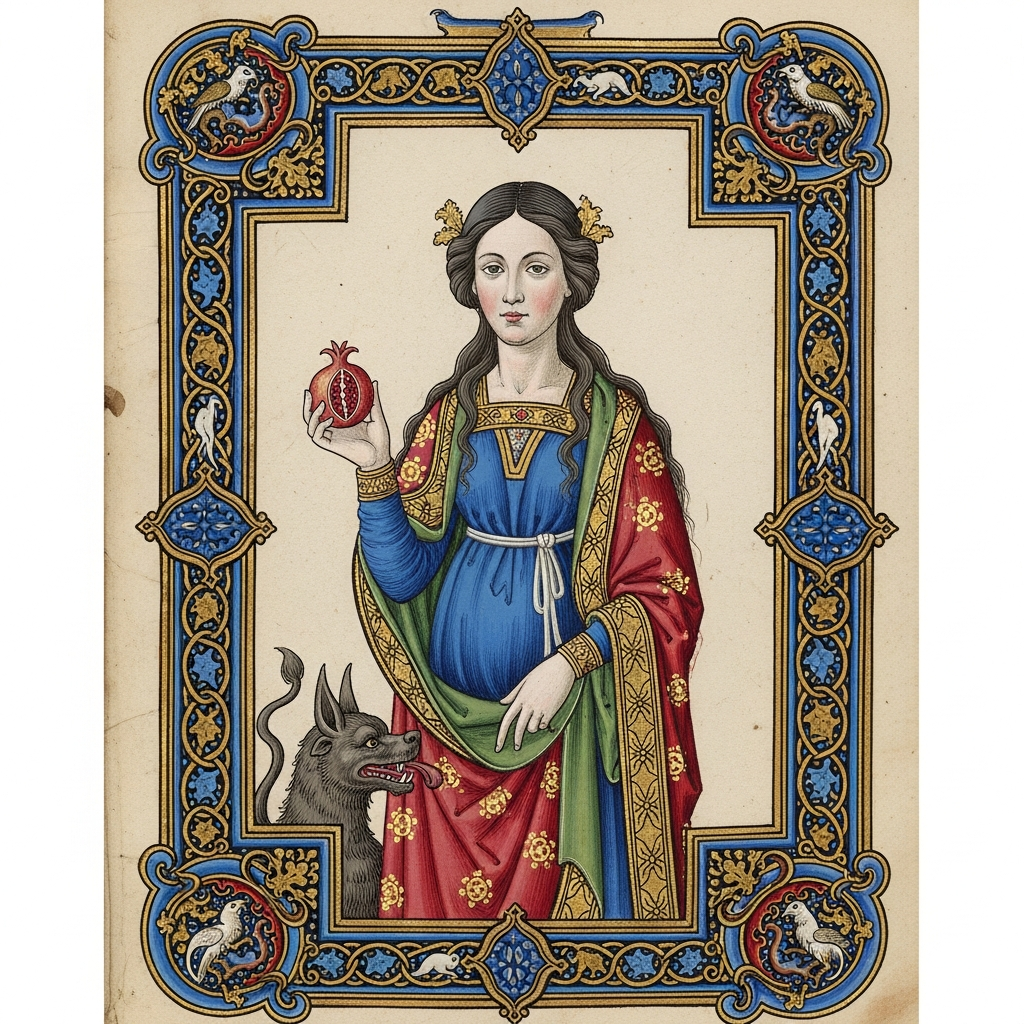
Persephone judges a soul's worthiness for liberation, granting passage to the enlightened or binding the unworthy to endless return.
Chthonic Initiate
All beings in her presence experience the cyclical truth of death and rebirth, gaining clarity on their spiritual state.
Bound to the underworld for part of each year by the pomegranate she ate
“Tell Persephone that Bacchius himself has set you free.” — Orphic gold tablet formula
The Eleusinian Mysteries made Persephone famous as the kidnapped maiden who returns. The Orphic tradition gave her a different role: she is not primarily the victim of abduction but the sovereign judge of the dead — the queen to whom the arriving soul must present its credentials.
The Orphic gold tablets — thin sheets of gold foil buried with initiates from the 5th century BC onward, discovered across the Greek world from Italy to Thessaly — are addressed to her. When the Orphic initiate dies and descends to the underworld, they face a choice of springs: the spring of Lethe (Forgetting) and the spring of Memory. The uninitiated soul, thirsty and confused, drinks from Lethe and forgets its divine origin, cycling back into rebirth. The initiate knows to refuse: “Do not drink from the spring on the left. There is another spring, cold water flowing from the Lake of Memory. Say: ‘I am a child of Earth and Starry Heaven, but my race is of Heaven alone.’” They drink from Memory, remember who they are, and present themselves to Persephone with the password: “Bacchius himself has set me free.” The queen recognizes the initiate and grants passage to the Elysian Fields.
This is the Greek version of the Book of the Dead — a manual for navigating death with the right knowledge, the right passwords, the right self-identification. The Egyptian dead needed to know the names of the 42 judges and declare their innocence before each one. The Orphic dead needed to know which spring to drink from and what to say to the queen. The Tibetan dead (the Bardo Thodol) needed to recognize the clear lights of consciousness as their own nature. Different traditions, identical structure: death is navigable if you have the right knowledge, and the mystery tradition is in the business of providing it.
Compare: Osiris (judge of the Egyptian dead, before whom the heart is weighed); the 42 Assessors of the Egyptian Book of the Dead (before whom the dead must declare innocence); the Bardo Thodol’s guide to navigating the after-death state; Yama (Hindu/Buddhist judge of the dead); Saint Peter (gatekeeper who holds the keys to heaven — the Christian version of the same archetype).
2 min read
Hades (her husband/captor); the cycle of seasons (her imprisonment IS winter)
Orphic Gold Tablets (Thurii, Pelinna, Hipponion; 4th-3rd c. BC); Pindar, *Dirges* fr. 133; Plato, *Meno* 81b-c; Graf & Johnston, *Ritual Texts for the Afterlife*