Combat Profile
Spirit Bridge
Opens a passage between the material and spirit worlds, allowing safe transit for shamans and their clients across dimensional boundaries.
Rhythm of Worlds
The drum's heartbeat synchronizes with cosmic and natural cycles, amplifying all spiritual communication and trance-work within its resonance.
Title: The Most Sacred Object in Shamanism, The Instrument of Ecstasy, The Burning Target of Colonization
Tradition: Siberian Sacred | Universal Shamanic Technology
Description:
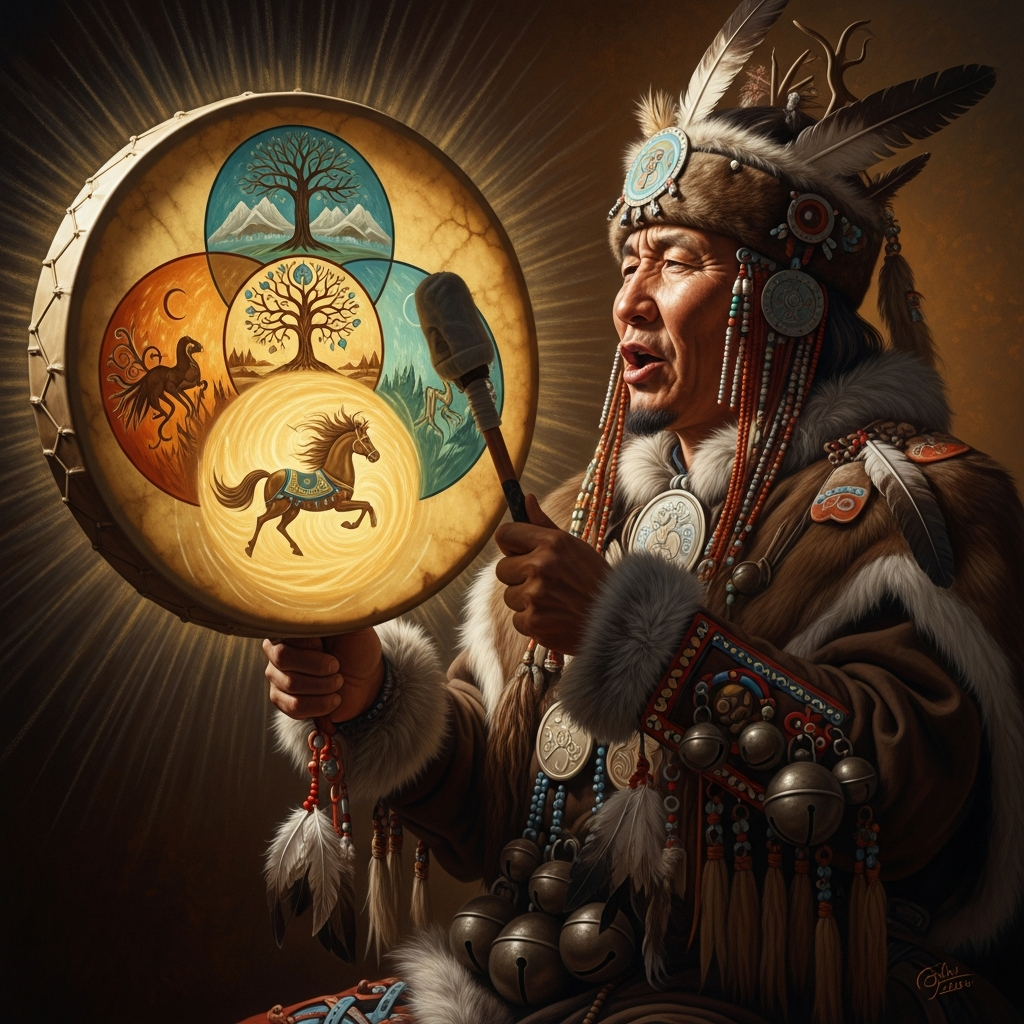
More than an instrument: the drum IS the shamanic practice. A novice shaman spends years learning to play, to become the drumming. The rhythm (usually 4-7 beats per second) induces theta-wave trance in both drummer and listener. The drum is called the shaman’s “horse”—it carries the consciousness across realms.
The drum frame is typically birch wood. The hide—traditionally reindeer, elk, or horse—is stretched and decorated with cosmological imagery: the three worlds, the tree, spirit helpers, protective symbols. Beating the drum with a drumstick (often decorated with fur and bells) is the shamanic journey method.
Missionaries knew the power. Catholic and Orthodox missionaries burned tens of thousands of Siberian drums, knowing that without them, shamanic practice became impossible. Soviet authorities continued the suppression. Shamans hid their drums, passed them down in secret, rebuilt them in exile. A shaman without a drum is like a knight without a sword—spiritually disarmed.
Modern shamanic revival has brought the drums back. A high-quality shamanic drum costs $200-$500 and is treated as a sacred object—never touched without permission, never used in mockery.
In RPG Context: The Shaman’s Drum is the key quest item. Finding, building, or restoring one unlocks shamanic abilities. Destroying an opponent’s drum (metaphorically or literally) renders them helpless.
STAT BLOCK:
| Stat | Score |
|---|---|
| ATK | 0 |
| DEF | 78 |
| SPR | 92 |
| SPD | 85 |
| INT | 0 |
| CHA | 74 |
| WIS | 86 |
| END | 80 |
| Element | Psychic |
| Role | Oracle |
| Rarity | Rare |
| Threat | Benign |
| LCK | 78 |
| ARC | 92 |
| Special | Spirit Bridge — Opens a passage between the material and spirit worlds, allowing safe transit for shamans and their clients across dimensional boundaries. |
| Passive | Rhythm of Worlds — The drum’s heartbeat synchronizes with cosmic and natural cycles, amplifying all spiritual communication and trance-work within its resonance. |
| Epithets | ”Dunur” (Evenki: the drum-horse), “Khuur” (Buryat/Mongol), “the Shaman’s Horse,” “the Burning Target” (colonial destruction), “the Heart of the Tradition” |
| Sacred Animals | Reindeer or elk (the hide stretched across the frame — the drum is made from the animal’s body and carries its spirit), horse (the drum as “horse” that carries the shaman) |
| Sacred Objects | The drum itself; the drumstick (orba in Evenki) decorated with fur, bells, and ribbon; the drum paintings (cosmological maps painted on the hide) |
| Sacred Colors | The colors of the painted cosmological imagery vary; red ochre (most common pigment for drum paintings — life force, blood, spiritual power) |
| Sacred Number | The drumbeat: 4-7 beats per second (induces theta-wave trance state); many drums have cosmological maps with 3 realms depicted |
| Consort(s) | N/A — the drum is a sacred tool; it is paired with the specific shaman who owns and consecrates it |
| Sacred Sites | The drum lives in the shaman’s home, in the place of honor; ritual burning sites where thousands were destroyed by Orthodox missionaries (17th-18th centuries) |
| Festivals | Every shamanic ceremony; the drum’s first use after consecration is a ceremony in itself; seasonal healing ceremonies; the drum is never played frivolously |
| Iconography | Round frame (birch wood) stretched with ungulate hide; painted with the World Tree, three realms, animal spirits, and protective symbols; the drumstick decorated with fur streamers and bells; always shown in the hands of the shaman in trance |
| Period | The world’s oldest intact shamanic drums date to c. 3000 BCE; the practice far older; suppression by Orthodox missionaries peaked 17th-18th centuries CE; revival from 1990s onward |
| Region | Pan-Siberian — Evenki (central Siberia), Yakut/Sakha (northeastern Siberia), Buryat (Lake Baikal region), Tuvan (southern Siberia), Altai (southern Siberia) — also Sámi (Scandinavia) and Korean mudang |
Power Tier: B — Greater (As conduit/amplifier, not as independent actor)
Alignment: Lawful Neutral (Technology requires discipline)
Domain: Trance induction, realm travel, shamanic amplification, rhythm magic
Sacred Symbols: Drum circle, spiral beat pattern, horse, ascending smoke
Cross-Tradition Parallels: The Lyre (Orphic mystery), the Conch (Vedic ritual), the Bell (Buddhist meditation), the Rattle (Native American), the Didgeridoo (Aboriginal)
Ability: A skilled shaman using the Drum gains +40 SPD to spirit travel and +50 SPR for compelling spirits to answer. Destroying a Drum reduces a shaman’s abilities by 60% until a new one is consecrated.
4 min read