Combat Profile
Celestial Mandate
Tengri reshapes reality itself, granting or revoking the mandate to rule from any mortal or immortal being.
Omniscient Firmament
Tengri observes all beneath the endless sky and passively grants fortune to those who honor the eternal blue expanse.
Title: Supreme Sky God of Turkic-Mongol Peoples
Tradition: Siberian Sacred | Tengrism (Modern Revival)
Description:
Tengri (also Tengre, Tänri) is the ultimate principle of cosmic order—not a personality but a presence, a vast and eternal consciousness inscribed in the sky itself. The Mongol khans ruled by the mandate of Tengri, and Genghis Khan attributed his conquests to Tengri’s will. Unlike anthropomorphic gods, Tengri transcends gender, form, and intention; it simply is, the container within which all other deities operate.
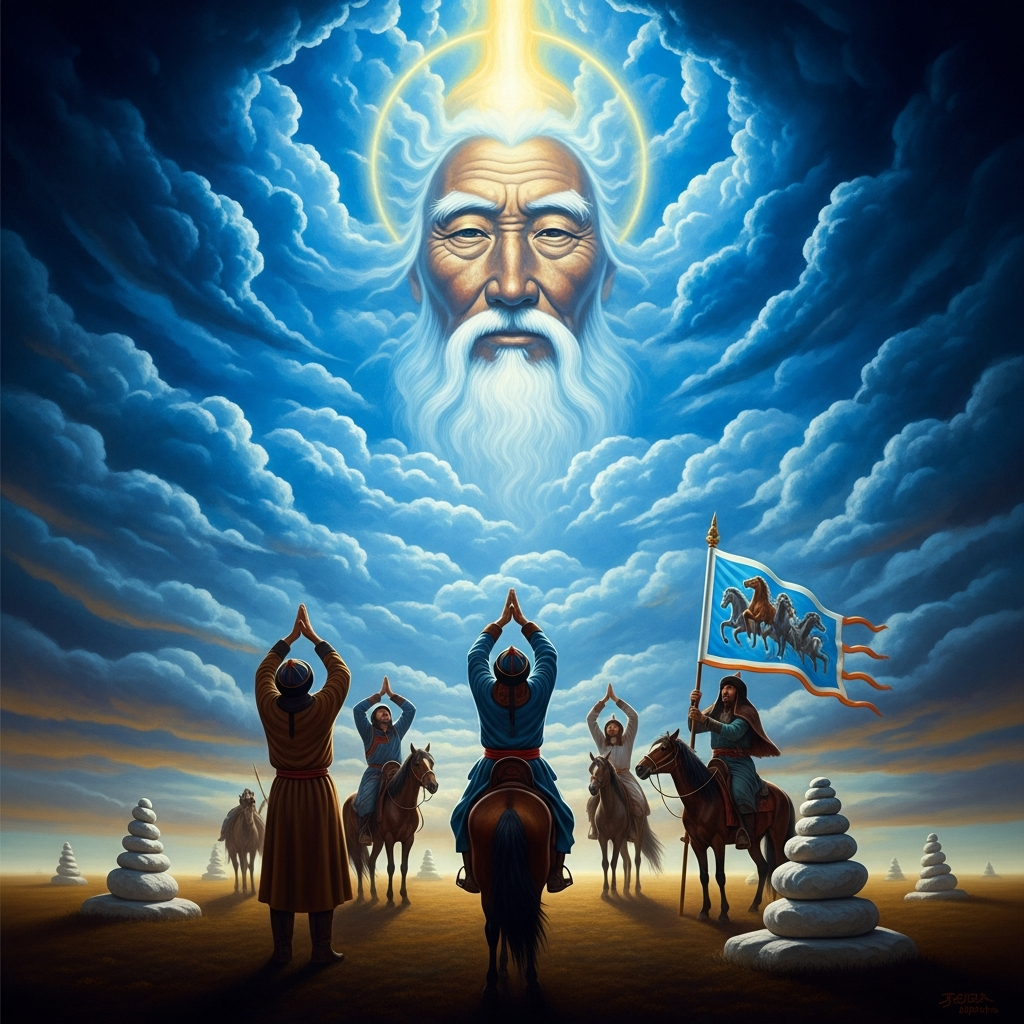
Prayers to Tengri are offered at dawn, facing east. The color blue (or white-blue) is sacred. Sacrifices ascend to Tengri through smoke—the pathway between realms. Even in Soviet times, when shamanism was outlawed, Tengrism survived as an underground philosophy. Today it experiences revival among Mongols, Buryats, Kazakhs, and diaspora communities, framed as a pre-religious cosmic philosophy compatible with Islam and Buddhism.
In RPG Context: Tengri is not a boss to fight. It is the source of legitimacy itself. A character blessed by Tengri gains unparalleled diplomatic weight. Enemies cursed by Tengri’s withdrawal lose ability to hold territory.
STAT BLOCK:
| Stat | Score |
|---|---|
| ATK | 98 |
| DEF | 100 |
| SPR | 99 |
| SPD | 85 |
| INT | 96 |
| CHA | 99 |
| WIS | 99 |
| END | 99 |
| Element | Air |
| Role | Sovereign |
| Rarity | Mythic |
| Threat | Apocalyptic |
| LCK | 89 |
| ARC | 99 |
| Special | Celestial Mandate — Tengri reshapes reality itself, granting or revoking the mandate to rule from any mortal or immortal being. |
| Passive | Omniscient Firmament — Tengri observes all beneath the endless sky and passively grants fortune to those who honor the eternal blue expanse. |
| Epithets | ”Köke Möngke Tengri” (Mongol: Eternal Blue Sky), “Tänri” (Turkic), “Gök Tengri” (Old Turkic: Blue Heaven), “the Mandate” |
| Sacred Animals | Horse (the sacred white horse sacrificed in his honor), eagle (sky messenger), white falcon (shahin) |
| Sacred Objects | Blue silk offerings, white stone cairns (ovoo), the nine-horse banner (tug), eternal flame in felt tents |
| Sacred Colors | Blue (the eternal sky — the most sacred color in Tengrism), white (purity, blessings from above) |
| Sacred Number | 9 (nine heavens in Turkic-Mongol cosmology; nine sacrificial horses in major ceremonies) |
| Consort(s) | Etugen (Earth Goddess) in many Turkic-Mongol traditions — the complementary pairing of Sky Father and Earth Mother |
| Sacred Sites | The open steppe under the open sky — Tengri has no temple; the ovoo (stone cairn) shrines on hilltops and mountain passes across Mongolia, Buryatia, and Kazakhstan |
| Festivals | Naadam (summer festival, Mongolia) — sky-honoring ceremonies; dawn prayers facing east during the new moon; seasonal horse sacrifices at the solstices in traditional Tengrism |
| Iconography | Not depicted in human form — represented by the open blue sky itself; the tug (nine-horse standard of Mongol khans) as the earthly emblem of his mandate; sometimes a great eagle in the highest heaven |
| Period | Attested from at least the 6th century CE in Turkic inscriptions (Orkhon inscriptions, c. 735 CE); pre-literate origins extend into the deep Eurasian Bronze Age; Tengrism revival from c. 1990s onward |
| Region | Mongolia, Inner Mongolia (China), Buryatia (Russia), Kazakhstan, Kyrgyzstan, Tuva — broadly the pan-Turkic and Mongol steppe heartland |
Power Tier: S — Cosmic
Alignment: Neutral Absolute (Order through Cosmic Law)
Domain: Sky, weather, imperial mandate, cosmic order
Sacred Symbols: Blue sky, eternal flame, nine-horse banner, white stone cairns
Cross-Tradition Parallels: Ahura Mazda (Zoroastrianism), Zeus Ouranos (Greek), Dyaus Pitar (Vedic), Amaterasu’s realm (Shinto)
Vulnerability: None known. Tengri cannot be bargained with, only appeased through right action.
3 min read