Contents
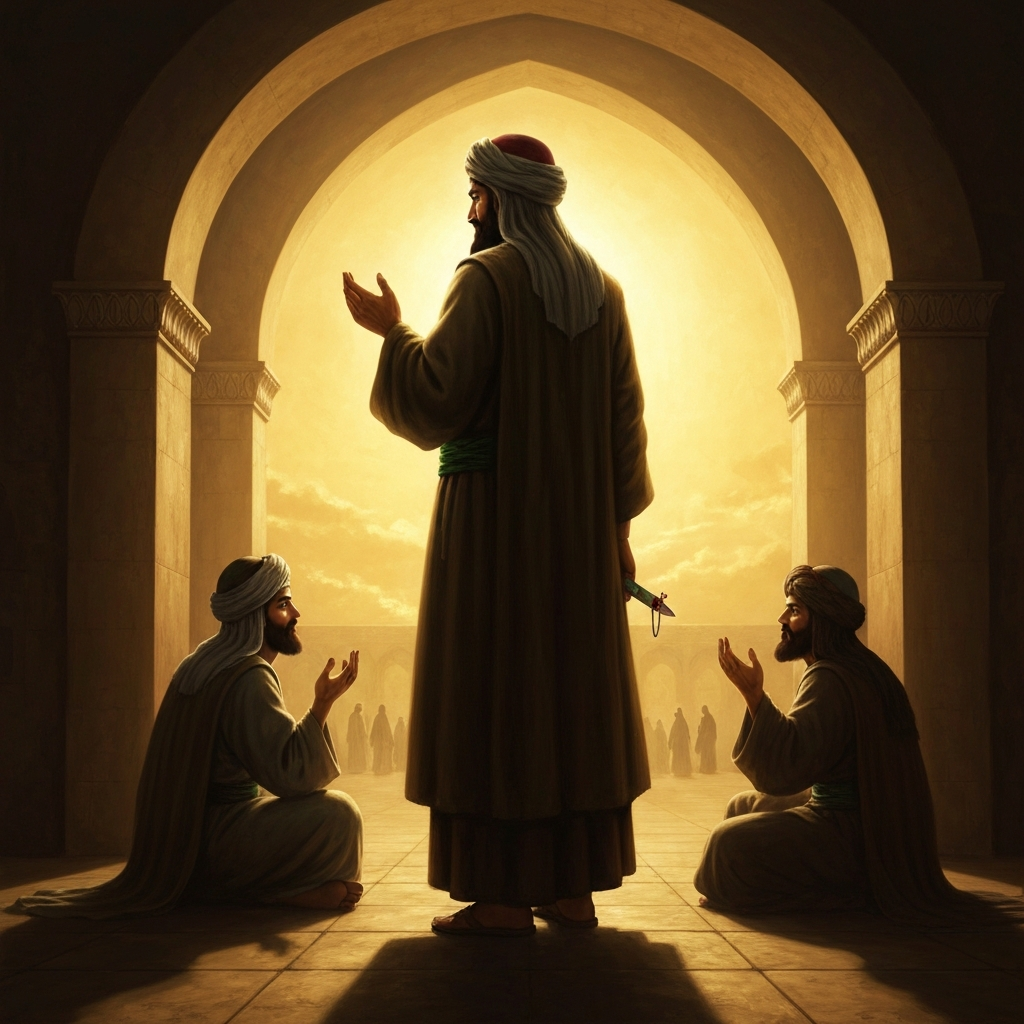
Moses, the greatest prophet of the Torah tradition, travels with a divine guide who damages a boat, kills a child, and rebuilds a wall — three acts that make no moral sense until the reasons are revealed, and the revelation teaches that divine wisdom operates in a register human ethics cannot reach.
- When
- Quranic time — narrative without historical date, Sura 18 of the Quran
- Where
- The junction of two seas — a mythological geography, not a specific historical location
Moses says: I will not rest until I reach the place where the two seas meet.
He has been told — the Quranic account locates this in a tradition attributed to the Prophet’s explanatory narrations — that at the junction of two seas there is a servant of God who knows something Moses does not know. Moses, the receiver of the Torah, the prophet who spoke with God on Sinai, the liberator of Israel, is being sent to a tutorial. The tutorial is about what the law cannot teach.
He travels with his young servant. They bring a fish as food for the journey — the fish that will, when they find the right place, spring back to life and dive into the sea. That is the sign.
They find the place. They meet the man.
He is called al-‘abd al-salih — the righteous servant — in the Quran. He is not named Khiḍr in the text, but the tradition, accumulated through the hadith commentary and the exegetical literature, identifies him as the immortal Khiḍr. He greets Moses and says immediately: You will not be able to have patience with me. How will you have patience in matters your knowledge does not encompass?
Moses promises patience. He will not ask questions. He will follow.
The first event: they board a boat. Khiḍr takes a plank from the hull and damages the boat. Moses, whose legal framework — the Torah’s requirement to do no harm, to respect others’ property — cannot accommodate this, breaks his promise immediately. He says: you have damaged the boat of people who gave us passage! You have done something terrible!
Khiḍr says: did I not say you would not have patience with me?
Moses apologizes. He renews his promise. They continue.
The second event: a young boy playing on the shore. Khiḍr kills him. Moses — the prophet for whom murder is among the gravest of crimes, the man who carries the tablet that says You shall not kill — breaks his promise again with even greater force: You have killed a pure soul without cause! This is a worse thing than the first!
Khiḍr says: did I not say this?
Moses apologizes. Final chance.
The third event: they come to a town that refuses them hospitality. They are hungry and tired and the townspeople will not help them. They find a wall that is collapsing. Khiḍr builds it up — spends hours rebuilding the wall for people who refused them food. Moses says: at least you could have asked a wage for that labor!
Khiḍr says: this is the parting between you and me. And now I will tell you what you could not have patience for.
The explanations.
The boat: the people who owned it were poor and needed it for their livelihood. There was a king along the coast who was seizing every boat he found. I damaged the boat so it would be overlooked as damaged goods. The damage preserved it.
The boy: his parents were believers. He was destined to grow into a person who would bring them grief and drag them into disbelief. I took him before that happened. God will give them in his place one who is better in purity and closer to mercy.
The wall: beneath it is a treasure buried by their father, who was a righteous man, and the two orphan boys of the town will find it when they are grown. If the wall had fallen, others would have found the treasure. I rebuilt it to protect what their father left them.
The three acts that looked like harm, destruction, and wasted effort were protection, mercy, and inheritance. Seen from inside the law, they were violations. Seen from the station Khiḍr occupies — direct divine commission, knowledge of the future, access to a level of consequence invisible to ordinary moral reasoning — they were the most merciful available actions.
The Sufi tradition reads this story as the central statement about the relationship between shari’a and haqiqa — outward law and inner truth. The law is not wrong. Moses is not wrong. But there is a level of divine operation that the law is not designed to govern, because it requires knowing what only God knows: the hidden constitution, the future consequence, the mercy hidden in the apparent harm.
Moses could not accompany Khiḍr. He did not have the knowledge. He had something else, something no less essential: the law. For the world to function, the law must govern what is visible. For the mystic to go further, something must be learned that goes beyond it.
The tutorial ends. Moses goes back.
Khiḍr continues.
Echoes Across Traditions
Entities
- Al-Khiḍr
- Moses
Sources
- Quran, Sura 18: Al-Kahf (The Cave), verses 60–82
- Al-Tabari, *Jami al-Bayan* — classical Quranic commentary on the Khiḍr passage
- Pierre Lory, 'Al-Khadir, figure du saint prophète' in *Numen* 47 (2000)
- Annemarie Schimmel, *Mystical Dimensions of Islam* (UNC Press, 1975)