Every Twenty Years Ise Shrine Dies and Is Reborn
First reconstruction 690 CE under Emperor Jitō; ceremony continuous to present (most recent 2013) · Naiku (Inner Shrine) and Geku (Outer Shrine) at Ise, Mie Prefecture
Contents
Every twenty years, the Grand Shrine at Ise is torn down and rebuilt exactly, plank by plank and nail by nail, on the adjacent plot — so that the sacred site is always new, always ancient, always both simultaneously.
- When
- First reconstruction 690 CE under Emperor Jitō; ceremony continuous to present (most recent 2013)
- Where
- Naiku (Inner Shrine) and Geku (Outer Shrine) at Ise, Mie Prefecture
The new site has been waiting for twenty years.
Adjacent to the existing shrine — close enough to see, far enough to have been a separate, empty, sacred space — the ground has been kept clear. Nothing grows on it that is not allowed. No one walks on it who is not authorized. The pebbles are raked in the pattern that will receive the new building. The site breathes.
Then, in the ceremonial year, the craftsmen begin.
They use hand tools. They use cypress wood cut from forests that the shrine has been managing for centuries, in the specific way that produces the specific straightness and grain that the specific joinery requires. They use no nails where traditional joinery can be used. They use the same measurements that the previous iteration used, and the iteration before that, and the iteration that was there when the emperor Jitō formalized the ceremony in 690 CE, and perhaps before that in the oral tradition that preceded the writing down.
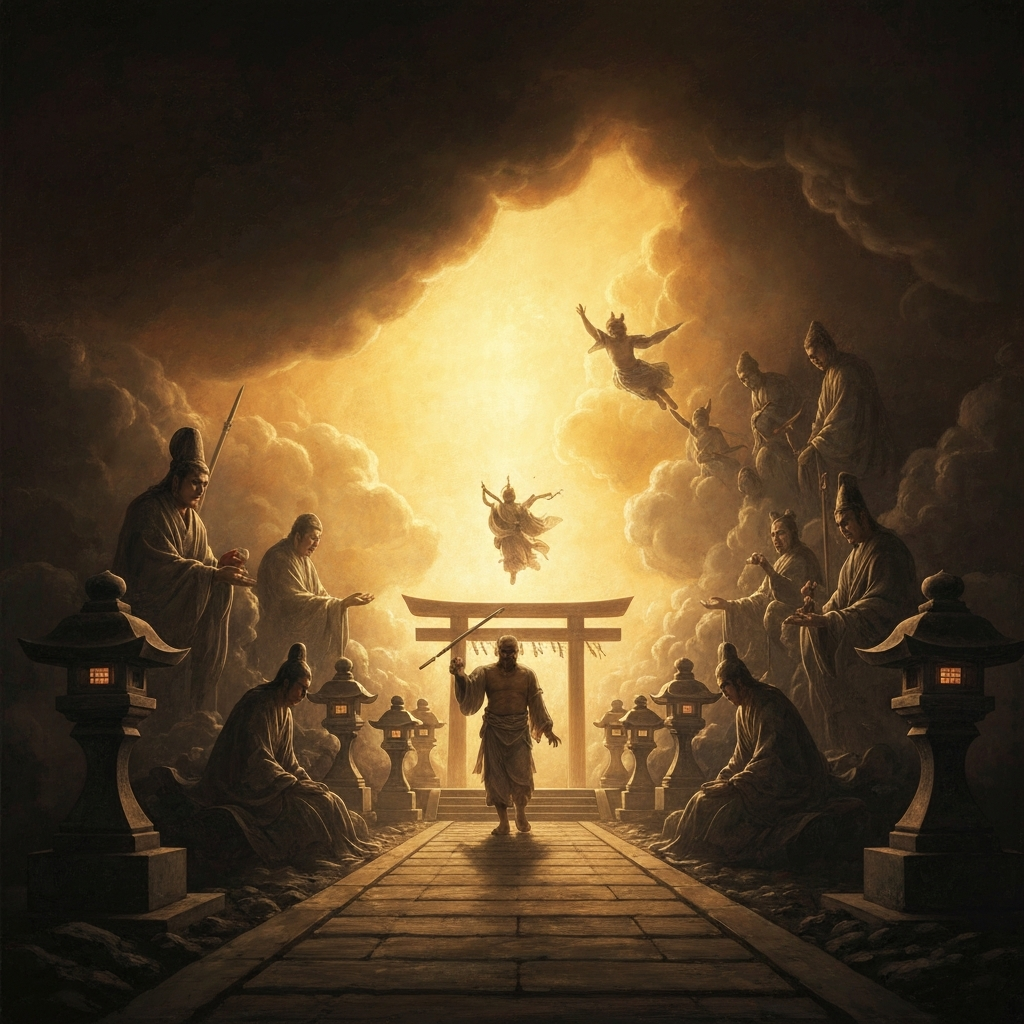
The ceremony is called Shikinen Sengū — the Periodic Relocation of the Shrine. It happens every twenty years, alternating between the two adjacent plots. The result is that at any given moment, one of the two plots holds the active shrine and one holds the empty, waiting space. The active shrine is always twenty years old. The tradition is thirteen hundred years old and continuous.
The philosophical implications were not lost on the people who designed this system.
The question the shrine physically answers: what makes a thing the same thing when it is rebuilt from different materials on a different plot?
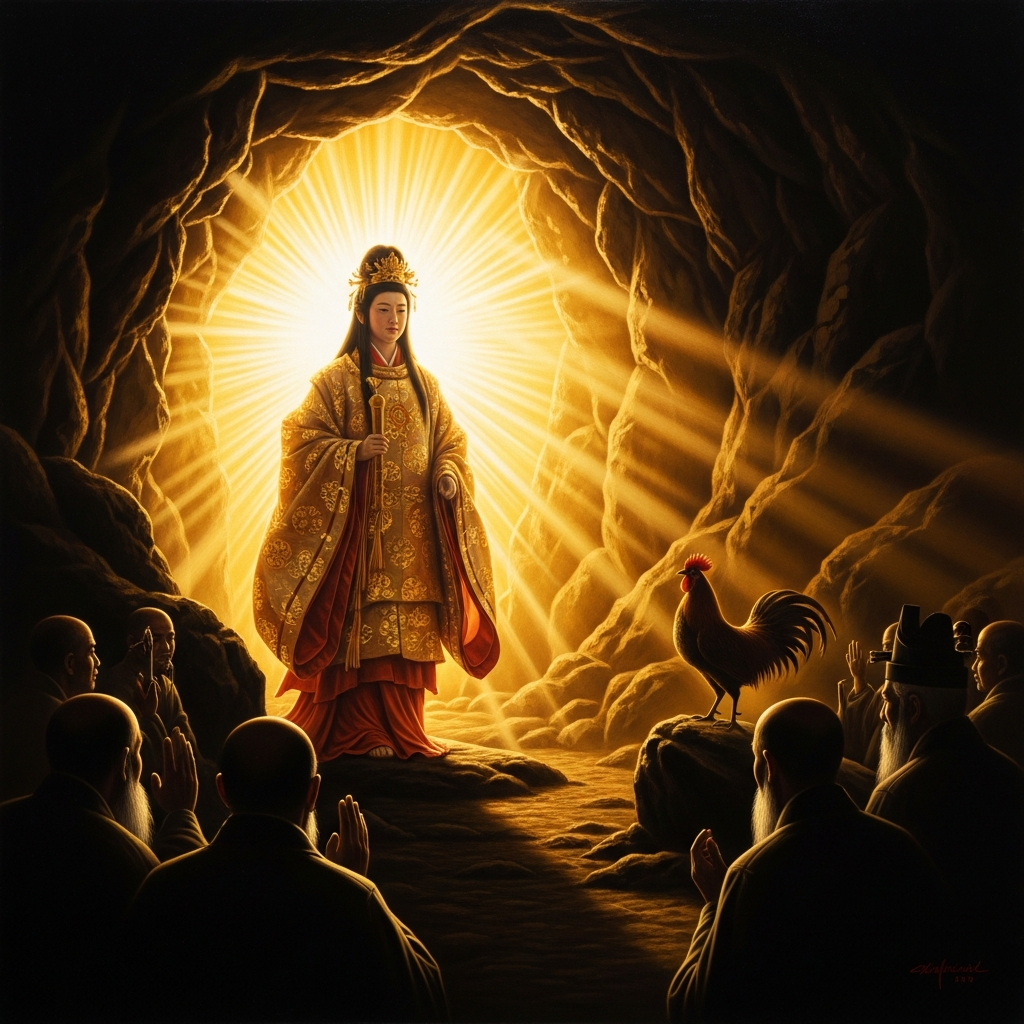
The Shinto answer: continuity of form, continuity of function, continuity of the kami’s residence. The mirror that is Amaterasu’s body remains. The prayers remain. The priests remain, passing through generations that replace each generation of priests the way the buildings replace the buildings. The shrine is the same shrine the way that you are the same person you were twenty years ago — not in materials, not in cells, but in the continuous pattern that persists through the replacement.
The techniques are not written in manuals.
The way to join a specific beam to a specific post, the angle of a specific roof element, the proportion of a specific gate — these are transmitted from master carpenter to apprentice through the twenty-year working cycle. When a Shikinen Sengū is performed, the young carpenters learning their craft work alongside the experienced ones. In twenty years, they will be the experienced ones teaching the young.
The knowledge lives in hands, not books.
If the ceremony were to stop for forty years — two cycles — the oldest practitioners would be gone and the specific embodied knowledge would be gone with them. The tradition would survive only as description, not as practice.
The twenty-year cycle is not arbitrary. It is calibrated to the human transmission of embodied knowledge.
On the morning after the completion of the new shrine and the formal transfer of the kami’s presence from old to new, the old building is dismantled. Its wood, which has been housing a deity for twenty years, is distributed to affiliated shrines throughout Japan, where it is used to rebuild their own structures.
The old shrine feeds the living tradition it was part of.
The new shrine begins its twenty years.
The empty plot begins its twenty years of waiting to be needed again.
Echoes Across Traditions
Entities
- Amaterasu
- the Ise craftsmen
- the Shikinen Sengū ceremony

Sources
- Breen, John and Mark Teeuwen, *A New History of Shinto* (Wiley-Blackwell, 2010)
- Nitschke, Günter, *Japanese Gardens: Right Angle and Natural Form* (Taschen, 1993)
- Pilgrim, Richard, 'Intervals (Ma) in Space and Time,' *History of Religions*, 1986
- Jinnai Hidenobu, *Tokyo: A Spatial Anthropology* (University of California Press, 1995)