The Sarcophagus Lid of Pakal: The King as Maize God
c. 683 CE — burial of Pacal; 1952 CE — archaeological discovery by Alberto Ruz Lhuillier · Palenque, Chiapas, Mexico — the Temple of Inscriptions
Contents
When archaeologists lifted the five-ton carved lid from Pacal's sarcophagus in 1952, they revealed the greatest single work of Classic Maya art — a king at the moment of death falling into the jaws of Xibalbá, his body forming the trunk of the World Tree.
- When
- c. 683 CE — burial of Pacal; 1952 CE — archaeological discovery by Alberto Ruz Lhuillier
- Where
- Palenque, Chiapas, Mexico — the Temple of Inscriptions
Alberto Ruz Lhuillier noticed a hole in the floor.
In 1949, the Mexican archaeologist was excavating the Temple of Inscriptions at Palenque — the nine-tiered pyramid on the western edge of the palace complex, named for the three great carved panels covering its walls with the longest text in Maya epigraphy. He noticed that one of the floor slabs in the temple’s interior had a row of plugged holes around its edge. The holes were filled, suggesting the slab had once been lifted and deliberately re-sealed.
He had the floor removed.
Beneath it was a staircase descending into the heart of the pyramid, filled with rubble. It took four seasons to clear the seventy meters of fill. In 1952, the team reached a triangular stone door at the bottom of the stairs. They moved it aside. Beyond was a stone crypt, its walls painted with nine figures — the Nine Lords of the Night — and in the center of the crypt was a sarcophagus, five tons of carved limestone, sealed with a lid of equivalent weight.
They raised the lid.
What the lid shows has been analyzed by every generation of Maya scholars since 1952, and the analysis has only deepened.
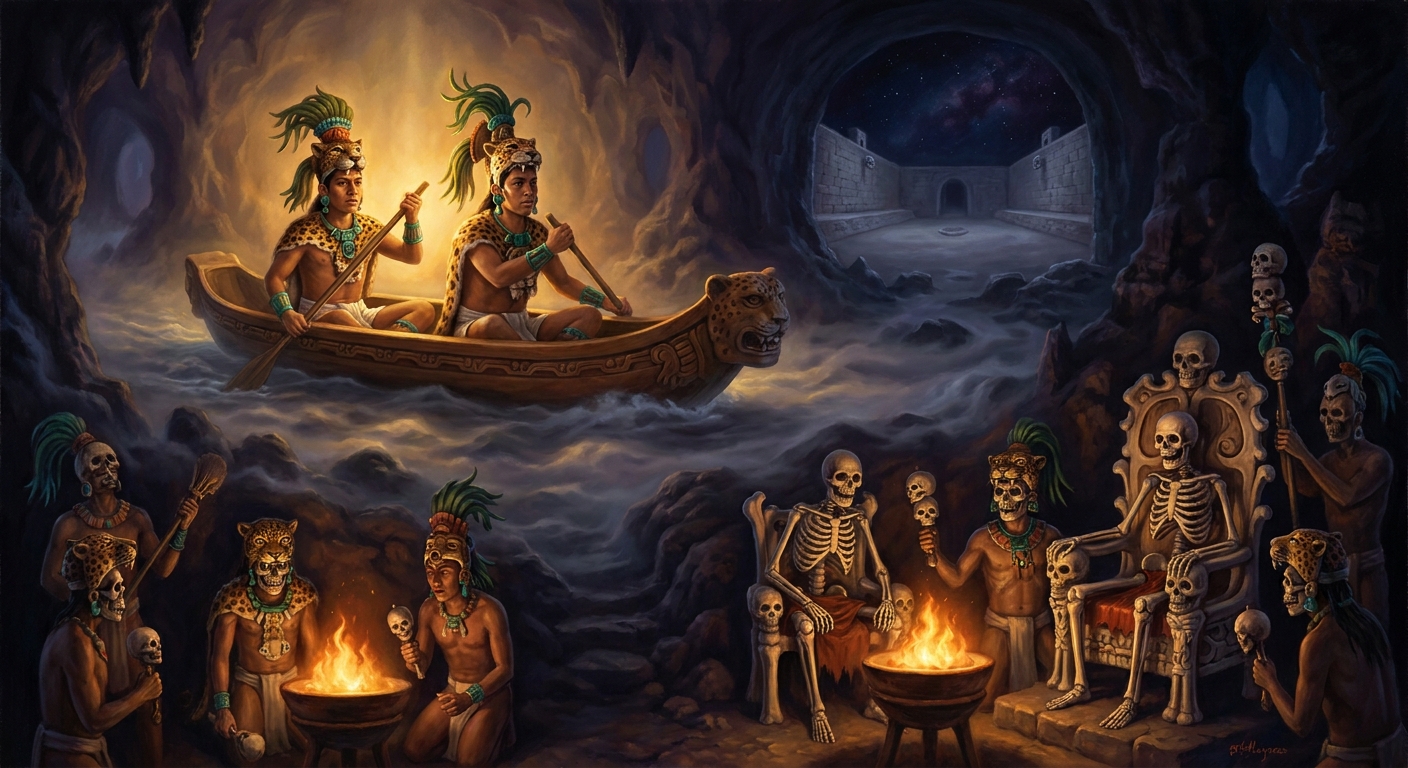
The central figure is a man in the moment of death or falling: his body is tilted back at an angle that initially suggested to some observers — incorrectly, famously — an astronaut in a spacecraft. The body is extended, arms raised slightly, knees bent, the whole form caught in a descent. Above him, rising from his body or from the place he is falling from, is the World Tree — the Wacah Chan, the Six-Sky Tree, the axis of the Maya cosmos that connects the underworld through the earth to the thirteen levels of heaven. A quetzal bird sits at the top of the tree. Around and below the falling figure are the symbols of Xibalbá: the skeletal jaws of the underworld, the place he is entering.
The man is K’inich Janaab’ Pakal — Great Sun Shield, the king who ruled Palenque for sixty-eight years, who died in 683 CE at the age of approximately eighty, whose building program at Palenque created the most sophisticated architecture and art in the Classic Maya world.
He is falling into the jaws of death. He is also the Maize God.
The iconographic signature of the Maize God appears throughout the lid.
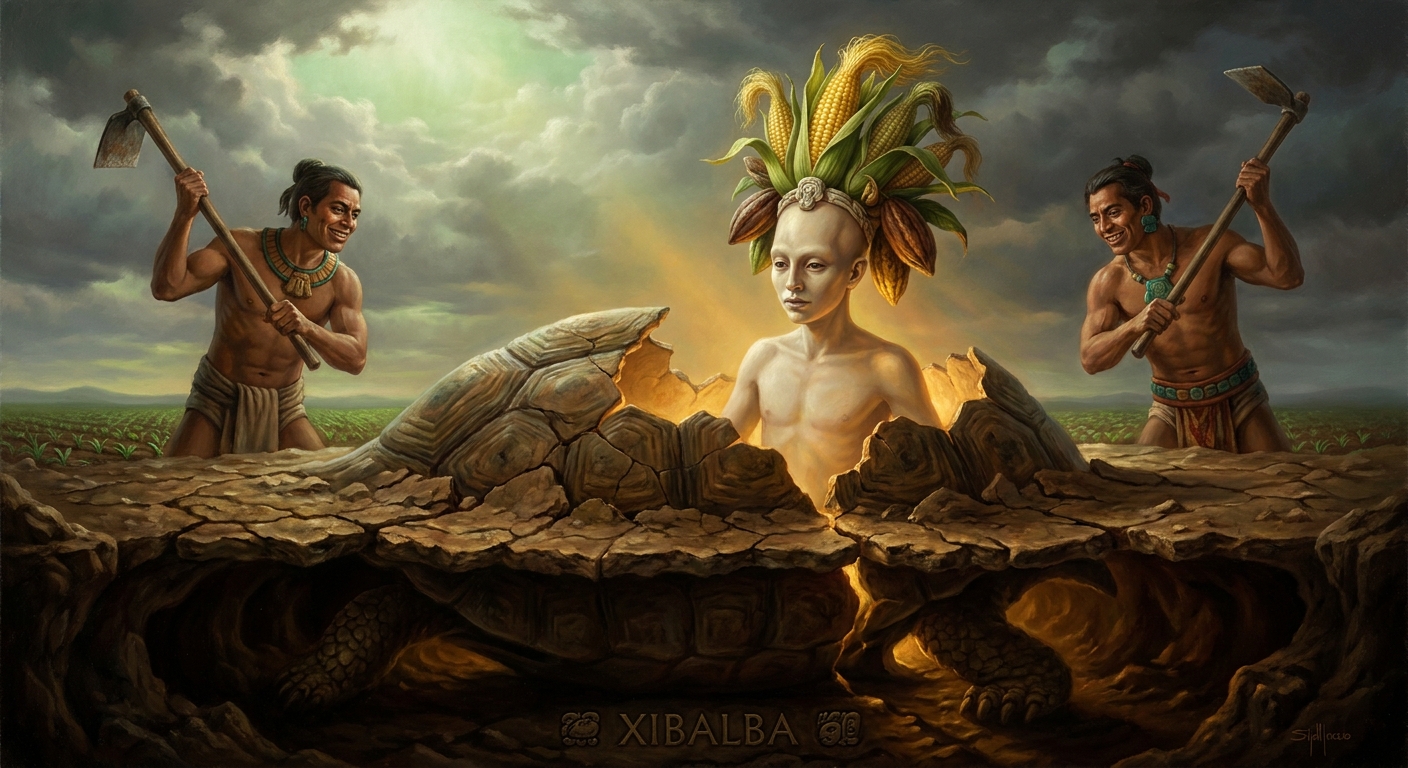
Pakal’s body is positioned in the same extended posture as the Classic Maya depictions of the Maize God at the moment of his descent into Xibalbá — the same tilt, the same arms, the same knees. The World Tree rising from his body is the corn plant rising from the place where the Maize God was buried. The descent of the king and the descent of the seed into the earth are the same event.
The nine figures on the crypt walls are the Nine Night Lords, cycling through their rotation. The ancestors of the Palenque dynasty are carved on the sarcophagus sides, rising from the earth as World Trees themselves — the king’s genealogy as a forest, his line as vegetation.
The Temple of Inscriptions sits above the crypt.
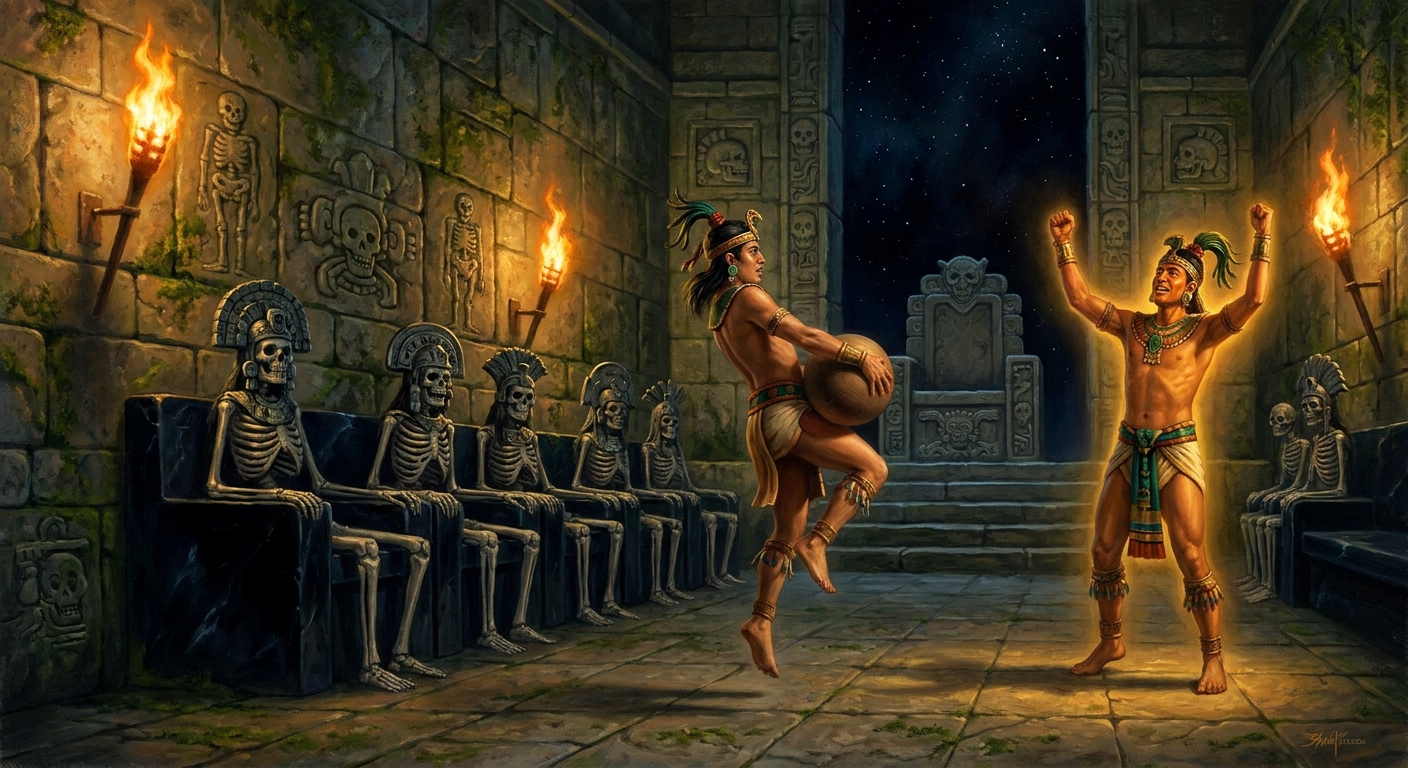
The pyramid’s nine tiers correspond to the nine levels of Xibalbá. The king is buried at the center of an architectural representation of the underworld, in the posture of the Maize God who must descend to generate new growth. The Long Count inscription in the temple records not only Pakal’s birth and death but events thousands of years in the future — the king’s successors projecting his presence forward through time, the dynasty as a form of cosmic insurance.
Pakal is falling.
He is also rising.
The sarcophagus lid says both at once, the way the corn kernel is both the end of the plant and the seed of the next one, the way the sun’s descent into the underworld is the condition of its morning rise, the way every Maya king understood himself: as the point where the cosmic cycles touch down in the personal body, the place where Xibalbá meets the sky.
The lid was sealed in 683 CE. It was opened in 1952.
In between, Pakal descended into the World Tree that rose from his body, and the corn grew, and the sun rose every morning, just as it had before.
Echoes Across Traditions
Entities
- Pacal the Great
- K'inich Janaab' Pakal
- the Maize God
- Alberto Ruz Lhuillier
Sources
- Linda Schele and David Freidel, *A Forest of Kings* (William Morrow, 1990)
- Simon Martin and Nikolai Grube, *Chronicle of the Maya Kings and Queens* (Thames & Hudson, 2000)
- Alberto Ruz Lhuillier, *El Templo de las Inscripciones, Palenque* (INAH, 1973)