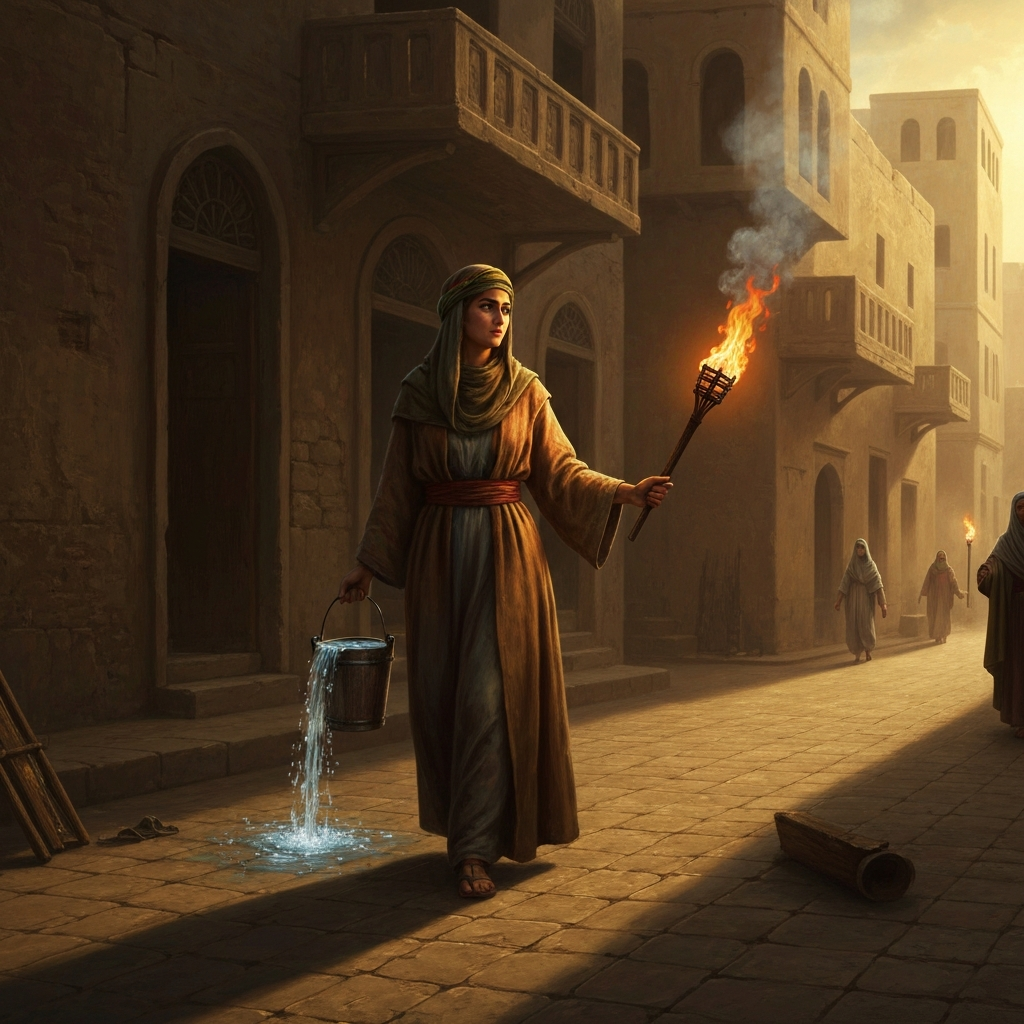
The Shaikh Who Died at the Winehouse Door
c. 1180–1220 CE — the era of Attar's composition; the tale is set in a timeless Islamic city · Nishapur, Khurasan (northeastern Iran) — Attar's city; the story is set in an unnamed city with a wine quarter and a Sufi community
Contents
In Attar's tales, a revered shaikh falls in love with a Christian wine-seller's boy, waits at the door of the wine-house for forty days, and dies there — and the tradition must decide whether this death is the deepest failure or the deepest teaching.
- When
- c. 1180–1220 CE — the era of Attar's composition; the tale is set in a timeless Islamic city
- Where
- Nishapur, Khurasan (northeastern Iran) — Attar's city; the story is set in an unnamed city with a wine quarter and a Sufi community
The shaikh has spent forty years building what is being destroyed.
He has spent forty years in fasting and prayer, in the night vigils and the dawn supplications, in the instruction of disciples who have come from distant cities to sit at his feet. He is, by every external measure, a man of God. His beard is white. His students number in the hundreds. His prayers are answered. His karamat — the charismatic gifts that indicate divine favor — are documented. He knows the Quran by heart in seven recitations.
Then he passes the wine quarter of the city and sees a boy carrying jugs.
The accounts vary as to whether the boy is Christian or simply non-Muslim — both are conventional in the symbolic repertoire of Persian mystical poetry, where the beloved at the wine-house represents the divine in a form the religious establishment refuses to recognize. The boy is beautiful. He is indifferent to the shaikh. He carries his wine without looking up.
The shaikh cannot move from the spot.
He returns the next day. He returns every day for forty days. He stands at the door of the wine-house like a beggar, his white robe acquiring the dust and cold of the street. His disciples come to fetch him. He refuses to leave. Some of them argue with him: master, this is haram, this is forbidden, you are destroying everything you have built. He does not argue back. He is beyond argument. Something in him that was held together by forty years of accumulated religious achievement has come loose, and the loose end is pulling him toward the door of the wine-house like a thread unraveling.
On the fortieth day, the boy emerges. He sees the old man in the dust. He says, with the cruelty of the beautiful toward those who cannot help loving them: Why do you come here? You are not one of us. The shaikh says: No. I am not one of you. I am not one of mine either. I am only what this love has left of me, which is nothing.
The boy goes back inside.
The shaikh dies at the door.
Attar does not editorialize in the immediate aftermath. He presents the death and allows the reader to sit with the discomfort. Then he offers several interpretations, none of which is the final word.
The first interpretation: this is failure. The shaikh succumbed to a test he should have passed. The transgression was real. The death is a warning.
The second interpretation: this is completion. The shaikh spent forty years building a religious identity — a self composed of piety, reputation, spiritual achievement. This self had to be destroyed before the journey could be completed. The love that destroyed it was not an accident. It was the final tool of a process that all the fasting and prayer had been preparing. Only when the self has nothing left — no reputation, no status, no safety — can it open completely. The boy at the wine-house was the instrument of an emptying that the mosque could not provide.
The third interpretation, offered in Attar’s framework: both are true simultaneously. The transgression was real. The completion was real. The divine uses real transgression to accomplish real completion. This is the most difficult teaching and the one that makes the poem so disturbing: it does not resolve into either condemnation or exoneration.
The poem that follows in Attar’s collection is about a disciple who asks his teacher: what happened to the shaikh? Where is he now?
The teacher is silent for a long time. Then he says: Do you want to know his address? Ask the wine-house boy.
The disciple is confused. The boy who was the instrument of the shaikh’s ruin knows his address?
That boy, says the teacher, was God. Those forty days at the door were not ruin. They were the only prayer in forty years that cost him something he actually valued. Everything else was cheap. He paid with his reputation and his life. This is the only currency that gets you through the door you were actually looking for.
Attar is not recommending transgression. He is recommending that you look at what love costs you — and whether you are paying or just practicing. The shaikh at the wine-house door was paying. That is why the tradition still tells his story.
Echoes Across Traditions
Entities
- Farid ud-Din Attar
- the unnamed shaikh (archetypal figure)
- the beloved at the wine-house door
Sources
- Farid ud-Din Attar, *Musibat-nama* (Book of Affliction), c. 1200
- Farid ud-Din Attar, *Ilahi-nama* (Book of the Divine), c. 1200
- Hellmut Ritter, *The Ocean of the Soul: Man, the World and God in the Stories of Farid ud-Din Attar* (Brill, 2003)
- Annemarie Schimmel, *As Through a Veil: Mystical Poetry in Islam* (Columbia, 1982)