Contents
Before the hunters go out, the medicine man prays to the buffalo people — acknowledging the gift, describing the need, asking rather than taking — and the whole ceremony of the hunt is understood as a reciprocal exchange between the people and the animals who give themselves.
- When
- Before every hunt — a ceremony as old as the people's relationship with the buffalo
- Where
- The northern plains — the grasslands of the Great Plains, Lakota territory
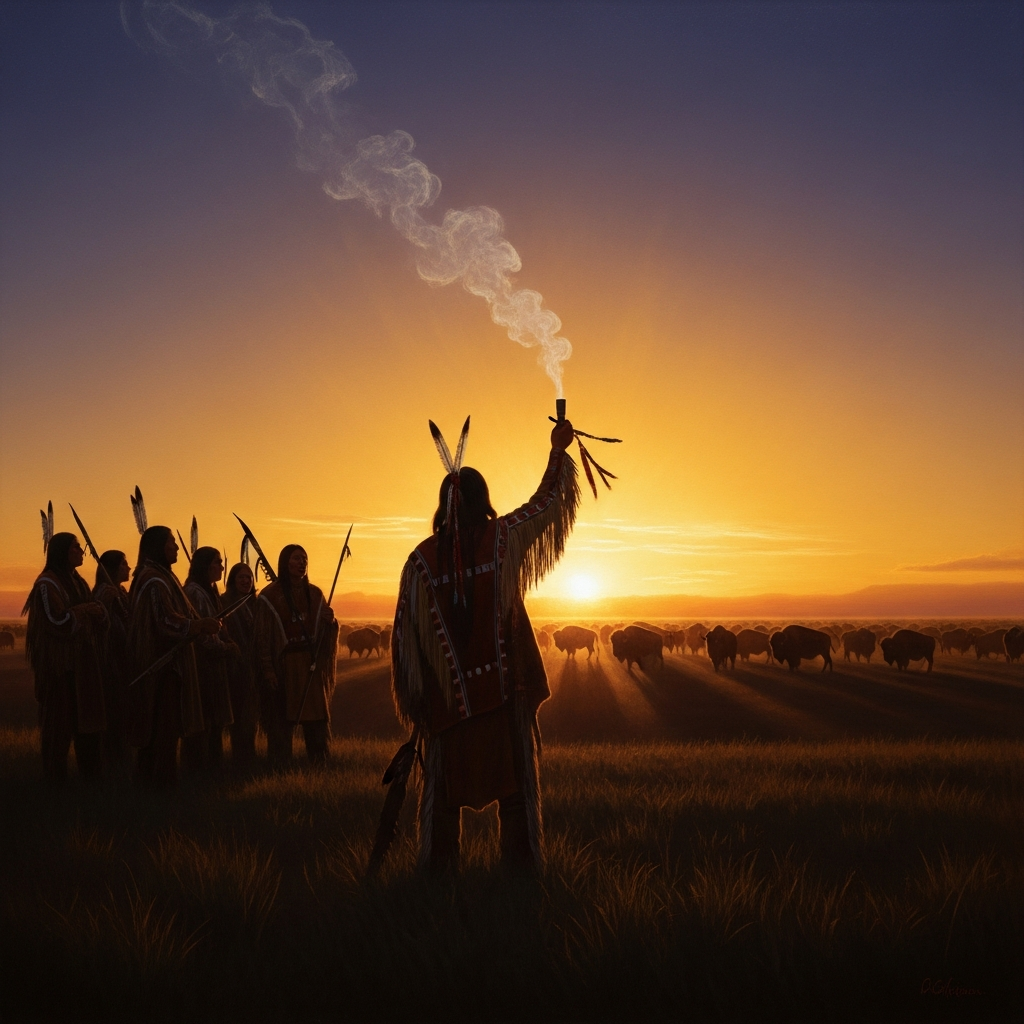
Before the hunters go, the ceremony happens.
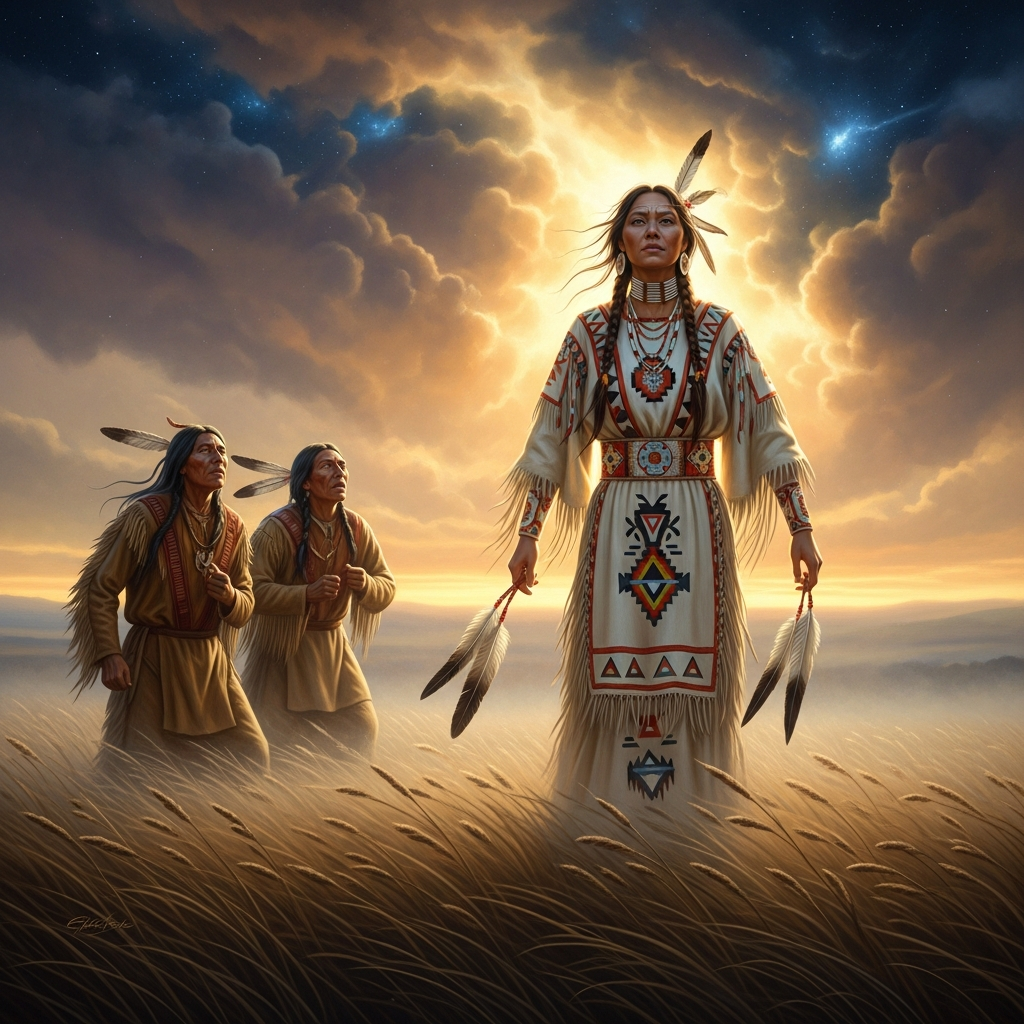
The medicine man takes the pipe and faces the direction from which the herd has been reported. He smokes. He speaks to the buffalo — not to the individual animals but to the buffalo people, the nation of beings who have agreed to be in relationship with the Lakota since the beginning. He says: we are hungry. Our children need to eat. We come with respect and with the pipe that White Buffalo Calf Woman gave us, which is the instrument of right relationship, and we ask you to give what you can give.
This is not magic. It is not manipulation. It is speech between persons.
The hunters know several things simultaneously.
They know that the buffalo are animals who can be hunted. They know that the buffalo are also persons — the buffalo people, who have their own lives and relationships and deaths, who die when they are killed and who are owed the acknowledgment that dying requires. They know that the herd’s willingness to be available for hunting is not an accident — it is a disposition that can be maintained or lost depending on how the hunters conduct themselves.
The hunters who take too many, who kill for sport rather than need, who waste the meat, who disrespect the remains — those hunters find that the herds move away. Not as punishment exactly, but as a natural consequence of a relationship treated carelessly. The herd is not a supply. It is a partner.
After the kill, there are more ceremonies.
The medicine man or the hunter who made the first kill speaks to the animal directly — not the species, but this animal, this body, this particular buffalo who is now dead and whose meat will feed specific children in specific tipis. He thanks it. He tells it what the meat will do: this child has been hungry, this elder needs the fat, this hide will warm this family through the winter. The specificity is important. The buffalo is not dying for an abstraction — it is dying for these children, these people, whose names could be given if required.
The skull is placed with the nose pointing west, toward the spirit world.
The bones are treated carefully. Nothing is wasted — not because waste is economically inefficient but because wasting what a person gave you is a violation of the relationship that made the gift possible.
Thirty million buffalo in 1800. Eight hundred in 1889.
The market hunters who exterminated the Plains bison in the 1870s and 1880s did not pray before the hunt. They did not acknowledge the gift. They took for commerce — for hides, for the bone meal fertilizer market, sometimes for the heads to hang on Eastern walls — and left the rest of the carcass on the ground.
The elders who watched the slaughter from the reservation fences said: the buffalo people have left. They have gone into the ground. The relationship has been broken in a way that requires a generation of ceremony to restore.
The bison population today is around 500,000, rebuilt from near-extinction by a century of effort.
The prayer before the hunt is still said when a Lakota hunter goes out for elk or deer.
The prayer is the relationship, and the relationship is what makes the land livable.
Echoes Across Traditions
Entities
- the medicine man
- the buffalo person
- the hunters
- the White Buffalo Calf Woman (in whose name the prayer is made)
Sources
- Black Elk, *The Sacred Pipe*, recorded by Joseph Epes Brown (University of Oklahoma Press, 1953)
- Andrew Isenberg, *The Destruction of the Bison* (Cambridge University Press, 2000)
- Luther Standing Bear, *Land of the Spotted Eagle* (University of Nebraska Press, 1933)