The Bridge of the Separator
Three days after death — the dawn of the fourth day in Zoroastrian eschatology · The Chinvat Bridge — the cosmic separator at the peak of Mount Harā Bərəzaiti
Contents
Three days after death, the soul of the departed stands at the Chinvat Bridge — and what it encounters crossing that bridge is the embodiment of its own choices: its conscience made visible, either as a beautiful maiden or a hideous hag.
- When
- Three days after death — the dawn of the fourth day in Zoroastrian eschatology
- Where
- The Chinvat Bridge — the cosmic separator at the peak of Mount Harā Bərəzaiti
For three days, the soul stays near the body.
The Hadokht Nask records this: for three days after death the soul hovers near the head of the corpse, chanting the Ushtavaid Gatha, the hymn of happiness, which is either the last song of a departing soul or the first prayer of a being who has always been more than flesh and is only now fully remembering this. For three days the prayers of the living help sustain the soul in this liminal space. The priests perform the Sros Drōn ceremony at each dawn and each dusk.
On the dawn of the fourth day, a wind comes from the south.
It carries the smell of plants and flowers — a fragrance sweeter than any the living world contains. The righteous soul, encountering this wind, says: What wind is this, the sweetest wind I have ever smelled? It is the breath of Daena, its own religious conscience coming to meet it.
The Daena appears.
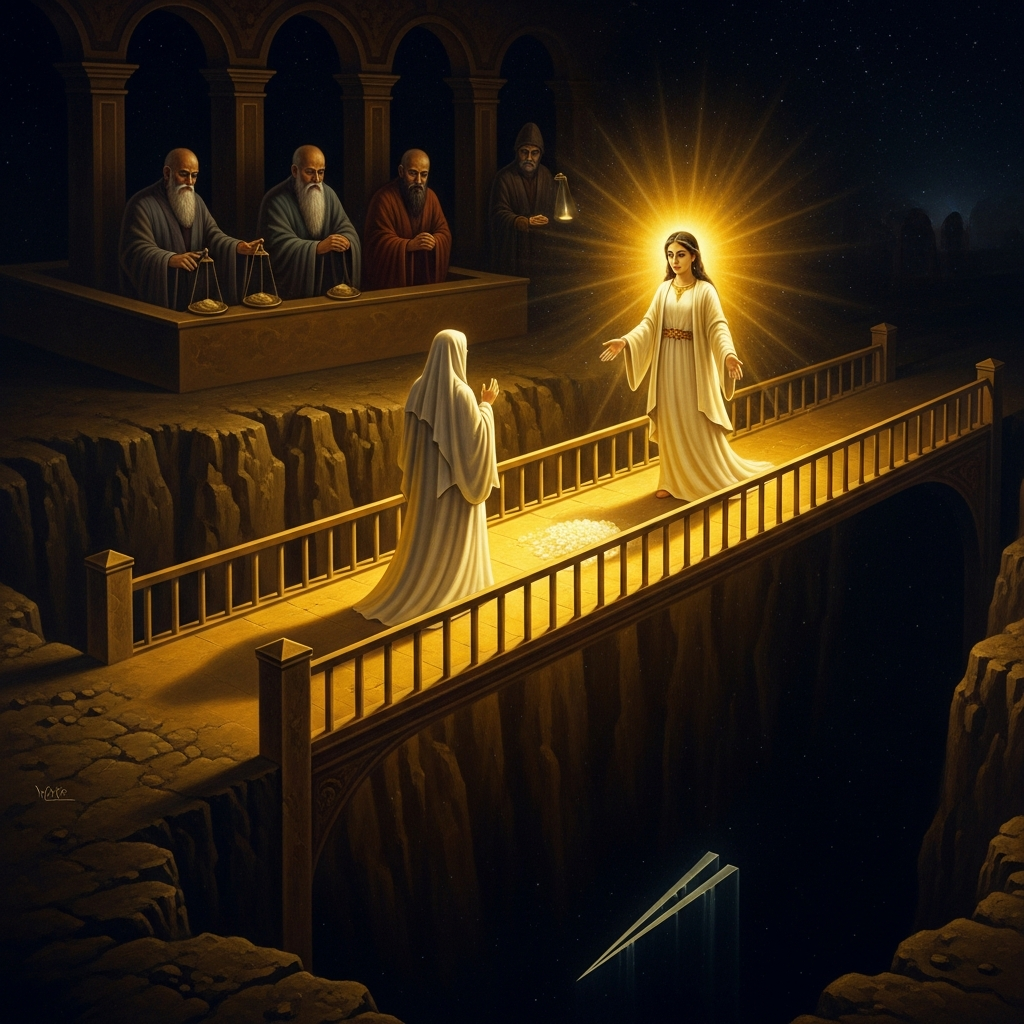
For the righteous soul, she is the most beautiful woman imaginable — taller than human height, brighter than the full moon, with eyes like the finest jewels, wearing robes that move with a light of their own. She identifies herself: I am your own religious self. I am the sum of your good thoughts, good words, good deeds, made into a person and coming to receive you.
The soul walks with her across the Chinvat Bridge.
The bridge crosses the abyss between the material and spiritual worlds. For the righteous soul it is wide — wide as a road, broad enough to walk in comfort, the crossing easy and the other side visible. The yazatas Sraosha and Mithra and Rashnu accompany the soul as guides and guardians.
For the wicked soul, the Daena appears differently.
She comes as an old woman, hideous beyond natural age, barefoot, ragged, with the smell of rot rather than flowers. She is the sum of bad thoughts, bad words, bad deeds made present. She is not someone else’s judgment — she is the wicked soul’s own spiritual self, the record of its choices made visible and given voice. She says the same thing the beautiful Daena says, but the statement has the opposite force: I am what you made me.
On the Chinvat Bridge, what changes is the bridge itself.
For the righteous soul it is wide. For the wicked soul it becomes, by the tradition’s terrifying image, as narrow as a razor’s edge. The soul looks at the bridge it must cross and finds it the width of a blade. The beautiful Daena waited for the righteous soul on the other side. The hideous Daena leads the wicked soul to a crossing that cannot be crossed, and the soul falls.
The fall lands in the House of Lies.
Not hell exactly — the Zoroastrian House of Lies is a specific region of the post-mortem world where souls endure the consequences of their choices in darkness and cold, eating the worst food, suffering the company of others who made the same choices. It is a temporary condition for most: at the Frashokereti, the final renovation, all souls will be purged by the river of molten metal that runs across the earth, and those that have suffered enough in the House of Lies will be purified and restored.
The righteous soul reaches the Garōthmān — the House of Song, the highest heaven, where Ahura Mazda and the Amesha Spentas reside. The light there is so different from any light the material world contains that the soul, reaching it, cannot compare it to anything it knew. The comparison the text uses is: it is as though you have always lived in a dark room and now you have gone outside.
Three judges wait at the bridge: Mithra, who sees all things, Sraosha, who listens and enforces, and Rashnu, who holds the scales. They watch the soul crossing. Their judgment is not separate from the bridge’s evidence — it is the bridge’s evidence made into a verdict.
What the soul experiences on the bridge is the weight of everything it chose to be.
Not what happened to it. What it chose.
The bridge holds.
Or it narrows.
The difference is the life.
Echoes Across Traditions
Entities


Sources
- Avesta, *Hadokht Nask*, translated by James Darmesteter
- Avesta, *Ardā Wīrāz Nāmag* (Book of the Righteous Viraz)
- Mary Boyce, *A History of Zoroastrianism*, Vol. I (Brill, 1975)
- Prods Oktor Skjærvø, *The Spirit of Zoroastrianism* (Yale, 2011)