Ganesh Writes the Mahabharata: The Tusk That Became a Pen
c. 400 BCE – 400 CE (Mahabharata composed; the frame story is part of the Adi Parva) · A cave in the Himalayas where Vyasa, the compiler-sage, retreats to dictate the longest poem ever composed in any language
Contents
The sage Vyasa has the entire Mahabharata in his head and no scribe fast enough to keep up. He needs a hand that can move at the speed of thought. He summons Ganesh — and Ganesh agrees on one condition: that Vyasa never pause in his dictation. Vyasa accepts on a counter-condition: that Ganesh never write a verse he has not understood. Then, when Ganesh's reed pen breaks under the speed of dictation, Ganesh snaps off his own tusk and keeps writing.
- When
- c. 400 BCE – 400 CE (Mahabharata composed; the frame story is part of the Adi Parva)
- Where
- A cave in the Himalayas where Vyasa, the compiler-sage, retreats to dictate the longest poem ever composed in any language
The sage Vyasa is in trouble.
He has the Mahabharata in his head — every verse, every sub-verse, every digression, every embedded story-within-a-story. He has spent decades composing it. The text describes the war between two branches of a royal family, the Kauravas and the Pandavas, fought on the field of Kurukshetra; it contains, embedded within, the Bhagavad Gita, the Anushasana Parva, the genealogies of every god and demon and sage relevant to the war, the dharmic code that governs human life, and the prehistory of the world. By Vyasa’s own count, when finished, it will be about a hundred thousand stanzas long, roughly 1.8 million words. He is one human being. He cannot write that down.
He prays to Brahma, the creator-god. He asks for help. He explains the problem.
Brahma listens, considers, and tells him: You will never find a human scribe fast enough to keep up with you. You need a god. Pray to Ganesh.
Vyasa goes deeper into his cave and begins to pray.
—
Ganesh is the elephant-headed son of Shiva and Parvati — patron of beginnings, remover of obstacles, fat-bellied, pot-eared, smiling. He is also the god most explicitly associated with writing in the Hindu pantheon. He is the one to ask.
He arrives at Vyasa’s cave.
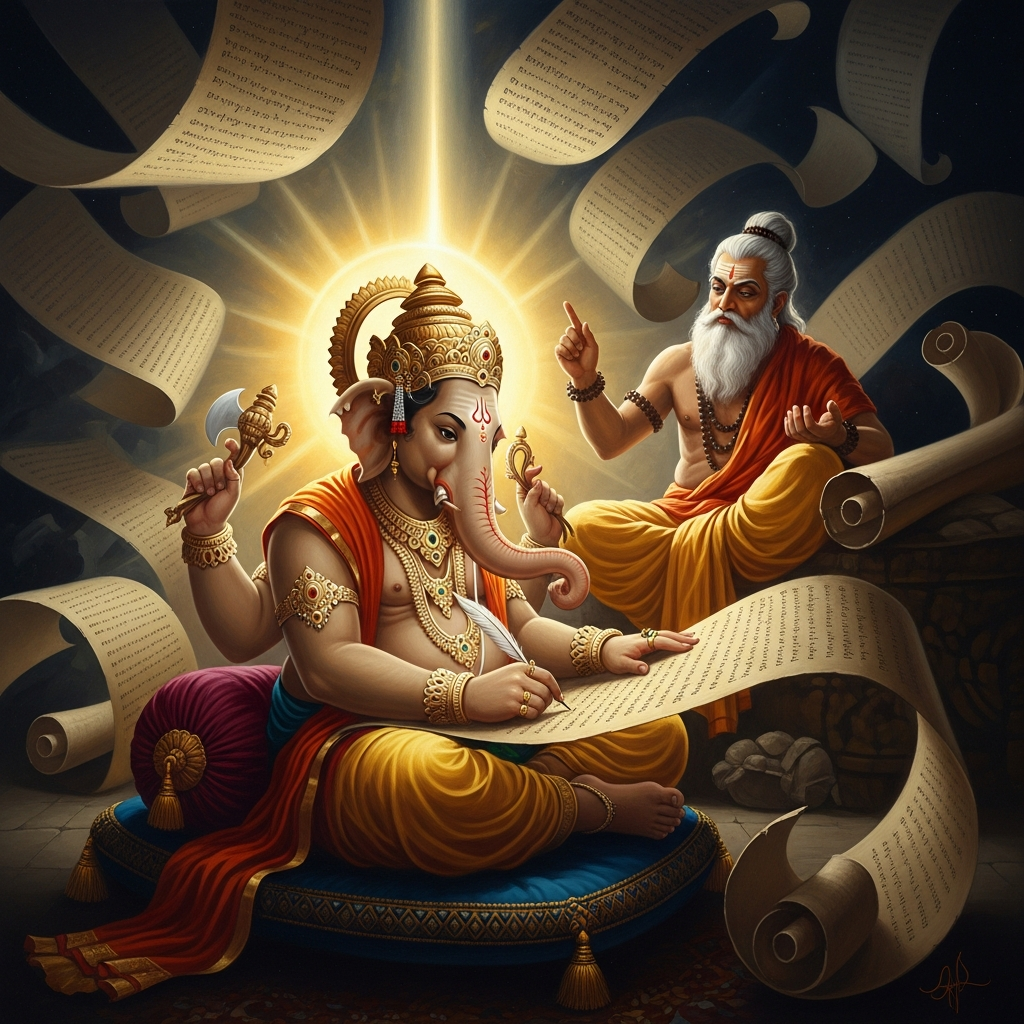
The two sit across from each other on the cave floor — the bearded ascetic on his tiger skin, the elephant-headed god on a low wooden platform, holding a reed pen and a long roll of fresh palm leaves. Vyasa lays out the project: the Mahabharata, in its entirety, dictated start to finish, no interruptions, no second drafts.
Ganesh listens.
Then Ganesh sets a condition.
I will write, he says, but only on the condition that the dictation never stops. The instant your voice pauses, my pen stops, and I leave. If you want me as your scribe, you will speak without break — through the day, through the night, through whatever weariness — until the work is done.
It is a difficult condition. The Mahabharata is not a poem one can dictate without thought. It is, in places, fiendishly intricate — long passages of philosophical argument, genealogies running across thousands of names, doctrinal arguments that require precision. To dictate it without pause is to compose at the speed of memory and tongue.
Vyasa thinks. He sees a way.
He sets a counter-condition.
Then I will speak without pause, he says. But on this condition: you must understand each verse before you write it. You may not write a line you have not fully comprehended.
Ganesh smiles. He accepts.
The trick is this: Vyasa knows that his own poem contains, by design, deliberately knotted verses — kuta-shlokas — verses so dense, so multivalent, that even a god will need a moment to untangle them. When Vyasa needs to rest, he will recite a knot-verse. Ganesh will pause to comprehend. In that pause, Vyasa will breathe, gather his thoughts, plan the next ten thousand stanzas, and resume.
The two poets — sage and god — bow to each other. The work begins.
—
For the rest of recorded mythology, no one knows quite how long they sat in that cave. Some sources say three years. Some say much longer. The cave is said to be in the Himalayas; pilgrims still visit a cave at Mana, in Uttarakhand, that local tradition identifies as the place.
Vyasa speaks. Ganesh writes.
The voice does not stop. It moves across the great battlefield of Kurukshetra, into the council chambers of the Kauravas, into the forest exile of the Pandavas, into the gambling hall where Yudhishthira loses everything, into the moment Draupadi is dragged into court by her hair. It dictates the lineages of every king from Manu down. It dictates the Bhagavad Gita — Krishna’s seven-hundred-verse discourse to Arjuna in the chariot between the armies — without pause.
Ganesh writes with both hands. He writes faster than any mortal scribe could. He writes with the patience of a god who has eternity and the focus of a god who has been given a single project. The palm leaves stack up on either side of him until they fill the cave.
And occasionally, when Vyasa needs a breath, he drops a knot-verse — a verse with multiple syntactically valid readings, a pun spread across three lines, a metaphor that requires unpacking — and Ganesh’s pen halts for a long second, his eyes narrowing as he turns the line in his trunk, and Vyasa breathes.
Then Ganesh nods, satisfied with his reading, and his pen moves again. Vyasa resumes.
—
At some point during the long composition — the texts do not specify exactly when — the reed pen breaks.
Reed pens are fragile. The speed of the dictation, the volume of the writing, the years of continuous use have worn it through. The pen splits at the nib. Ganesh holds it up: useless.
This is, by the rules of their contract, a disaster. To stop and find a new pen is to break the dictation. If the dictation breaks, Ganesh leaves. The Mahabharata, half-written, will collapse.
Vyasa does not pause.
Ganesh does not pause either.
He raises his right hand. He puts it to his right tusk — the great curved white tusk that has been with him since birth — and he snaps it cleanly off at the base.
Blood flows briefly. He does not flinch. He dips the broken point of the tusk in the ink-pot. He resumes writing.
The dictation continues.
The tusk, freshly snapped from a god’s body, holds ink better than reed. It writes faster. It does not split. The text proceeds without skipping a verse.
This is why Ganesh is depicted, in every temple and every household shrine, with one whole tusk and one broken tusk — the iconography that distinguishes him from any other elephant-deity. The broken tusk is the pen. He never replaced it.
—
Eventually the dictation ends. Vyasa speaks the final verse — the Mahabharata concludes, after the war and after the deaths and after Yudhishthira’s ascent to heaven and his discovery that even heaven contains its illusions — and Ganesh sets down the tusk.
The two of them look around the cave. It is full of palm leaves. The longest text ever composed in any language is finished.
They bow to each other again. Ganesh leaves. Vyasa, who is by some accounts an immortal and by other accounts simply a very long-lived rishi, walks out of the cave to teach the text to his students — first his son Shuka, then his disciples, who will spread it across India.
The text will be copied, recopied, retranslated, performed at festivals, recited every night, painted on temple walls, animated on television, set to music in a hundred regional languages, fought about, harmonized, condensed, expanded again. It will become the cultural backbone of a subcontinent.
But every recitation begins with a verse to Ganesh. Every Indian schoolchild who opens a notebook on the first day of the school year is taught to write Shri Ganeshaya Namaha at the top. Every business venture begins with him. Every wedding invitation has his image on the cover. He is the patron of beginnings because he is the patron of the first beginning that mattered: the Mahabharata itself, written by a god who, when his pen broke, broke a piece of his own face to keep going, because the dictation would not stop.
This is what writing is, the myth says. Not inspiration alone. Not memory alone. The willingness to break a piece of yourself to keep up with what is coming through.
Scenes
In a Himalayan cave at dawn, the bearded sage Vyasa sits cross-legged on a tiger skin
The cave fills with thousands of palm leaves stacked floor to ceiling
Ganesh raises a hand to his face, snaps off his own right tusk with a clean break, dips its broken point in ink, and resumes writing without looking up
Echoes Across Traditions
Entities


Sources
- Vyasa, *Mahabharata* (Adi Parva — opening frame, c. 400 BCE – 400 CE)
- J. A. B. van Buitenen (trans.), *The Mahabharata Vol. 1* (1973)
- Bibek Debroy (trans.), *The Mahabharata* (10 vols., 2010–2014)
- Robert Brown (ed.), *Ganesh: Studies of an Asian God* (1991)