Napi the Old Man: How the Blackfoot World Was Made
timeless (oral tradition) · The northern Great Plains — the rolling grass country of present-day Montana, Alberta, and Saskatchewan, where the Blackfoot have lived for thousands of years
Contents
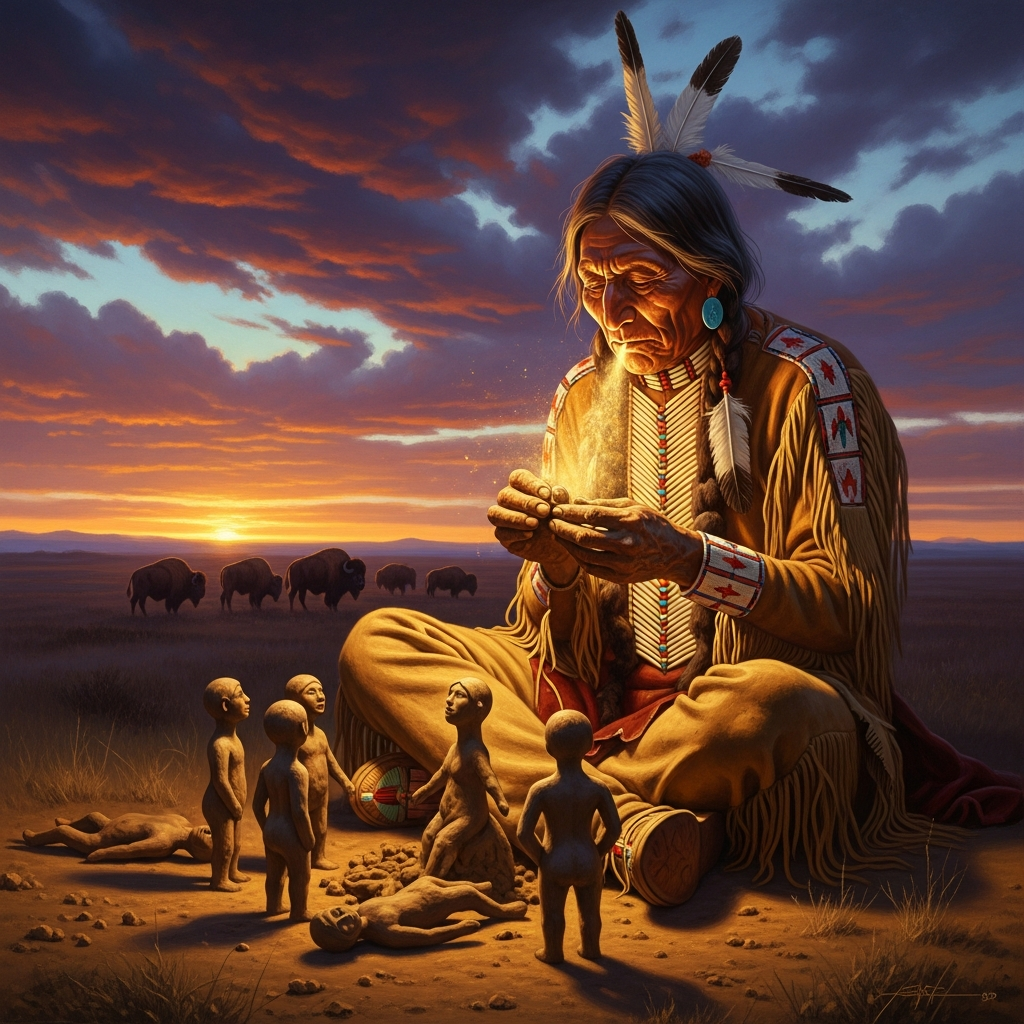
Old Man — Napi — walks alone across the empty earth before there are people. He shapes the buffalo, paints the elk, sets the rivers running, gives each animal its instructions. Then he kneels by a riverbank and forms a man and a woman from clay. He breathes on them. They wake. He teaches them how to live, what to fear, and what game to hunt — and then he walks westward into the mountains, promising he will return.
- When
- timeless (oral tradition)
- Where
- The northern Great Plains — the rolling grass country of present-day Montana, Alberta, and Saskatchewan, where the Blackfoot have lived for thousands of years
Before there were people, there was Old Man.
The Blackfoot call him Napi. The name has been variously translated — Old Man, Old One, sometimes Dawn Old Man — and the figure he denotes is not quite like any creator-god in the traditions Europeans were raised on. He is the maker of the world. He is also, in many of the stories, foolish, lustful, vindictive, hungry, sometimes wise, sometimes wrong. He is a creator who is not above the creation. He walks among it, sometimes makes mistakes, sometimes regrets them.
In the beginning, the Blackfoot say, Old Man walked the earth alone.
The earth was already here. He had not made it; it had always been here, or he had emerged onto it from somewhere else, or it had been here longer than he had been keeping track. The earth was rolling and grassy. There were rivers. There were mountains, far to the west, where the Rockies are. There was sky. There was sun. But there was no movement. No animals. No people. The wind moved the grass. Otherwise, nothing.
Napi looked at this empty fertile world, and the work was obvious to him. The world needed inhabitants.
—
He started with the smallest animals.
He shaped, in some accounts, the field mice first — pinching them out of the wet earth at the edge of a creek, breathing on them, watching them scurry into the grass. Then ground squirrels. Then prairie dogs. He liked the small busy creatures and made many of them.
He worked his way up. Hares. Foxes. Coyotes — and the coyote was his particular project, because he gave the coyote, in some Blackfoot traditions, a portion of his own trickster nature. Wolves. Bears. He made the elk, with high carved antlers and slender legs. He made the deer, smaller and shyer.
He made the buffalo last among the four-legged.
He made the buffalo carefully. He had been thinking about it. The buffalo, he had decided, was going to be the central animal of the prairie — the keystone, the foundation of everything that lived here. He shaped it large. He gave it a great hump of muscle on its shoulders so it could push through deep snow. He gave it a thick coat that grew shaggy in winter and thinned in summer. He gave it a tongue blue from the alkaline grass it would eat. He set it on the prairie and stepped back.
The buffalo lifted its head. It looked at him. It bellowed.
The bellow rolled across the empty plain. Napi was pleased.
—
He made birds.
He set them in the air. He gave each one a different song so the prairie would never be silent. He made the meadowlark with its yellow breast and its bright clear whistle, and the meadowlark, in some Blackfoot stories, became Napi’s favorite — the bird he listened to in the long afternoons.
He made fish. He filled the rivers and lakes.
He made insects, somewhat reluctantly — the texts hint that Napi did not entirely like the mosquitoes he had made and considered, late, redoing the design — but he kept them, because everything needed to eat.
He made plants. He had already made grass, which was here from the beginning, but he added the trees: the cottonwoods that line the prairie rivers, the lodgepole pines on the foothill slopes, the wild plums and chokecherries that bear fruit in late summer. He made the prairie turnip, the camas root, the wild onion, the bitterroot — the foods the Blackfoot would later harvest by the long bone-handled digging stick.
He made the world.
When he had finished, he sat down on a hill and looked at it. The sun was setting. The buffalo were grazing in herds across the bottoms. The wolves were trotting along the ridges. The meadowlarks were calling from the grass. The rivers were running. He had been at work for what felt, to him, like a great while.
The world was finished, except for one thing.
—
He had not made humans.
He went down to a riverbank, where the soil was wet and red, and he sat down beside it. He took up a handful of the wet clay. He began to shape it.
The Blackfoot stories give him, here, the most attentive moment of the whole creation. He had made the buffalo carefully; he made humans even more carefully. He shaped a head. He shaped two arms. He shaped two legs. He pressed eyes, mouth, ears. He stood the figure up to dry beside him. He made a second figure — a woman — opposite the first. He shaped her differently in the small ways that the bodies of women are different, and stood her up beside the man.
He waited until they were dry.
He bent down close to the man’s face and breathed.
The man’s chest moved. His eyes opened. He blinked.
Napi turned to the woman and breathed on her. She woke too.
The two of them looked at each other, then at Old Man.
—
He sat with them for a long time. He had to teach them everything.
He showed them how to recognize fire and how to make it from the flint stones and the dry tinder. He showed them how to make weapons: the flint-tipped spear, the bow that he had to whittle the prototype of right there to demonstrate, the arrow with feathers fletched on it. He showed them which plants were food and which were medicine and which would kill them. He showed them which animals could be hunted and which were dangerous to hunt. He told them, particularly, about the buffalo: how to track it, how to butcher it, how to use every part — the meat for food, the hide for tipi covers, the bone for tools, the sinew for thread, the horn for cups, the hooves for glue, the hair for ropes, the dung for fuel where wood was scarce. The buffalo, he said, would be your central relative on the prairie. Treat the animal with respect. Take only what you need. Sing to its spirit when you kill one. The buffalo will keep your people alive.
He taught them the names of the constellations. He pointed out the Bear and the Hand and the Bunched Stars. He explained the seasons. He explained how to read the smoke for weather.
He taught them the songs.
This is one of the most distinctive features of the Blackfoot Napi tradition. Napi is the giver of the songs. Each ceremony, each dance, each ritual that the Blackfoot perform was, in the deepest tradition, taught by Napi himself or by an animal-spirit acting under his instruction. The Sun Dance, the Pipe Ceremony, the Beaver Bundle ceremony, the Medicine Lodge — all of these have, in their oral histories, an account of how Napi or his envoys taught them to the first people. The songs are not invented. They are transmitted. The original transmission was Napi’s.
He taught them how to bury their dead. He taught them how to mourn. He taught them how to marry, how to raise children, how to organize the camp circle when a band moved.
He taught them, finally, who he was. He told them, I am Old Man. I made all this. I made you. I will not stay with you. I have other work.
—
He stood up. The man and woman watched him.
He turned westward. He began to walk. He walked across the prairie toward the line of mountains in the far distance — the Rockies, blue with snow even in summer.
The first man called after him: Old Man, where are you going? When will you return?
Napi did not turn around.
He said, over his shoulder: I am going west. I will return. When the times are very hard, look for me. I will come back.
He walked into the foothills. He walked up into the higher passes. He disappeared into the mountains.
The first man and the first woman stood on the prairie watching him go. When his shape was no longer visible, they looked at each other. They took each other’s hands. They walked back to the camp Napi had taught them to build, and they began the long work of being the first humans.
—
The Blackfoot have been on the northern plains for at least the last several thousand years, by archaeological reckoning. They were on the prairie when the first French traders came up from Quebec in the 1730s, when the first Lewis and Clark party crossed in 1805, when the buffalo herds were in the tens of millions, and when the buffalo herds were exterminated by the U.S. and Canadian governments in the 1870s and 1880s as a deliberate policy of starving the Plains Indians.
Through every phase of this, the elders kept telling the story of Napi. They kept telling it through the great smallpox epidemics. They kept telling it through the loss of the buffalo. They kept telling it through the reservation period, through the boarding schools that punished children for speaking Blackfoot, through the long twentieth-century erosion of the language. Many of the stories were written down in English by anthropologists — George Bird Grinnell in 1892, Clark Wissler in 1908, others — preserving them for the time when the Blackfoot themselves would reclaim them.
In the late twentieth century and into the twenty-first, that reclamation has been underway. Blackfoot-language schools on the reservations of Montana and Alberta now teach the Napi stories in the original language. Children at the Piegan Institute in Browning, Montana, learn the cycle of stories — Napi making the world, Napi tricking the buffalo into a corral, Napi getting his head stuck in an elk skull, Napi making a deal with the sun — in Blackfoot, sitting on the floor of a classroom, an elder telling them the way the stories were always told.
Napi did not return at the buffalo’s extermination. He did not return when the children were taken to the boarding schools. He did not return when the language was nearly lost. The promise I will come back sounds, in modern Blackfoot ears, like a promise that has not yet been kept.
But the elders point out — and this is one of the deeper readings of the myth — that Napi never specified what return would look like. The buffalo herds, slowly, are being restored on tribal lands. The language is being taught again. The ceremonies are being performed again. The young people are coming home from the cities to learn what their grandparents knew. None of this is Napi walking back out of the mountains in human form. But all of it, the elders say, is Napi keeping his word in the way Napi keeps words — sideways, slowly, through the work of those who remember the songs he taught the first man and the first woman on a riverbank, before he turned west and walked into the snow.
Scenes
Old Man Napi walks alone across an empty prairie, his shadow long behind him in the late sun
Napi kneels by a slow river, shaping figures of clay on the bank: a buffalo, an elk, a wolf, a man, a woman
Napi walks westward into the foothills as the sun sets
Echoes Across Traditions
Entities
- Napi (Old Man)
- The First Man
- The First Woman
- The Buffalo
Sources
- Oral traditions of the Blackfoot Confederacy (Siksika, Kainai, Piikani, Aamsskáápipikani)
- George Bird Grinnell, *Blackfoot Lodge Tales* (1892)
- Clark Wissler & D. C. Duvall, *Mythology of the Blackfoot Indians* (1908)
- Percy Bullchild, *The Sun Came Down: The History of the World as My Blackfeet Elders Told It* (1985)


