Rashnu Weighs the Soul
After every death — and at the final judgment at the Frashokereti · The Chinvat Bridge — the cosmic threshold between material and spiritual existence
Contents
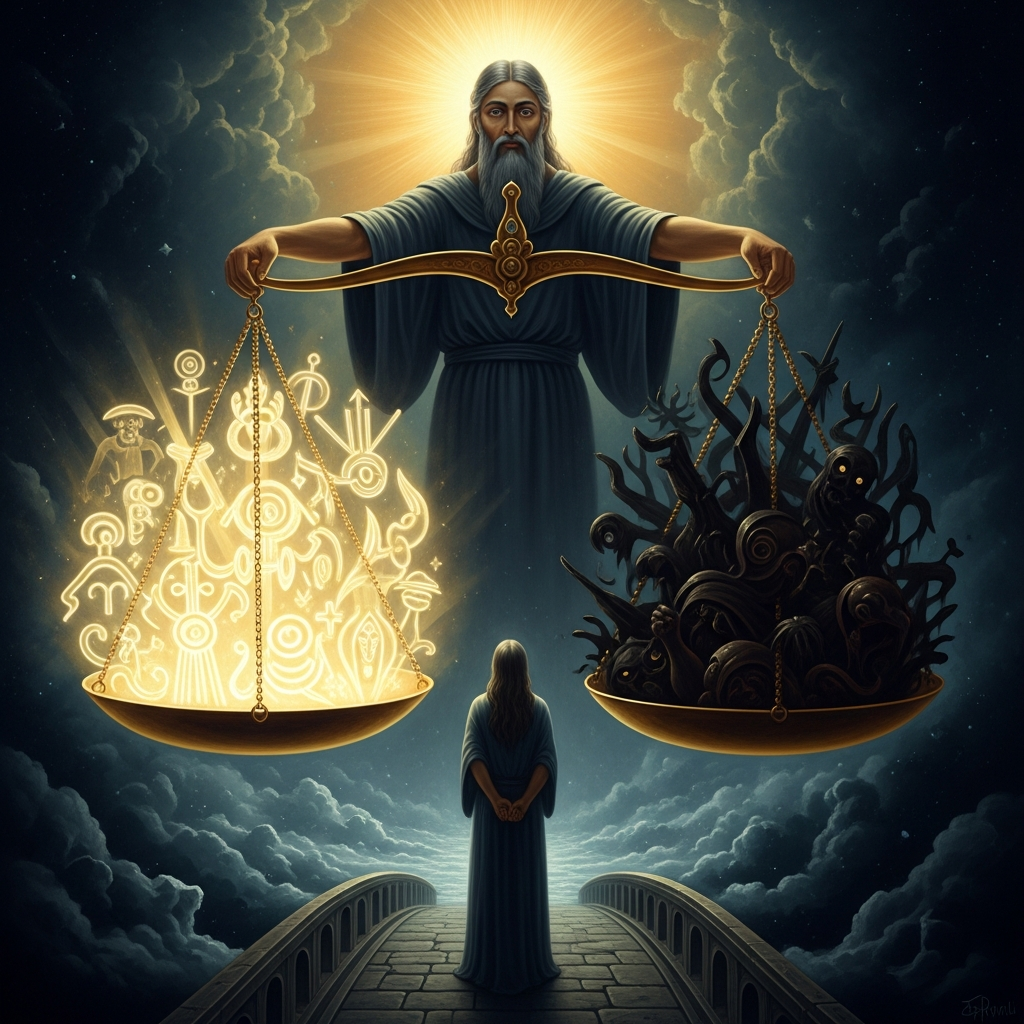
At the Chinvat Bridge, the yazata Rashnu holds the golden scales on which every soul's deeds are weighed — not with mercy or severity but with perfect justice, because the scales cannot lie and Rashnu cannot be moved by pleading.
- When
- After every death — and at the final judgment at the Frashokereti
- Where
- The Chinvat Bridge — the cosmic threshold between material and spiritual existence
The scales are made of gold.
This is not wealth — Rashnu has no use for wealth. The gold signifies something else: incorruptibility. Gold does not rust, does not tarnish, does not change its weight with the weather or the season. The scales made of gold are the instrument of measurement that is what it is, always, without variation. They cannot be bribed because they are not conscious of the offer. They cannot be moved by weeping because they respond only to mass.
Rashnu is the yazata of justice — absolute, exact, unemotional justice. He is not cruel. He is not indifferent to the suffering of the souls he judges. He simply cannot be moved from accuracy by any consideration that is not accuracy. When a soul approaches him at the Chinvat Bridge, he weighs it. He weighs the good deeds against the bad deeds. If the good deeds outweigh the bad, the soul crosses. If the bad deeds outweigh the good, the soul falls. If the two sides are exactly balanced — and the tradition takes seriously the possibility of exact balance — the soul goes to the Hamestagan, a middle place, neither heaven nor the House of Lies, to wait for the final renovation.
He cannot grant exceptions.
This is the point that the tradition makes most insistently about Rashnu: no prayer, no intercession, no post-mortem repentance can change the reading of his scales. Not because he is unmerciful — the tradition does not portray him as taking satisfaction in negative verdicts — but because his scales register reality, and reality cannot be changed by wishing. The soul that stands before him has already lived its life. The deeds are what they are. The scales report what they weigh.
The three judges — Mithra, Sraosha, and Rashnu — operate differently.
Mithra observes covenants: he records every promise made and broken, every oath sworn and violated, every treaty honored or betrayed. His record is comprehensive because he has ten thousand eyes and has been watching. Sraosha hears the soul’s inner reality — the alignment between profession and practice, the tone beneath the words. Rashnu weighs the deeds themselves, the actual material consequence of the choices made.
Together they constitute a complete accounting. There is no dimension of a human life that escapes these three observers: not the private promise, not the public action, not the inner intention.
The weighing of the heart in the Egyptian tradition — the heart placed on one pan of the scales, the feather of Ma’at on the other — is structurally almost identical to what Rashnu does. The difference is the symbol: the Zoroastrian scales weigh deeds directly, without the need for a symbolic object that represents the moral weight. The deeds themselves have weight. Good thoughts, good words, good deeds weigh more than bad thoughts, bad words, bad deeds. The spiritual physics of the cosmos directly registers moral reality.
This is, in a sense, the entire Zoroastrian ethical system compressed into an image.
Everything you do, think, and say has weight. The weight is real, not metaphorical. It accumulates. It is perfectly recorded. It is perfectly measured by an instrument that cannot be deceived or moved. The only variable you control is what you put on the scales before you reach the bridge.
This is not a cause for despair — the tradition is not designed to produce despair. It is a cause for clarity. The scales do not require you to be perfect. They require your aggregate choices to tend toward goodness, which is a different demand: patient, cumulative, allowing for failure as long as the failure is not the dominant pattern.
Rashnu holds the scales in his hands and waits.
He has always been there and he will always be there and every soul that has ever died has come to him in the end.
The scales tell the truth.
That is their only function and it is sufficient.
Echoes Across Traditions
Entities


Sources
- Avesta, *Yasna* 1 and the cosmological texts
- Mary Boyce, *A History of Zoroastrianism*, Vol. I (Brill, 1975)
- Prods Oktor Skjærvø, *The Spirit of Zoroastrianism* (Yale, 2011)
- Shaul Shaked, 'Mizan,' *Encyclopædia Iranica* (2004)