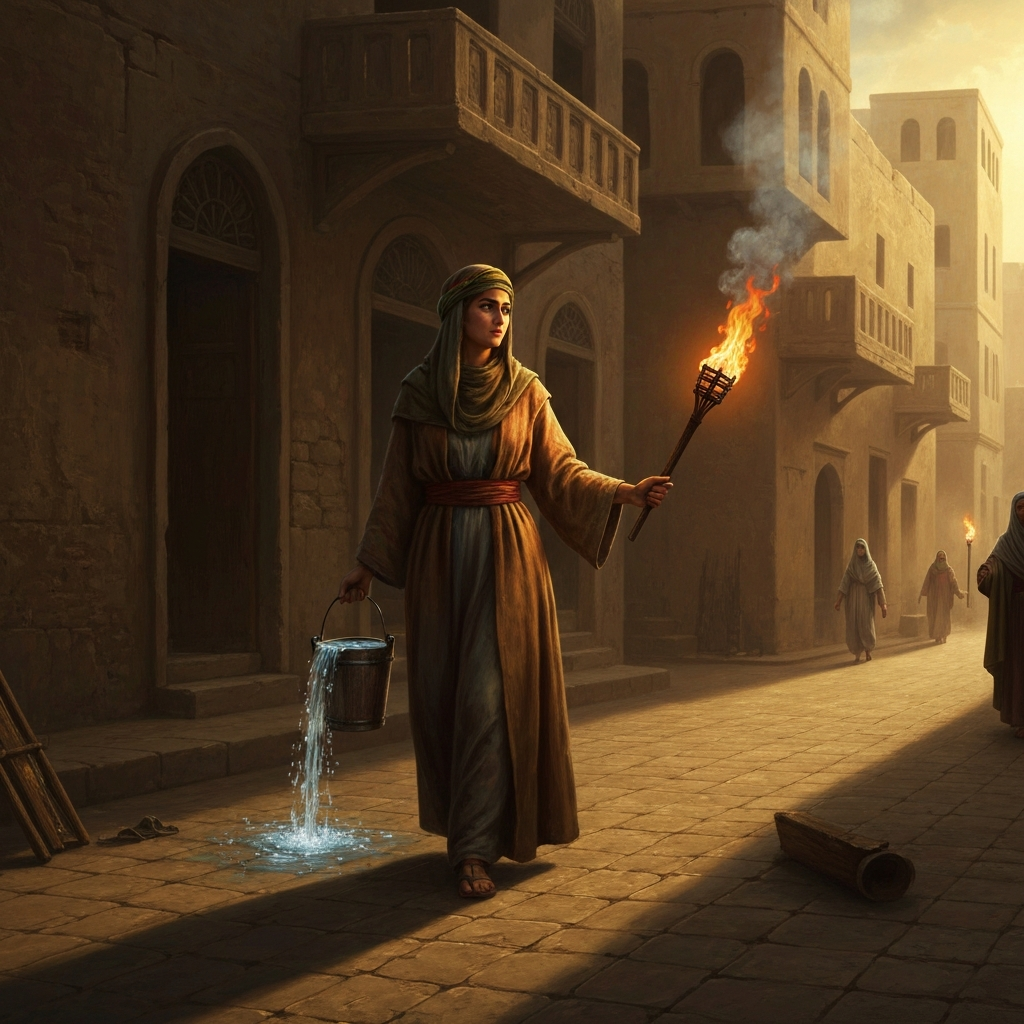
The Dervish Who Owns Nothing and Lacks Nothing
8th–10th century CE — the formative period of Sufi poverty teaching · Basra, Khurasan, and the roads between them — the geography of early Sufi wandering
Contents
The Sufi concept of faqr — spiritual poverty — is not destitution but the interior condition of needing nothing except God. The dervish who owns nothing owns everything; the one who needs nothing receives everything. Poverty is the richest station on the path.
- When
- 8th–10th century CE — the formative period of Sufi poverty teaching
- Where
- Basra, Khurasan, and the roads between them — the geography of early Sufi wandering
The Prophet said: My poverty is my pride.
This hadith — whether authenticated in the traditional sense or not — became the theological foundation for the entire Sufi doctrine of spiritual poverty. The implications are deliberately paradoxical. Pride in poverty means: the quality of having nothing to show God, no achievements, no stored merit, no property in the soul, is the quality that makes approaching God possible. The full vessel cannot be filled.
Faqr is Arabic for poverty, from the same root as faqir, the poor one, which in Persian becomes fakir and in Turkish becomes dervish — from darwish, a doorway person, someone at the threshold between having and not-having. The vocabulary of all three languages converges on the same image: the person without property.
But the Sufi masters are insistent that faqr is not about material possessions in the first instance. A wealthy person can have faqr. A destitute person can lack it entirely.
The distinction the masters draw is between needing things and owning them.
The ordinary human being — and the ordinary religious person is included in this — relates to the world through need. I need security, so I accumulate property. I need recognition, so I perform virtue. I need certainty, so I accumulate theological knowledge. I need love, so I secure relationships. All of these needs drive the accretion of a self that is constantly trying to fill itself.
Faqr is the dissolution of the needs. Not the fulfillment of the needs — their dissolution. The dervish who has faqr does not satisfy the need for security by finding security; he discovers that the need itself was based on a misunderstanding about what he is. The self that needed to be protected was not the real self. When the real self is discovered — the self that is already, always, in God — the needs that were driving the accumulation dissolve. And the dissolution of needs is experienced as a fullness that the accumulation never produced.
This is the paradox the masters are describing: my poverty is my pride. I am proud of having nothing to protect, nothing to maintain, nothing to lose. And the freedom that comes from having nothing to lose is the richest condition a human being can inhabit.
Rabia of Basra demonstrates faqr in her material life, but the masters are careful to say the material is only the sign.
She lives in a house with a clay jug, a mat, and a brick for a pillow. When people bring gifts, she distributes them before nightfall. When people offer money, she returns it. She spins wool and lives on what the wool earns. The poverty is real. But the tradition does not hold it up as a model because it recommends destitution. It holds it up because the destitution is evidence of the interior condition. A person who genuinely has faqr — who genuinely needs nothing except God — finds no reason to maintain the appearance of prosperity. The material poverty is the material fact of the interior poverty.
The masters also know the danger of the opposite error: using material poverty as a spiritual credential. The dervish who is proud of having nothing has converted spiritual poverty into spiritual wealth — he now has something (his spiritual achievement) that he is protecting and displaying. This is faqr performed, not faqr lived.
The test the masters use: when the dervish is given something, do they take it easily and give it away easily, or do they perform the refusal? The one who has faqr is not attached to having nothing any more than to having something. The one who performs faqr is attached to the performance of having nothing. The difference is visible to anyone who looks.
The Prophet’s phrase — poverty as pride — enters the tradition as both foundation and warning.
Every generation of Sufi teachers inherits it and has to decide what it means for their particular students in their particular circumstances. The traveling dervishes of the tenth and eleventh centuries, wandering from city to city with nothing but their robes, were demonstrating a material faqr that the institutionalized orders of the thirteenth century — with their lodges, their endowments, their political connections — could no longer claim in the same form.
The masters of the institutionalized period argued: faqr is interior and can coexist with any material circumstance. The radical wandering dervishes argued: interior faqr that does not show in any material consequence is probably not real.
Both positions are right about something.
The vessel that can receive everything is the vessel that holds nothing of its own.
The question is only whether the holding-nothing is real or performed.
Echoes Across Traditions
Entities
- Rabia al-Adawiyya
- Ibrahim ibn Adham
- unnamed wandering dervishes of the tradition
Sources
- Annemarie Schimmel, *Mystical Dimensions of Islam* (UNC Press, 1975), chapter on poverty
- Paul Nwyia, *Exégèse coranique et langage mystique* (Dar el-Machreq, 1970)
- Sara Sviri, 'The Early Mystical Schools of Baghdad and Nishapur' in *History of Islamic Philosophy* (Routledge, 1996)
- Seyyed Hossein Nasr, *Sufi Essays* (SUNY Press, 1991)