Contents
For eight years Mansur al-Hallāj is imprisoned in the Round City of Baghdad, awaiting execution. The guards report that his cell fills with light at night. Other prisoners are healed. He dictates poems through the bars. The prison cannot contain what he is.
- When
- 913–922 CE — Baghdad, the Abbasid Caliphate, under Caliph al-Muqtadir
- Where
- Baghdad, Iraq — specifically the Dar al-Sultan prison in the Abbasid Round City
The arrest comes at the end of a long campaign.
Al-Hallāj has been a traveling preacher for decades — moving through Khurasan, India, and the Hijaz, gathering followers, saying things that the authorities of mainstream Islam find increasingly dangerous. The words Ana al-Haqq — I am the Truth — are already attached to his name by the time he arrives back in Baghdad. The Vizier Ali ibn Isa has been watching him. In 913 CE, the order comes: arrest him.
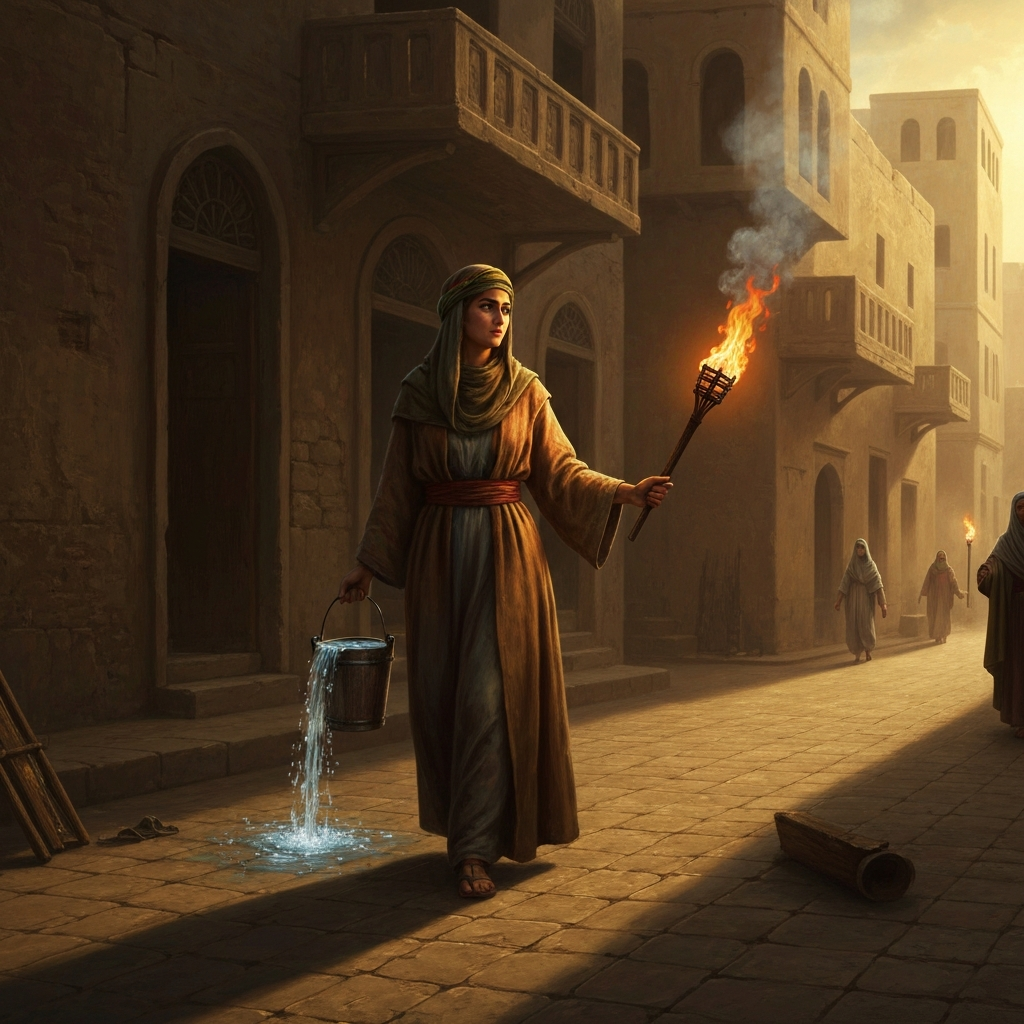
He is brought to the Dar al-Sultan, the state prison in the center of Baghdad’s Round City. He is forty-seven years old. He will be there for nine years before he is executed.
What the hagiographers record about those nine years is not a story of diminishment.
The first miracle the guards report is the light.
At night, when the other prisoners are asleep and the corridor is dark, the cell where al-Hallāj is confined fills with a white radiance that has no apparent source. No lamp. No fire. The light comes from the man. Guards who encounter it first approach with the intention of reporting it as a trick — reflected moonlight, some contraband fire-making material. They examine the cell and find nothing. The light is there or it isn’t, and when it is there, the man in the cell is awake and praying and does not acknowledge the guards at all.
This gets reported up the chain. The Vizier is told. The investigation produces nothing concrete. Al-Hallāj remains in the cell.
The second report concerns the other prisoners. There are people in that prison — ordinary criminals, political prisoners, debtors — who begin to recover from illnesses after al-Hallāj prays over them through the bars. The healings are not dramatic in the accounts, not sudden and spectacular, but persistent: a man who had a fever for weeks breaks it after al-Hallāj’s prayer. A man with a suppurating wound finds it healed. The prison population begins to regard the mystic in the far cell as a kind of physician.
The most consequential accounts are not the miracles. They are the conversations.
In nine years of imprisonment, al-Hallāj continues to teach. People come to the prison specifically to question him. Guards relay questions from visitors. Sympathizers on the outside — and there are sympathizers, including high-placed ones, even among those who have condemned his words — send notebooks and ink so he can write. The Sufi tradition preserves a number of his prison compositions: quatrains and ghazals written in what is now called his prison period, some of the most intense mystical poetry in Arabic.
The poems address themes that are not surprising given his situation: the dissolution of the self in divine love, the indifference to pain, the logic of the mystic’s position. The most famous prison poem begins: Kill me, my faithful friends, for in my killing is my life. It continues: My death is my living and my living is my death. This is not metaphor. Al-Hallāj is describing the state he has been in for years — what the Sufis call fana, annihilation of the personal self in the divine — as a permanent condition. He cannot be killed because the thing that would be killed is already gone. He is already only God, and God cannot be executed.
The theological establishment finds this claim blasphemous. The mystical tradition finds it the deepest possible statement of the Sufi path. Both are using the same word — fana — and meaning different things by it.
The Vizier who arrested him dies. A new administration arrives. The political currents shift. For years the sentence is in suspension — there are factions at the Abbasid court that want to execute al-Hallāj and factions that consider this a dangerous overcorrection. The prisoner sits in his cell and lights up the corridor at night and heals the sick and writes poems about dying into God.
He is finally brought to trial in 922, nine years after his arrest. The charges are heresy and subversion. The evidence is his public statements and his followers’ devotion. He is condemned.
The night before his execution, one of his students reportedly asks him: what is love? He replies: You will see it today, and tomorrow, and the day after. He means: today, execution. Tomorrow, martyrdom. The day after, the teaching spreads because death could not stop it.
The prison could not contain the light. The execution will not contain the words.
Kill me, my faithful friends.
He knew what was coming. He had been naming it for years.
Echoes Across Traditions
Entities
- Al-Hallāj
- Vizier Ali ibn Isa
- the Baghdad prison guards
- the Caliph al-Muqtadir
Sources
- Louis Massignon, *The Passion of al-Hallaj: Mystic and Martyr of Islam* (Princeton University Press, 1982)
- Herbert Mason, *Al-Hallaj* (Curzon, 1995)
- Paul Nwyia, *Ibn Abbad de Ronda et al-Hallaj* (Dar el-Machreq, 1972)
- Carl Ernst, *Words of Ecstasy in Sufism* (SUNY Press, 1985)