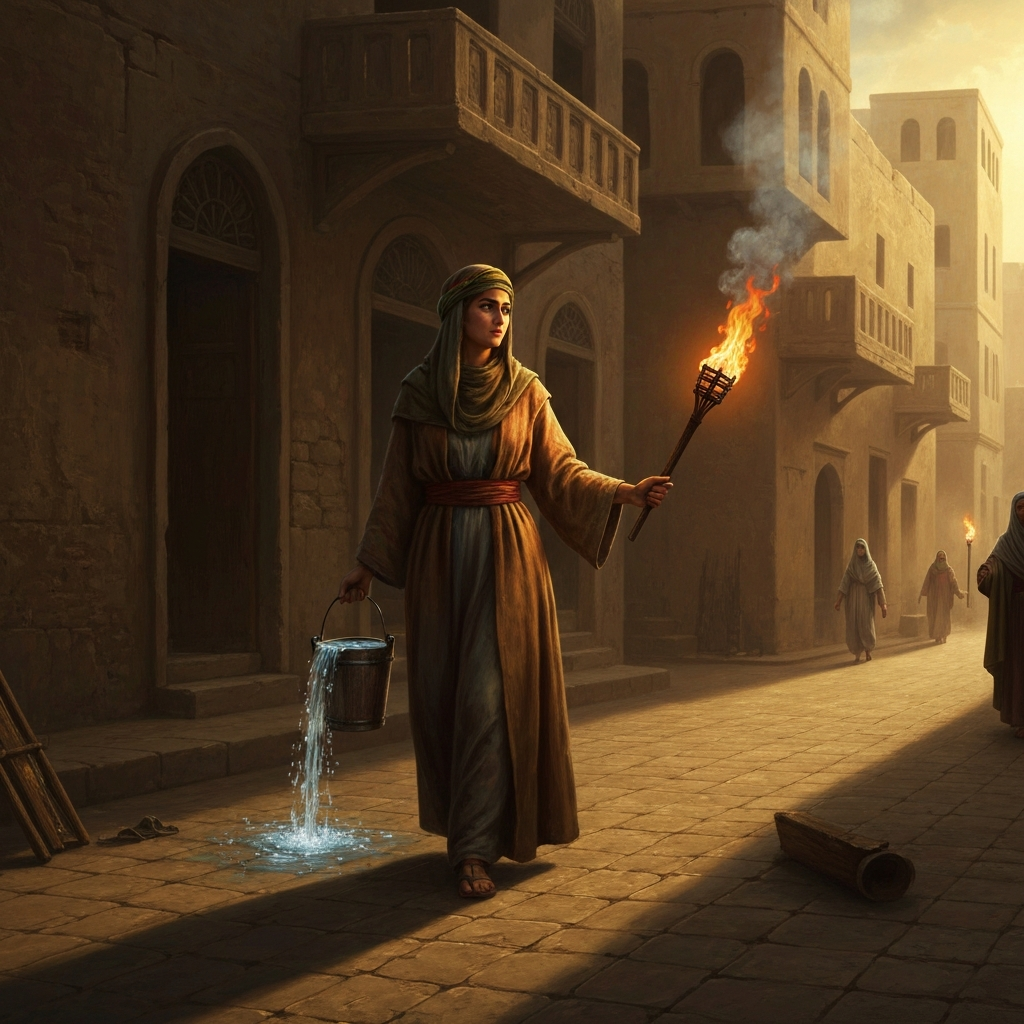
Kashf: The Moment the Veil Lifts
9th–13th century CE — the formative and classical period of Sufi epistemology · Baghdad, Mecca, Damascus — the cities of Islamic intellectual and spiritual life
Contents
Kashf — unveiling, the mystical disclosure through which the hidden realities of the cosmos become visible to the prepared heart — is the Sufi term for the direct perception that lies beyond ordinary religious knowledge, the moment the practitioner sees what the prophets saw.
- When
- 9th–13th century CE — the formative and classical period of Sufi epistemology
- Where
- Baghdad, Mecca, Damascus — the cities of Islamic intellectual and spiritual life
The veil metaphor is Quranic.
God veils Himself from the creation by seventy thousand veils of light and darkness. This hadith — attributed to the Prophet though disputed in its precise form — establishes the structural framework that Sufi epistemology inherits: the divine is present everywhere, but present behind veils. The veils are not deceptions. They are protections — both protecting the creation from an intensity of divine presence that would overwhelm it, and protecting the divine mystery from being reduced to an object of ordinary knowledge.
Kashf — literally unveiling, uncovering — is the process by which veils are removed. Not all at once, not by the practitioner’s own force, but progressively, in proportion to the purification of the heart. As the heart is cleaned of its own obscuring properties — the thick coating of self-interest, distraction, and conceptual overlay that ordinary life deposits — it becomes more transparent to what is always shining through it.
The moment of kashf is the moment a veil lifts and the practitioner sees what was always there but invisible.
Al-Ghazālī, in his Mishkat al-Anwar (The Niche of Lights), performs the most careful Islamic analysis of what kashf reveals.
He works from the famous Light Verse of the Quran (24:35): God is the light of the heavens and the earth. The parable of His light is as a niche wherein is a lamp. He unfolds this verse through multiple layers of interpretation, showing that ordinary religious knowledge — the light of the lamp — is real but limited. Above it is prophetic knowledge, and above that, the direct divine light that is the source of all lesser lights.
His key claim: the mystic who has undergone the purification of the heart and reached the station of kashf is not having a subjective emotional experience. They are perceiving something real — the divine realities (haqa’iq) that ordinary perception cannot register. The veil that separated them from this perception was not on the side of the divine; it was on the side of the perceiver. The practitioner’s own opacity was the obstacle. The kashf is the removal of that opacity.
This is why Ghazālī insists that kashf is a form of knowledge, not merely experience. The prophet’s kashf is knowledge — this is why we trust prophetic revelation. The mystic’s kashf participates in the same epistemological category, even if at a lower degree of completeness and reliability.
Ibn ʿArabī develops the doctrine of kashf into the most elaborate Sufi epistemology.
For Ibn ʿArabī, kashf is not occasional and unpredictable — the random lifting of a veil — but systematic. There is a science of kashf, and the Futuhat al-Makkiyya is largely this science: a map of what becomes visible at each stage of the mystic’s progress, what divine names and realities disclose themselves as the heart is increasingly purified, what the logical structure of the divine self-disclosure looks like when seen from inside rather than from outside.
He distinguishes between different modes of kashf: kashf basari (visual unveiling, the appearance of divine light in visual experience), kashf qalbi (heart-unveiling, the direct intuition of divine realities without visual form), and kashf ruhi (spirit-unveiling, the perception from the deepest level of the soul of the divine at the level of pure Being). Each level corresponds to a depth in the practitioner’s interiority that only becomes accessible at the corresponding station of the path.
The ordinary practitioner experiences kashf in small forms that are perhaps not recognized as kashf.
The moment in prayer when the words cease to be words and become presence. The moment in Quran recitation when the meaning arrives before the words are finished. The moment — Ghazālī describes this carefully — when the practitioner understands something about God or about their own soul that they had not understood before, without any intervening reasoning: the understanding arrives whole, complete, self-evident. This is kashf in its ordinary form.
The veil lifts. A little more is visible. The practitioner returns to the ordinary world with a different orientation — not completely changed but slightly enlarged, carrying something that was not there before.
The path continues. The veils are many.
But the light is the same light on every side of every veil.
That is what kashf shows.
Echoes Across Traditions
Entities
- Ibn ʿArabī
- Al-Ghazālī
- Al-Muhasibi
Sources
- Ibn ʿArabī, *Futuhat al-Makkiyya*, discussion of kashf as epistemological category
- Al-Ghazālī, *Mishkat al-Anwar* (The Niche of Lights), the key text on mystical light and perception
- William Chittick, *The Sufi Path of Knowledge* (SUNY, 1989)
- Alexander Knysh, *Islamic Mysticism: A Short History* (Brill, 2000)