Odin on Yggdrasil: The God Who Sacrificed Himself to Himself
Eddic sources compiled c. 1220-1270 CE from oral traditions reaching back to the Migration Age, c. 300-700 CE · Yggdrasil, the World Tree; the well of Mimir at one of its roots; the spaces between the nine worlds
Contents
Odin hangs himself on the World Tree for nine days, stabbed with his own spear, neither fed nor given water, to win the runes — the cosmic alphabet that is also the structure of reality.
- When
- Eddic sources compiled c. 1220-1270 CE from oral traditions reaching back to the Migration Age, c. 300-700 CE
- Where
- Yggdrasil, the World Tree; the well of Mimir at one of its roots; the spaces between the nine worlds
The stanza is in the Hávamál, the “Sayings of the High One.” Odin is speaking in the first person.
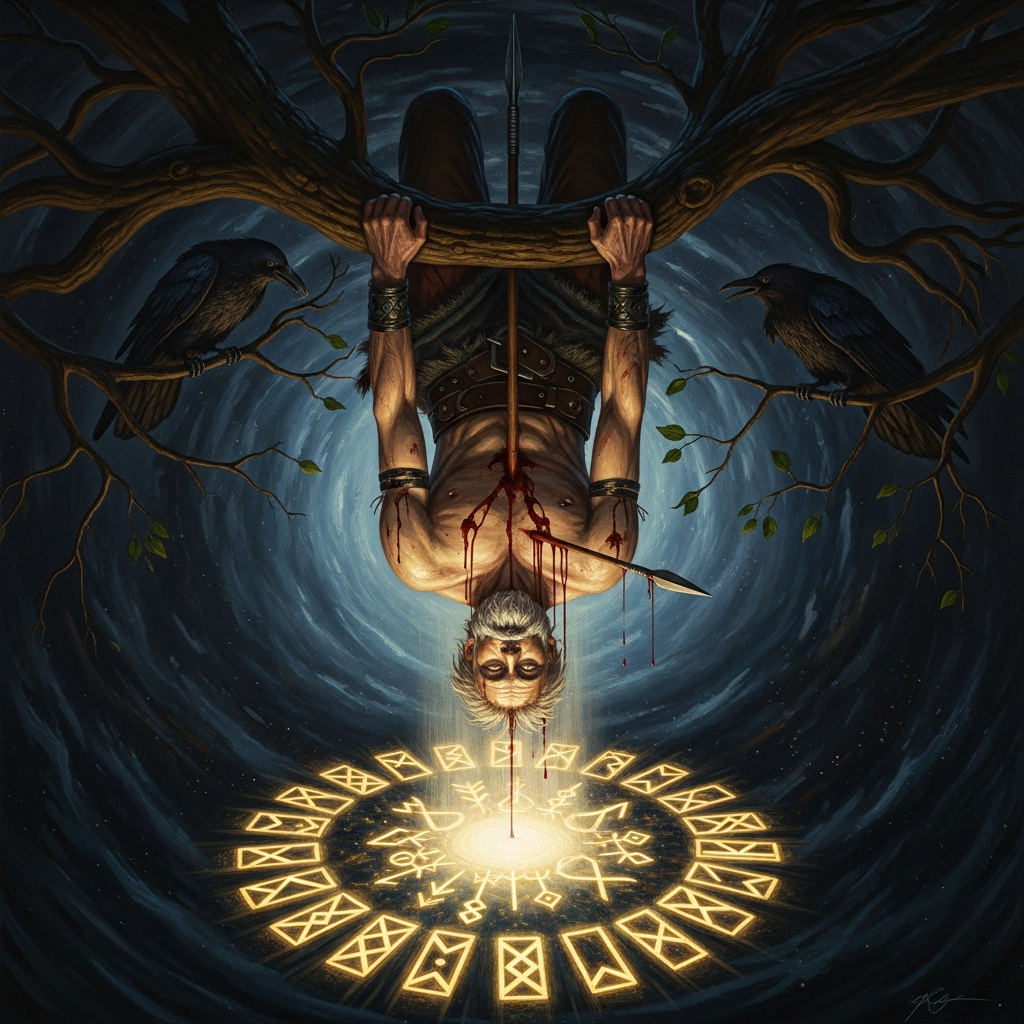
I know that I hung on the windswept tree / for nine whole nights, / wounded with a spear, dedicated to Odin, / myself to myself / on that tree of which no man knows / from what roots it grows.
I was given neither bread nor drinking horn. / I looked downward. / I took up the runes. / Screaming, I took them. / I fell back from there.
Nine lines. Every line is strange. The god is narrating his own death with a calm that the stanza form enforces: alliterative, measured, a meter designed for wisdom rather than drama. He hung. He was not fed. He looked down. He screamed. He fell back. The runes came to him in the falling.
Yggdrasil is not a tree in any ordinary sense.
Its name means either “the horse of the Terrible One” (Ygg being one of Odin’s names, and drasil meaning horse — the Old Norse kenning for a gallows was “the horse of the hanged man”) or simply “the great world tree.” Both readings are probably intended. The tree is the cosmos. It grows from three roots: one in Asgard, the realm of the gods; one in Jotunheim, the realm of the giants; one in Niflheim, the realm of the dead. At each root there is a well.
At the root in the realm of the dead sits the dragon Nidhogg, gnawing. At the root in Jotunheim sits Mimir, the wisest being in all nine worlds, drinking from his well. Odin has already been to Mimir. He paid for a single drink from the well of wisdom with one of his own eyes. He pressed the eye out and dropped it in the water and drank, and ever since he wears a wide-brimmed hat pulled over one side of his face.
This is Odin’s method: he gives pieces of himself for knowledge. The eye for Mimir’s well. The hanging for the runes. In some sources he gives other things, suffers other ordeals, on the same terms. He does not value his body over what the body’s sacrifice can purchase.
Why does a god need to sacrifice himself?
The runes are not ordinary knowledge. They are not information that can be transmitted by a teacher or written down in a library. They are the fundamental structure of reality — the patterns underlying all things, the actual operating code of the cosmos. The way to understand this in modern terms: not the description of physics but physics itself, not the map but the territory, not the words for fire but fire.
The runes can only be found at the threshold of death because that threshold is the only place where the barrier between the knower and the known dissolves. As long as Odin is the king of Asgard, sitting on his throne in Valhalla with his ravens Huginn and Muninn (Thought and Memory) on his shoulders, he knows what thought and memory can know. That is a great deal. It is not enough.
To know the runes, he must be at the place where thought and memory give out.
The hanging achieves this by degrees. After one day without food and water, thought begins to fray. After three, memory becomes unreliable. After nine, the distinction between the self and the world around it grows porous. The tree is not separate from the man on it anymore. The nine worlds the tree connects are not separate from each other.
And in that state, looking down — down past the roots, toward the deepest root in Niflheim where Nidhogg gnaws — the runes rise up.
The runes he discovers are not merely letters. In the Norse understanding, each rune is an entity — a force, a quality, a power with its own name and nature. Fehu is cattle and wealth. Isa is ice and stillness. Tiwaz is the sky-god’s sacrifice (Tyr, who put his hand in the wolf’s mouth and lost it). Algiz is protection. Dagaz is the dawn. There are twenty-four in the Elder Futhark, and together they cover the primary forces of existence.
To know a rune is to know the force it names — not as a student knows a definition but as a craftsman knows a material. Odin, after his hanging, can carve runes into wood, into stone, into a corpse’s tongue to make it speak. He can carve runes onto a cup to detect poison. He can carve runes onto a battlefield to determine the outcome before it begins.
But the runes are not personal power. That is the point of the sacrifice. He did not get the runes by being Odin — by virtue of his rank or his strength or his previous wisdom. He got them by ceasing, for nine days, to be Odin. He got them by being nobody, wounded, starving, suspended on a tree between worlds, in the exact state where a king is indistinguishable from a corpse.
The sacrifice is the credential. The hanging is the only credential the runes accept.
The one-eyed god, the hanged god, the god of the wild hunt who rides eight-legged Sleipnir through the sky — Odin accumulates his power through a series of losses. The eye. The nine days. The son Baldr, whom he cannot save from death. The world, which he knows will burn at Ragnarok. He knows all of this in advance. The runes have told him.
He prepares anyway. He collects warriors in Valhalla. He trains them. He is building an army for a battle he knows he will lose, at which he knows he will be swallowed by the wolf Fenrir, at which the world will end.
This is not despair and it is not denial. It is the Norse category of courageous doom — the quality that makes the Viking funeral pyre make sense, that makes the hero Ragnar Lothbrok laugh in the snake pit. The correct response to a fate you cannot change is not to flinch from it. The correct response is to face it with your eyes open.
Both eyes, now — though one is in Mimir’s well.
The wisdom that cost Odin his eye was worth one drink. The wisdom that cost him nine days on Yggdrasil was the structure of reality itself.
He did not begrudge the price. The Hávamál, the poem where he narrates the hanging, is also a practical wisdom text — a collection of maxims, advice on hospitality, friendship, love, the proper management of a life. It does not have the tone of a god looking down at humanity. It has the tone of someone who paid enough to know.
The runes came to him screaming.
He says so himself, in the first person, in the eight-hundred-year-old poem.
He screamed. He fell back. He had them.
The question the myth asks is the question every tradition asks about wisdom: how much of yourself do you have to give up to find out what is actually true? Odin’s answer is that you have to give up everything, including the self that was asking the question, and then fall, and scream in the falling, and the truth will be there at the bottom of the fall waiting for you.
It has been waiting there the whole time.
It could not come to you. You had to come to it.
Echoes Across Traditions
Entities
- Odin
- Mimir
- Yggdrasil
- Huginn
- Muninn

Sources
- Snorri Sturluson, *Prose Edda* (c. 1220 CE)
- Anonymous, *Hávamál* ('Sayings of the High One'), stanzas 138-145, in *Poetic Edda* (compiled c. 1270 CE)
- Saxo Grammaticus, *Gesta Danorum* (c. 1200 CE)
- Hilda Ellis Davidson, *Gods and Myths of Northern Europe* (1964)
- John Lindow, *Norse Mythology: A Guide to the Gods, Heroes, Rituals, and Beliefs* (2001)
- Rudolf Simek, *Dictionary of Northern Mythology* (1993)