Thor in Utgard: The Competitions That Were Lies
Snorri Sturluson's *Prose Edda* composed c. 1220 CE; the underlying oral tradition reaches back to the Migration Age, c. 300-700 CE · Midgard; the giant stronghold of Utgard, somewhere in Jotunheim beyond the eastern wilderness; the road through the primordial forest
Contents
Thor travels to the giant's stronghold Utgard with Loki and two humans. He fails every competition — but the competitions were illusions. He was wrestling Old Age, drinking from the ocean, lifting the Midgard Serpent.
- When
- Snorri Sturluson's *Prose Edda* composed c. 1220 CE; the underlying oral tradition reaches back to the Migration Age, c. 300-700 CE
- Where
- Midgard; the giant stronghold of Utgard, somewhere in Jotunheim beyond the eastern wilderness; the road through the primordial forest
They leave Asgard in Thor’s chariot — the two goats Tanngrisnir and Tanngnjostr pulling it, Loki beside him, and two young humans: a boy named Thialfi, who is the fastest runner alive, and his sister Roskva.
The sky cracks when the chariot moves. People looking up and seeing lightning and hearing thunder are hearing Thor’s journey. That is the source of the storms: the god going somewhere in his chariot, the axle-lightning, the wheel-thunder, the hooves of the goats on the road of the sky.
They travel east. The road eventually leaves the sky and enters Jotunheim — the land of the giants, the wilderness beyond the edge of the world that humans and gods know. The forest is enormous. The trees are larger than the trees in any world Thor has been to. This is the first sign that scale is going to be the subject of this journey.
The first night, they sleep in what they think is a hall with five chambers.
In the morning, they discover it is a glove.
The glove belongs to a giant named Skrymir — so large that when he wakes up and puts on his glove, they are standing next to it, and the glove is the size of a hall. He offers to carry their provisions, ties all the food in his bag, and spends the day walking ahead of them. They try to keep up.
That night, Skrymir falls asleep under an oak and begins to snore. Thor cannot open the food bag — the knots will not give. He tries until his hands hurt. Then he tries to wake Skrymir by hitting him on the head with Mjolnir.
Skrymir wakes and asks if a leaf has fallen on him.
Thor hits him again. Skrymir says he thought he felt an acorn.
Thor hits him a third time with everything he has, the hardest blow he has ever struck. Skrymir wakes up and says there must be birds in the tree above him.
In the morning, Skrymir leaves them directions to Utgard and departs. Later, the myth will explain: Skrymir was Utgard-Loki in disguise, and the three hammer-blows that didn’t wake him made three valleys in the mountains of Jotunheim. The greatest weapon in the Norse cosmos, struck three times at full force, made valleys.
Utgard is a city whose walls are so tall that Thor has to crane his neck back until his headband slips to see the top.
Utgard-Loki is its king. He is enormously large — all the giants here are enormous — and he receives Thor with an attitude of bemused condescension. He has heard of Thor. He asks if any of Thor’s party has a talent that would be worth demonstrating before the giants of Utgard.
Loki goes first.
His talent is eating. He claims he can eat faster than anyone in the hall. Utgard-Loki sets him against a giant named Logi. A long trough of meat is brought in. They eat from opposite ends.
They meet in the middle. Loki has eaten all the meat from his side. Logi has eaten all the meat from his side, plus the bones, plus the trough itself. Loki loses.
Logi, the explanation will come later, was Wildfire. You cannot out-eat fire.
Thialfi races next, against a young man named Hugi. Three races; Thialfi is the fastest runner alive, and he loses all three by increasing margins. Hugi was Thought. You cannot outrun thought.
Then Thor.
Thor’s first contest: drinking from a horn. Utgard-Loki brings a drinking horn and says the good drinkers of Utgard can drain it in one go, the adequate ones in two, the weak ones in three. Thor puts the horn to his lips and drinks with enormous strength and capacity for a very long time.
The horn is not much lower.
He drinks again. It drops slightly.
He drinks a third time, as deep a draught as he can manage, his face red, his chest heaving, and when he sets it down the horn is lower but not empty.
He has failed.
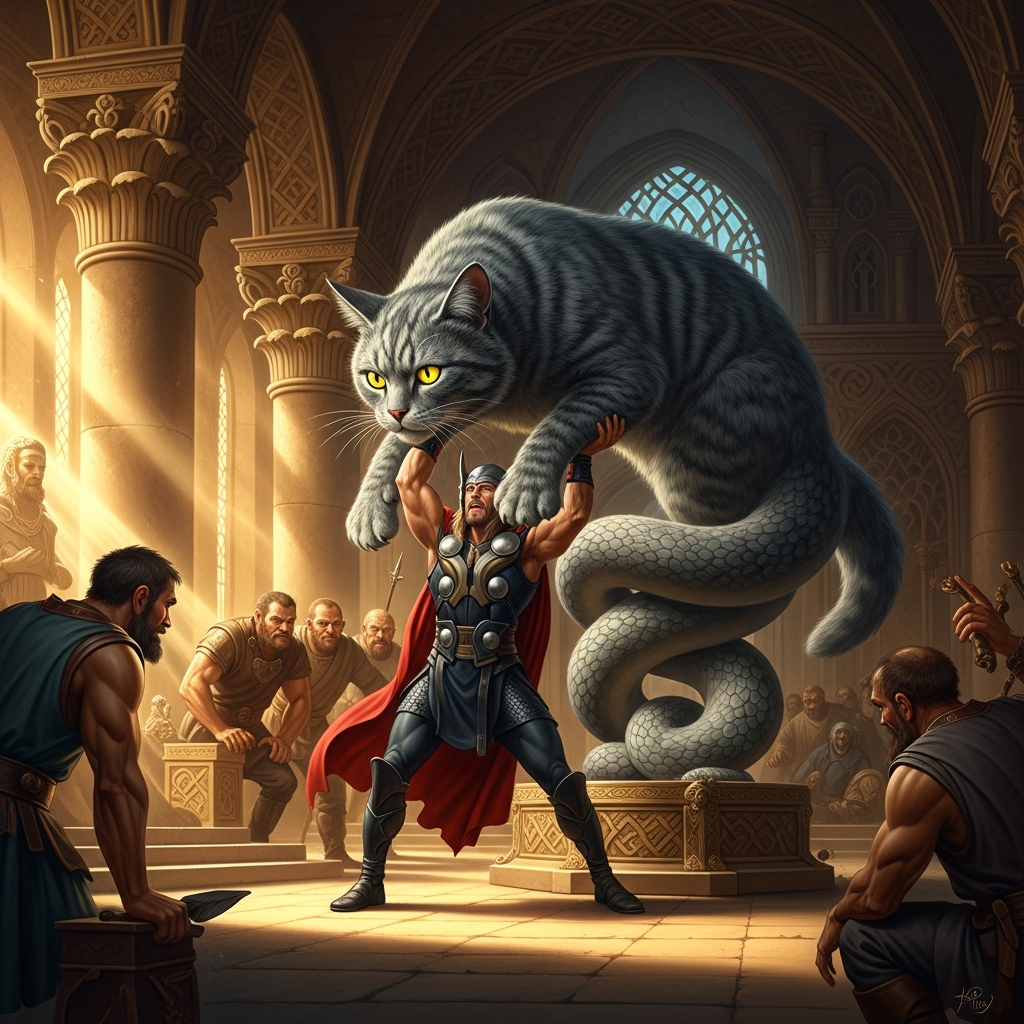
Thor’s second contest: lifting Utgard-Loki’s cat off the floor. Thor grabs the cat and pulls. The cat’s back arches. One paw lifts from the floor. The other three stay down.
He has failed.
Thor’s third contest: Utgard-Loki offers him a wrestling match against an old woman named Elli. She is bent and grey. Thor takes hold of her. He cannot move her. The harder he pushes, the more his footing gives. She drives him to one knee.
He has failed again.
The next morning, as Thor and his party are leaving Utgard, Utgard-Loki walks them to the gate and explains.
He will never allow them back in Utgard, he says. Not because they are not dangerous. Because they are.
The horn was connected to the sea. The lowering Thor achieved in three pulls was the creation of the tides — the ocean has been measurably lower since that night. The cat was the Midgard Serpent, Jormungandr, the serpent that encircles the entire world in the ocean. When one paw lifted from the ground, heaven and earth moved. The gods were terrified watching.
Elli was Old Age. No one defeats Old Age.
As Utgard-Loki finishes the explanation, Thor raises Mjolnir to destroy him. Utgard-Loki vanishes. The city of Utgard vanishes. There is nothing in front of Thor except an empty plain.
He stands on the plain for a moment.
He has drunk three pulls from the ocean and lowered it. He has lifted one paw of the Midgard Serpent — the thing he will not fully defeat until Ragnarok, when he kills it and walks nine steps and falls dead from its venom. He has driven Old Age to a knee before it drove him to one.
He did not win. He came closer than anyone ever has.
The myth is precise about this. It does not say Thor is weak. It does not say the limits are arbitrary. It says: the horn is the ocean, and the ocean is a real thing, and no strength in the cosmos is equal to all of it. The cat is the Midgard Serpent, and the Midgard Serpent is what encircles the world, and to lift it all would be to unmake the world. The old woman is time, and time brings everything to its knee eventually, gods included.
Utgard-Loki’s illusions were not trickery in the pejorative sense. They were scale made perceptible. Thor had to see what he was competing against before he could understand what his competition meant.
Loki, who lost to fire, does not lose face in this story.
This is worth noticing. Loki travels with Thor, loses first, and the story doesn’t use his loss to diminish him. He went first. He ate as fast as any being in the Norse cosmos can eat. He lost to Wildfire, which consumes everything. The competition was honest. The opponent was absolute.
The story’s lesson distributes across all three competitors — the trickster, the swift human, the strongest god — and the lesson is the same for all of them: there are categories of force that exceed any personal maximum. Thought is faster than the fastest runner. Fire consumes more than the most voracious appetite. The ocean is deeper than the strongest thirst. Time outlasts the strongest grip.
The myths about Thor’s strength are all true.
This myth is also true.
Both can be true. The Norse tradition understood this. Strength is real. Its limits are also real. The two truths do not cancel each other.
The sky still cracks when Thor’s chariot moves. He still kills the giants one by one as they threaten the order of the world. He will still kill the Midgard Serpent at Ragnarok, at the cost of his life.
He just knows, now, what the Midgard Serpent actually is.
One paw lifted from the ground.
That is what he moved.
Echoes Across Traditions
Entities
- Thor
- Loki
- Utgard-Loki
- Elli
- Hugi
- Jormungandr
- Thialfi


Sources
- Snorri Sturluson, *Prose Edda*, Gylfaginning chapters 44-47 (c. 1220 CE)
- Hilda Ellis Davidson, *Gods and Myths of Northern Europe* (1964)
- John Lindow, *Norse Mythology: A Guide to the Gods, Heroes, Rituals, and Beliefs* (2001)
- Rudolf Simek, *Dictionary of Northern Mythology* (1993)
- Carolyne Larrington, *The Norse Myths: A Guide to the Gods and Heroes* (2017)