Contents
An inventor builds wings of feathers and wax to escape a labyrinth he himself designed. He warns his son: not too low, not too high. The boy, drunk on flight, climbs toward the sun. The wax melts. The feathers come loose. The sea takes him.
- When
- c. 1400 BCE (mythic time)
- Where
- Crete — the labyrinth at Knossos, the cliffs above the Aegean, the sea between Crete and Sicily
The labyrinth was Daedalus’s idea.
He was the greatest craftsman of his age — Athenian by birth, exiled for murder, taken in by King Minos of Crete because Crete needed what he could build. He built the wooden cow that allowed Pasiphaë, Minos’s queen, to satisfy her unnatural lust for the white bull of Poseidon. The result of that union was the Minotaur — a child with a man’s body and a bull’s head, growing up in the palace.
Minos could not kill it. It was, after all, his wife’s son. So he asked Daedalus to design something that could hold it.
Daedalus built the labyrinth at Knossos. A maze so cunning that anyone entering would never find the way out — even, the legend says, the architect himself struggled to escape. The Minotaur was placed at its center. Athenian youths and maidens, sent as tribute, were periodically pushed in.
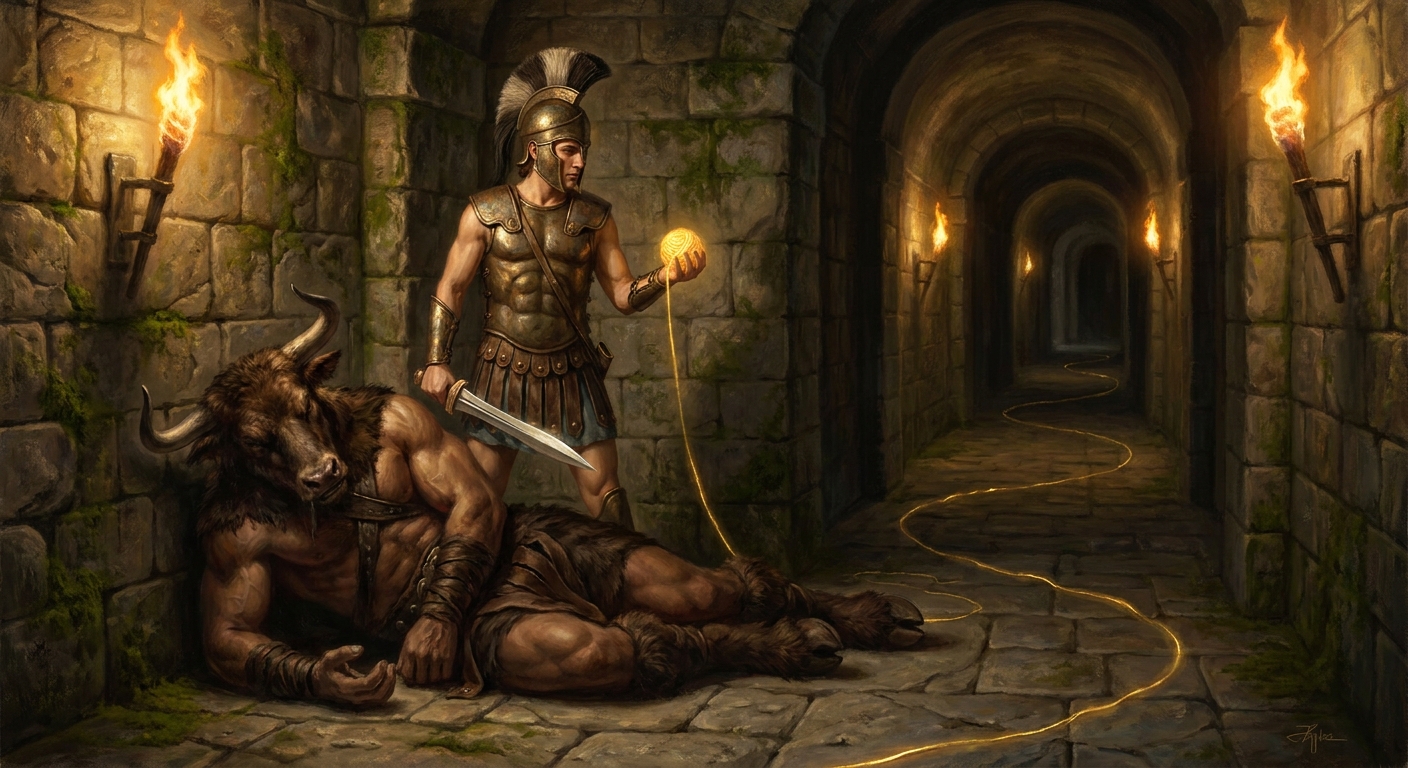
Then Theseus came. Daedalus, sympathetic, gave Ariadne the thread. Theseus killed the Minotaur, found his way out by the thread, and sailed home with the king’s daughter.
Minos was furious. He could not punish his daughter. He could punish the man who had given her the thread. He locked Daedalus and his young son Icarus in the tower of the labyrinth — the architect imprisoned in his own creation, with the boy who had done nothing wrong except be born to him.
The sea was watched. The harbors were watched. There was no way off Crete by water.
Daedalus looked up.
The sky was not watched.
He began to collect feathers. Gulls’ feathers from the windowsill. Feathers traded from the kitchen. Feathers from any bird that could be caught. He arranged them by length. He took wax from the palace candles and softened it in the sun. He built two frames of light wood — one large, one small — and he bound the feathers to them with wax and with thread.
He worked for weeks. Icarus watched. The boy was at the age where he could not hold still: he picked up the loose feathers and let them drift on the warm air rising from the courtyard, and he laughed.
When the wings were done, Daedalus tested them. He ran along the tower’s roof, leapt, and felt the morning thermals catch. He glided. He came back down. He fitted the small wings to his son’s shoulders.
Then he gave the only piece of advice he would ever give about flight.
Not too low, he said. The sea spray will wet the feathers and the wings will grow heavy and you will fall. Not too high. The sun will melt the wax and the feathers will come loose and you will fall. Fly the middle way. Fly between sea and sun. And follow me.
Icarus nodded.
They jumped.
The wings caught. The boy screamed with delight. Below them the labyrinth fell away, the palace, the white roofs of Knossos, the tessellated coastline of Crete. They headed north over the open Aegean — Daedalus going first, glancing back constantly, calling instructions over the wind.
Icarus listened for a while.
Then he stopped listening. He felt the lift of the wings on the rising air. He felt his own muscles learning to bank, to angle, to ride a thermal up. He climbed. He climbed because climbing felt like the thing flight was for. He saw his father below him now, growing smaller. He laughed and climbed higher.
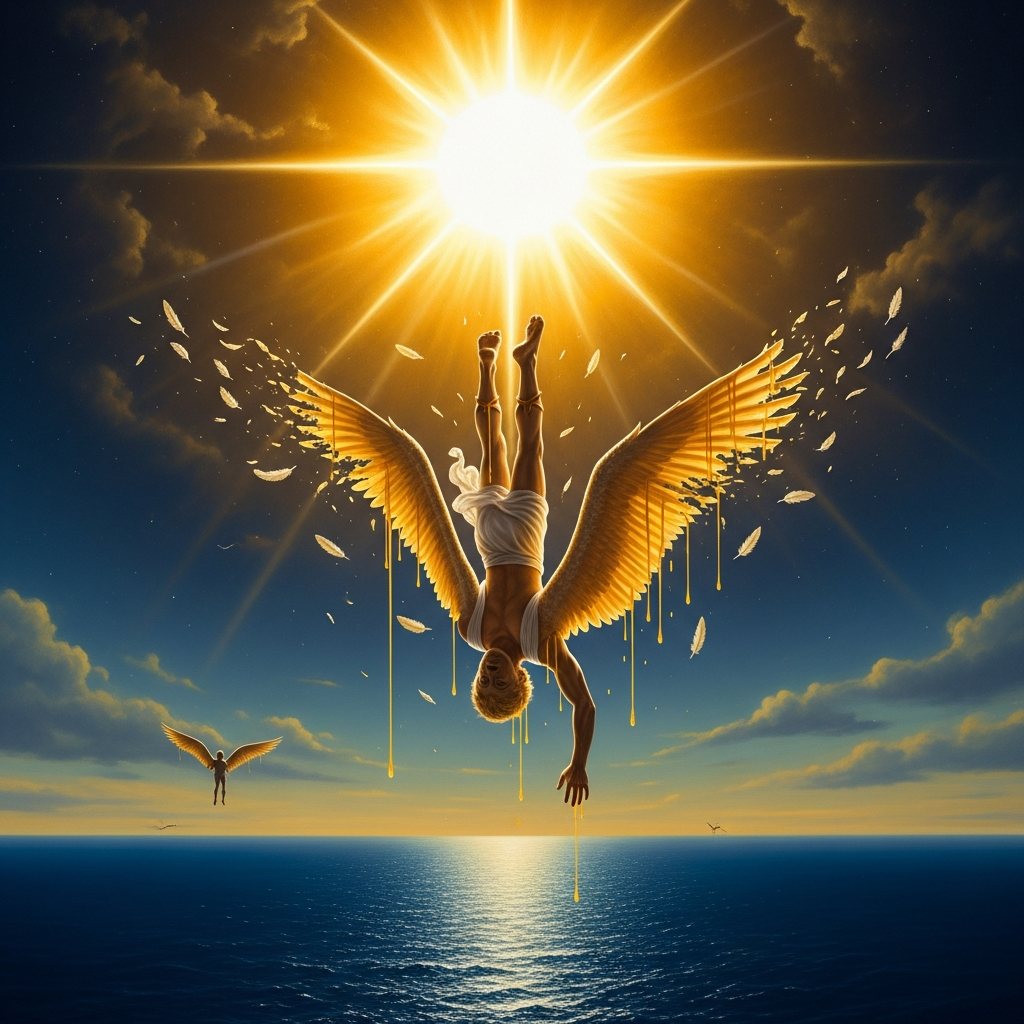
The sun was warm at first. Then hot. Then very hot. He was rising into thinner, brighter air. He did not feel the wax soften — wax does not warn. He felt the first feather slip free, and he reached for it, and a dozen more came loose at once.
The wing on his right side disintegrated.
He was falling.
He flapped the half-wing on his left side and got nothing. He shouted his father’s name. He shouted it again. Daedalus, far below, looked up. He saw the small body falling against the blue, trailing a brief halo of feathers. He saw the splash.
Daedalus circled.
He saw the wings on the water, the frames bobbing, the feathers spreading in a small circle. He saw his son’s body just below the surface, face up, eyes open. He came down to the cliffs of an island — later called Icaria, after the boy — and he buried what the sea gave back.
He flew on alone to Sicily. He never made another pair of wings.
The story is short and it does not console. It does not say Icarus learned anything. It does not say his fall was redeemed. It says only this: a father built a working machine, gave his son the manual, and watched him die using it wrong. The wax melted because wax melts. The wings worked exactly as designed. The boy went too high.
Every generation that builds something new — fire, ships, gunpowder, engines, networks — eventually has a child who climbs too high in it. The story keeps being told because the wax keeps being warm and the sun keeps being there and the lift of a working wing is, the moment you feel it, the most persuasive argument in the world for going further.
Scenes
In the labyrinth's tower workshop, Daedalus binds feathers to a wooden frame with beeswax
Father and son leap from the cliff
Icarus, alone in the high blue, his wings half-melted, falling
Echoes Across Traditions
Entities
- Daedalus
- Icarus
- Minos
- Pasiphaë
- The Minotaur
Sources
- Apollodorus, Library, Epitome 1.12-15
- Ovid, Metamorphoses VIII.183-235
- Diodorus Siculus IV.77
- Hyginus, Fabulae 39-40