Qamata and the Four Giants at Earth's Corners
Primordial time — before the Xhosa people walked the Eastern Cape · The beginning of the world — the four corners where the giants stand are understood cosmographically
Contents
Qamata, the supreme creator of the Xhosa people, creates the world with the help of his mother Nkosazana — but the great sea monster Sea challenges creation, and four giants are placed at the earth's corners to guard it forever.
- When
- Primordial time — before the Xhosa people walked the Eastern Cape
- Where
- The beginning of the world — the four corners where the giants stand are understood cosmographically
The world is made, but it is not safe.
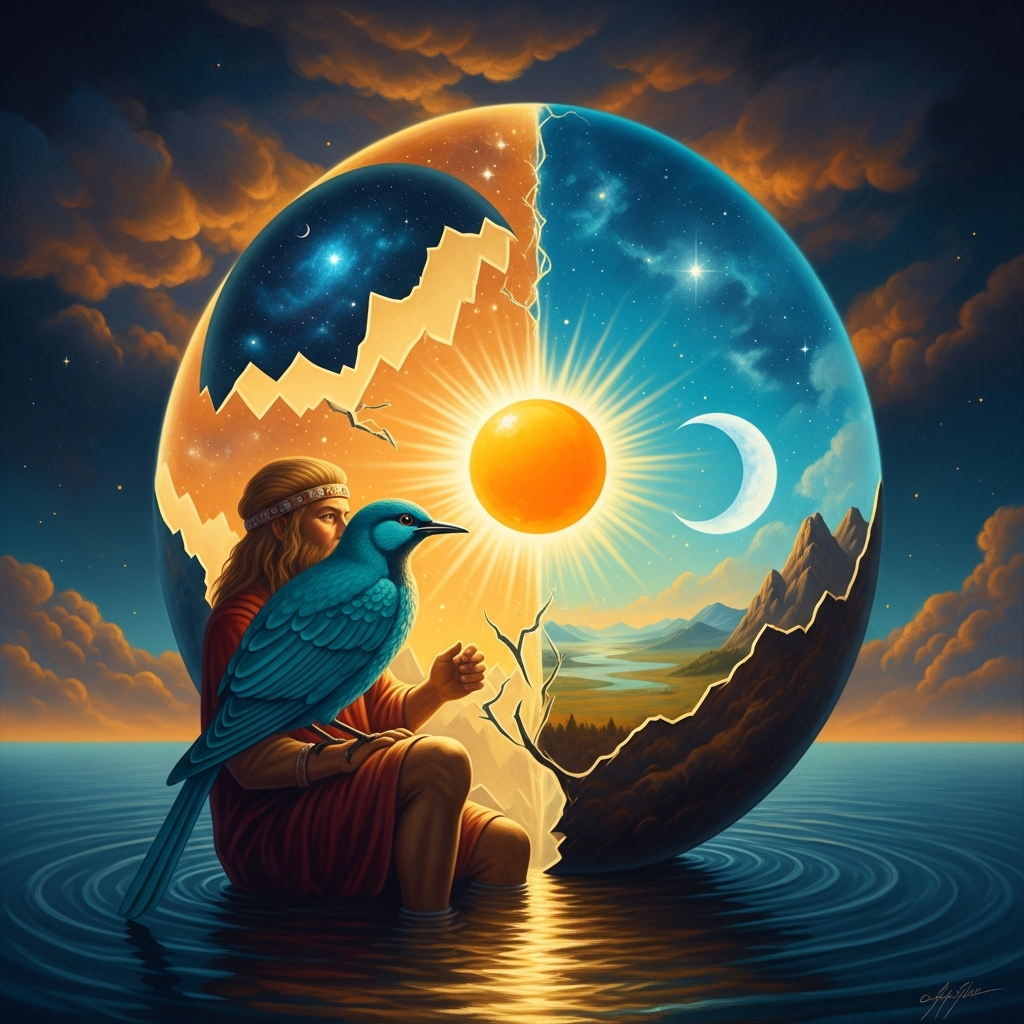
Qamata creates the earth with the help of Nkosazana his mother — she is the source of the knowledge that directs the creation, the divine intelligence that makes the forms that Qamata builds possible. Together they make the land and the plants and the animals. The sky is raised and held above the earth. The rivers are run to the sea.
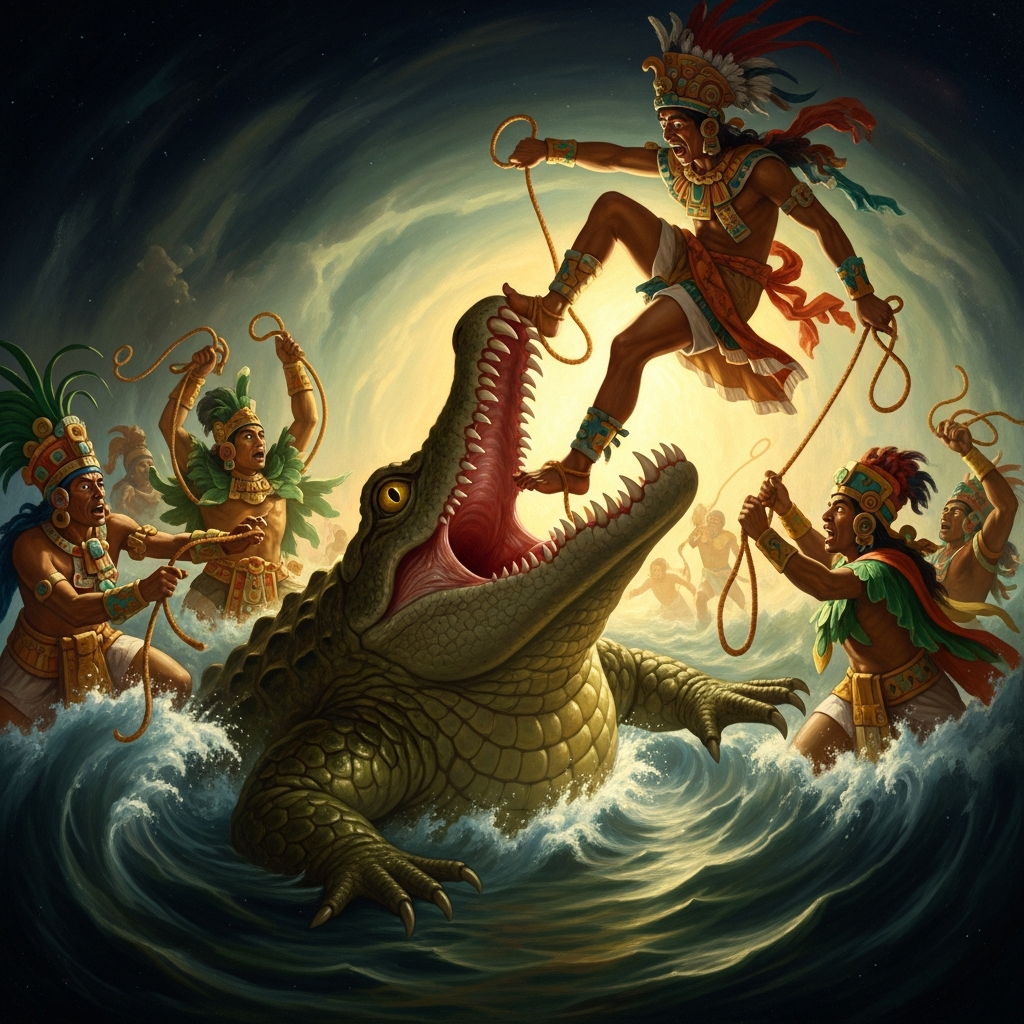
But the sea monster — Wanamazana, the great creature in the deep water — does not accept what has been made. She attacks. She rises from the depth and strikes at the edges of creation, trying to swallow what the creators have built. The world is threatened before it is inhabited.
Qamata creates four giants.
He places them at the four corners of the earth: north, south, east, west. The giants are enormous — their feet touch the deepest foundations of the world, their heads are in the clouds, their arms are long enough to reach any point on the earth’s surface. They are not decorative. They are military installations, the world’s first defenders, the permanent sentinels whose existence allows everything else to exist safely.
The four giants fight the sea monster. The fights go on for a long time. Eventually — not through victory exactly, but through the ongoing effort of the guardians — the monster is held back. The creation holds.
The giants are still at the corners.
They are still fighting.
The ongoing battle is the ongoing world.
This is the Xhosa understanding of cosmic stability: it is not a given, not a natural default state that maintains itself. It is the consequence of ongoing guardianship, the result of forces that are continuously holding the destruction back. The world’s stability is active, not passive. The four giants at the corners are doing work right now.
This has practical implications for human behavior. If the world’s stability requires ongoing effort from divine beings, then human stability — the social order, the agricultural cycle, the maintenance of the covenant between the living and the dead — also requires ongoing effort. Nothing in the Xhosa cosmos maintains itself automatically. Everything requires tending.
The fields must be cultivated, not just planted. The ancestors must be fed, not just acknowledged once. The elders must be consulted, not just nominally respected. The sacred groves must be maintained, not just declared sacred and left alone.
The giants are working. Are you?
Nkosazana is not a minor figure.
In many tellings of the Xhosa creation, Nkosazana — who is also a goddess associated with mist, rain, and the beauty of the morning — is presented as equally important to Qamata in the creative act. She does not merely assist; she initiates the knowledge from which the creation proceeds. This mirrors the Zulu Inkosazana (whose name derives from the same root, meaning Princess or Lady), and suggests a shared Southern African tradition of a sky-goddess associated with rain and fertility and feminine divine power.
The colonial and missionary suppression of African religion frequently erased female divine figures, either by ignoring them in accounts of male-focused sky-god religion or by assimilating them to the Virgin Mary in a way that stripped them of their independent divine status.
Nkosazana was the knowledge behind the creation.
Qamata was her son.
The Xhosa have known this for as long as they have told the story.
The Eastern Cape remembers.
The Xhosa people of the Eastern Cape province of South Africa — whose land was taken by successive waves of colonial violence from the 1770s to the 1880s, who lost their cattle in the famous Great Cattle Killing of 1856-57, who gave South Africa Nelson Mandela and Walter Sisulu and Oliver Tambo and Steve Biko — are a people who have lived with the four giants at the corners of their world fighting continuously.
The cosmic story and the historical story rhyme.
The creation that is never finally secured, that requires continuous guardianship, that exists in permanent tension with the forces that would swallow it — this is the Xhosa experience of existence, encoded in the myth of Qamata and the giants a long time before the colonists arrived with their guns and their fences.
The giants are still at the corners.
Still working.
Echoes Across Traditions
Entities
- Qamata
- Nkosazana
- The Great Sea Monster (Wanamazana)
- The Four Giants
Sources
- Hunter, Monica, *Reaction to Conquest* (Oxford University Press, 1936)
- Mbiti, John S., *African Religions and Philosophy* (Heinemann, 1969)
- Parrinder, Geoffrey, *African Mythology* (Paul Hamlyn, 1967)
- Leeming, David, *Creation Myths of the World* (ABC-CLIO, 2010)