Sita and the Golden Deer: The Trap That Took the World
c. 500 BCE – 200 CE (Ramayana composed and recorded) · Panchavati — a forest hermitage on the Godavari river, where Rama, Sita, and Lakshmana have built a hut of leaves during their fourteen-year exile
Contents
In the forest exile, a deer with a coat of beaten gold appears at the edge of Sita's hut. She has never seen anything so beautiful. She begs Rama to bring it to her — alive, if he can. Rama suspects what it is. He goes anyway. And in the long minutes while he is away, the demon king Ravana, robed as a holy beggar, walks up the path and asks her for alms.
- When
- c. 500 BCE – 200 CE (Ramayana composed and recorded)
- Where
- Panchavati — a forest hermitage on the Godavari river, where Rama, Sita, and Lakshmana have built a hut of leaves during their fourteen-year exile
They are in the fourteenth year of exile.
Rama, prince of Ayodhya, was banished from his father’s kingdom on the eve of his coronation by the cunning of a stepmother. He has accepted the banishment without protest — that is who Rama is — and his wife Sita and his brother Lakshmana have followed him into the forest because they will not be parted from him. For thirteen years they have lived as ascetics, moving from one forest to another, killing demons that threaten the rishis, eating fruit and roots, sleeping on grass.
They are happy. The poem is clear about this. The forest exile, for all its hardship, is the period of their deepest joy — three of them, alone in the woods, far from the politics of the court. They have built a hut of leaves on the banks of the Godavari, in a grove called Panchavati, and they expect to spend the last year of exile here.
What none of them yet knows is that they have been seen.
Far to the south, in his palace on the island of Lanka, the demon king Ravana has been told about Sita. He has been told by his sister Surpanakha, whose nose Lakshmana cut off when she tried to seduce Rama. Surpanakha has spent her recovery describing Sita to Ravana — her beauty, her bearing, the way her presence changes a room — and Ravana, who has ten heads and twenty arms and a harem of every species, has decided he must have her.
He cannot take her by force. Rama is too dangerous. He has to draw Rama away.
He calls his uncle Maricha. Maricha is a shape-shifter, a rakshasa who has tangled with Rama before and barely escaped with his life. When Ravana proposes the plan, Maricha begs to be excused. He tells Ravana that Rama is no ordinary man — that the arrows of Rama travel like thought — that the only safe course is to let Sita go. Ravana threatens him. Maricha calculates: he can die now at his nephew’s hand, or die later at Rama’s. He chooses Rama’s, because at least then he will die looking at a god.
He goes to the forest. He becomes a deer.
—
Not just a deer.
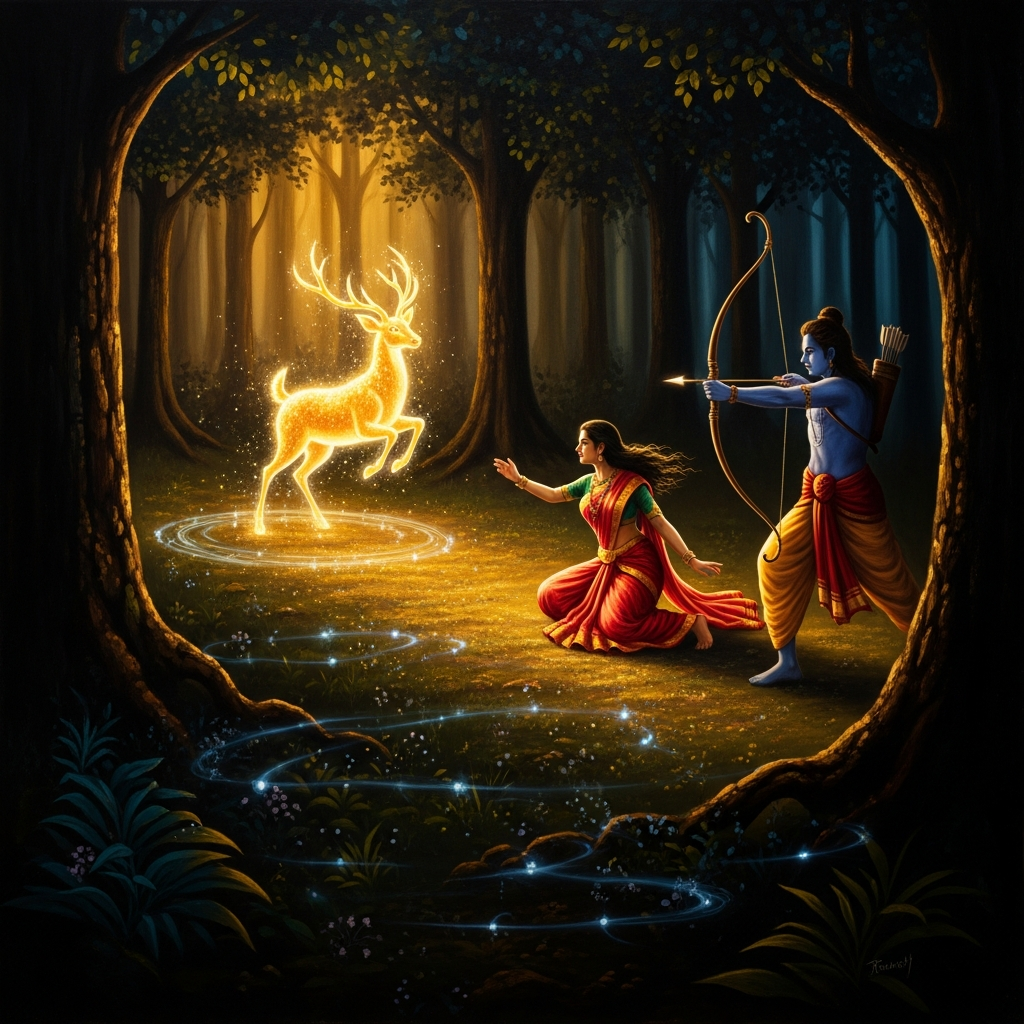
A deer with a hide of beaten gold. White spots like pearls along its sides. Eyes black and enormous. Antlers tipped with sapphire. A creature so visibly unreal that no one with sense would believe in it.
Sita is at the door of the hut. She has just come up from the river with a clay pot of water on her hip. She sees the deer at the edge of the clearing.
She has never seen anything so beautiful in her life.
She calls to Rama. Rama and Lakshmana come out and look. Lakshmana takes one look and says: That is not a deer. That is a rakshasa. There are no real deer like that. We must not chase it.
Sita does not hear him. She is already speaking to Rama in the soft voice she uses for nothing else. Husband, please. Bring me that deer. Alive if you can — I want to keep it, want to feed it from my hand, want to bring it back with us to Ayodhya when we go home. If it cannot be brought alive, then bring me the skin, only the skin, so I can sit on it. I have never asked you for anything.
Rama hesitates. He has heard Lakshmana. He is not stupid. But Sita’s joy, her sudden delight in a thing, is not something he can refuse. He does not refuse.
He tells Lakshmana to stay with Sita. He tells Lakshmana, specifically, not to leave her, no matter what you hear. Then he picks up his bow and goes after the deer.
—
The deer leads him a long way.
It runs at the edge of his vision through the trees. When he gets close, it bounds away. When he lags, it pauses to graze and look back. He chases it for what feels like hours, deeper and deeper into forest he does not know, and finally the deer stops in a clearing far from the hut.
Rama draws his bow. He hesitates one last second. Then he shoots.
The arrow takes the deer through the heart. The deer falls. As it falls, the gold and pearl drop away from it, and the body of Maricha — old, scarred, rakshasa — twists on the ground in its dying.
And as Maricha dies, he opens his mouth and screams in Rama’s exact voice:
Sita! Lakshmana! Help me!
The cry is loud enough to carry back through the forest. It is loud enough to be heard at the hut. Rama hears it leave Maricha’s mouth and goes cold.
He turns and starts running back.
—
At the hut, Sita has heard the cry.
She turns to Lakshmana. She tells him to go. Lakshmana refuses — he tells her, Brother said not to leave you, and Brother cannot be in trouble; no one can hurt Rama; that cry is a trick.
Sita does something she has never done before. She accuses him. She says — and the poem records this with shame — that he wants Rama to die so he can have her. The accusation is so unjust, so foreign to everything Lakshmana is, that he stares at her.
Then he obeys.
He draws a line in the dust around the hut — what tradition will call the Lakshmana rekha — and he tells Sita, Do not cross this line. Whatever happens. Whoever comes. Stay inside it. The line will protect you. And he goes after his brother.
The clearing is empty.
For a long minute, nothing happens. Sita is alone in the hut. She is shaking. The forest is too quiet.
Then a man walks up the path.
He is tall. He is bearded. He wears the saffron robes of a wandering ascetic. He carries a beggar’s bowl. He stops at the edge of the line in the dust — Sita does not yet know what line — and he asks, in a voice both gentle and grand, for alms.
Sita’s training is older than her fear. A holy man at the door must be fed. To refuse would be the worst sin a forest hermit could commit. She picks up fruit and rice. She walks to the threshold.
The ascetic is still on the other side of Lakshmana’s line.
He cannot cross it. He needs her to cross it.
He praises her. He asks her name. He talks of the holy places he has seen. He extends the bowl, just a little farther, just past the line, so that to put the food in he must reach.
Sita steps over the line.
The ascetic drops the disguise. The bowl falls. The robes fall. Standing on the path is Ravana — ten heads, twenty arms, a chariot waiting in the air behind him drawn by donkeys. He seizes her in two of his hands and lifts her into the chariot and the chariot rises into the sky.
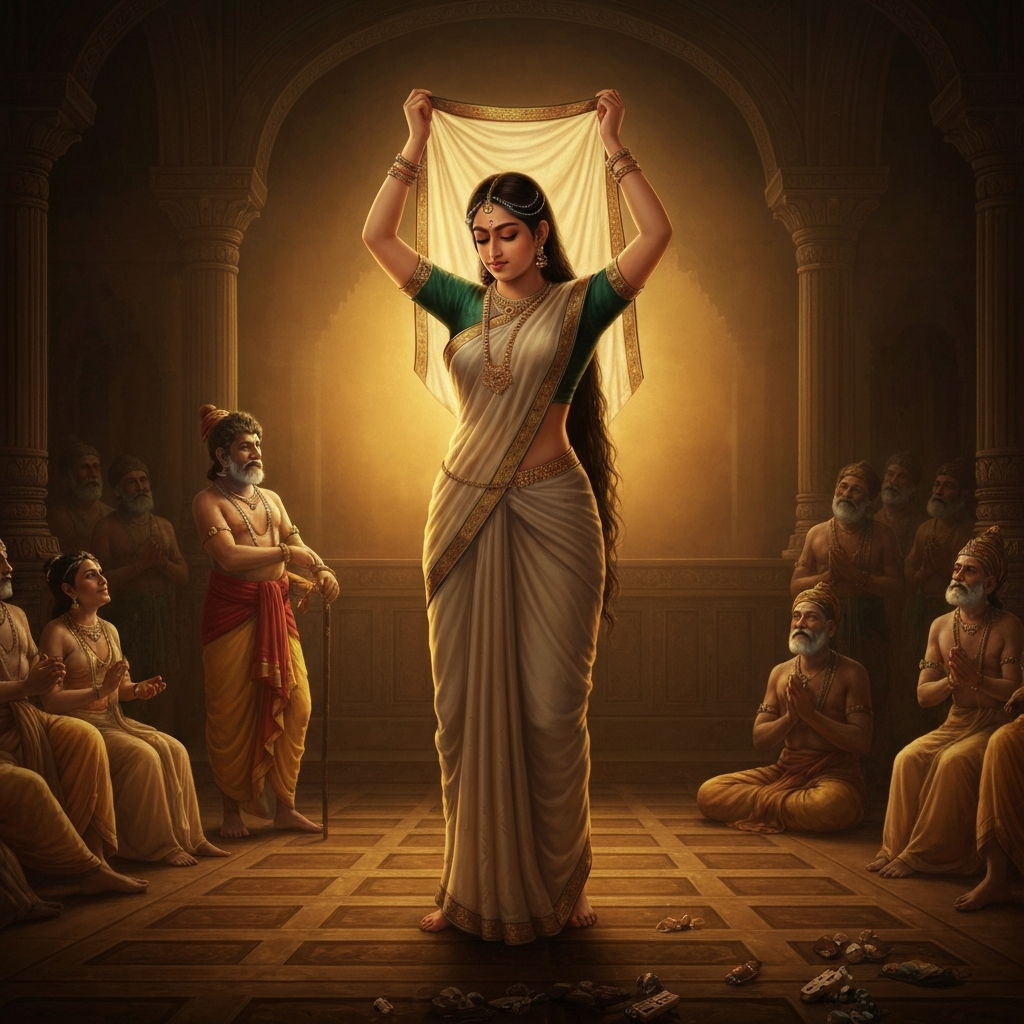
Sita screams. She tears the gold from her wrists and throws it down so that someone — anyone — will know which way they have gone. She throws her veil. She throws her ornaments. They land in the trees below.
The chariot turns south.
—
When Rama returns to the hut and finds it empty, the poem tells us he loses, for the only time in the epic, his composure entirely. He runs from tree to tree calling her name. He asks the deer where she has gone. He asks the river. He asks the rocks. The forest does not answer.
The bridge to Lanka, the army of monkeys, the slaying of Ravana, the great war that fills the rest of the Ramayana — all of it begins now, in this empty hut, with a clay water-pot still on the floor and the line in the dust scuffed where she crossed it.
The trap was beautiful. That is the lesson the poem keeps returning to. It was not crude; it was not obviously evil. It looked like a deer made of gold. The world breaks open around the small things we cannot help wanting.
Sita will remain captive on Lanka for the rest of the year. Rama will come for her with an army. Ravana will die. But everything that happens afterward — every arrow, every burned tower, every ocean crossed by leaping monkeys — flows from the moment a woman saw a beautiful animal at the edge of a clearing and asked, gently, for it to be brought to her.
Scenes
At the forest's edge, a deer with a coat of beaten gold and silver-spotted flanks pauses to graze
Rama draws his bow in the deep forest
A bearded ascetic in saffron robes stands at the threshold of the leaf-hut, begging-bowl extended
Echoes Across Traditions
Entities


Sources
- Valmiki, *Ramayana* (Aranya Kanda, c. 500 BCE – 200 CE)
- Robert P. Goldman et al. (trans.), *The Ramayana of Valmiki* (Princeton, 1984–2017)
- Tulsidas, *Ramcharitmanas* (16th c. CE retelling)
- C. Rajagopalachari, *Ramayana* (1957 retelling)