The Seven Grandfather Teachings
Oral tradition of the Anishinaabe people; codified in contemporary Ojibwe cultural education · The Anishinaabe homeland; the spirit world; the journey through time and creation
Contents
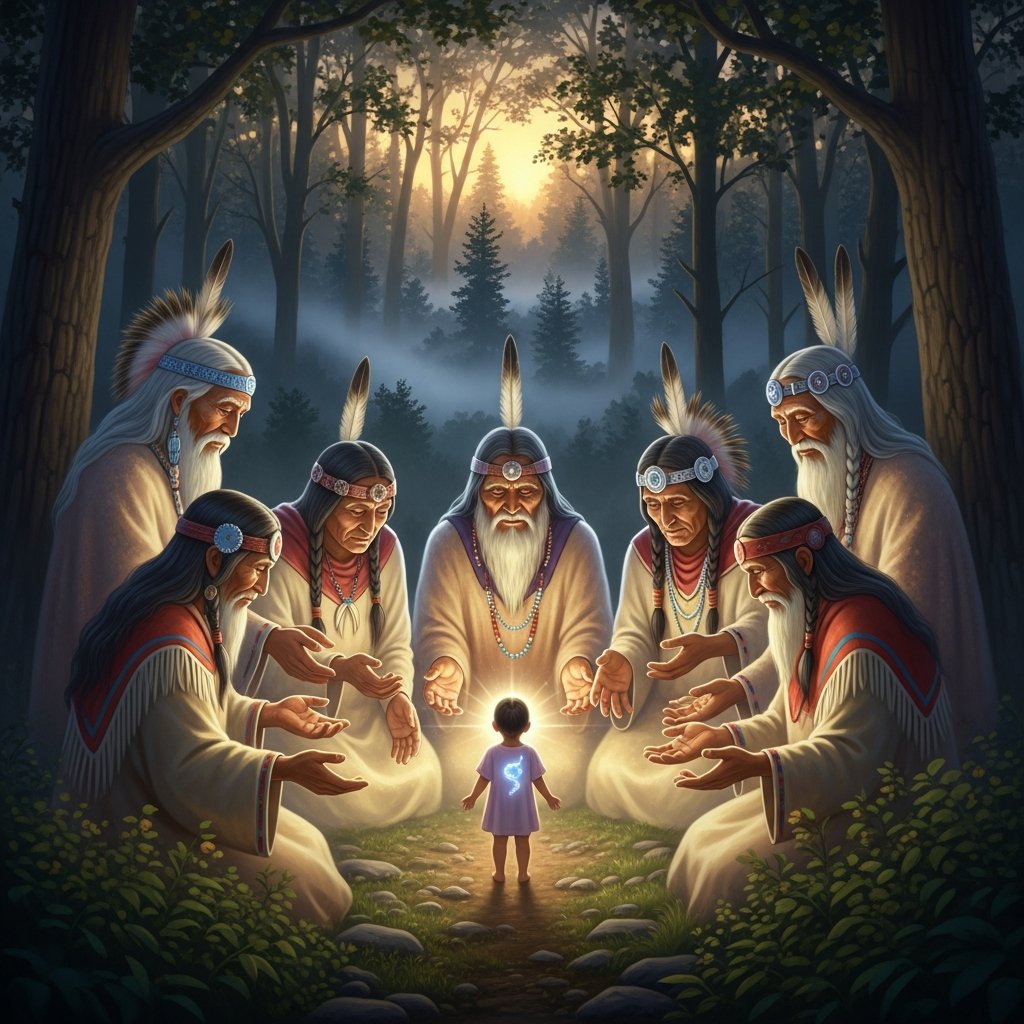
The Seven Grandfathers — ancient spirit beings — search among the people for the human most worthy of sacred knowledge and choose a young child still untarnished by the world. They send the child on a journey through time and creation. On his return, they teach him the Seven Teachings: Wisdom, Love, Respect, Bravery, Honesty, Humility, and Truth — the principles on which a good life and a good community are built.
- When
- Oral tradition of the Anishinaabe people; codified in contemporary Ojibwe cultural education
- Where
- The Anishinaabe homeland; the spirit world; the journey through time and creation
In the beginning of this story, the people are struggling.
The world is new — or the people are new in the world — and they do not yet know how to live well in it. They have the necessities: food, shelter, fire, language. What they do not yet have is wisdom — not the practical wisdom of how to hunt or make a canoe, but the deeper wisdom of how to treat each other, how to move through the world in a way that sustains it rather than depletes it, how to be fully human rather than merely alive.
The Creator sees this. The Seven Grandfathers are given a task.
They are ancient beings, these Seven — older than the Anishinaabe people, older than the form the world currently wears. They are not gods in the sense of beings who issue commands from above. They are grandfathers in the exact sense: patient, watchful, interested in the future in the way of beings who have already had their own lives and whose investment now is in what comes next. The Creator sends them to find a human being worthy of receiving the teachings that would help the people live well.
The Grandfathers send a messenger to search the whole earth.
The messenger travels for a long time. He moves through every community of people he can find, watching and listening for the one who would be the right receiver. He is not looking for the most powerful, or the most intelligent, or the most accomplished. He is looking for something harder to name: innocence, still-openness, the unclosed quality of a being who has not yet been organized by the world into a fixed shape.
He finds a baby.
The infant is so young that the world has not yet made its marks on him — no losses yet, no habits of cynicism or defensiveness, no wounds that have become walls. The messenger brings his report to the Seven Grandfathers, and they agree: this is the one. But they cannot give the teachings to an infant. The teachings require a person who can understand them and carry them.
They send the child on a journey.
The journey takes him through all the stages of life, in the company of a spirit guardian, to see what the world is: all of its beauty and its hardness, its generosity and its capacity for harm. He travels for what feels like a lifetime — the tradition varies on the specifics, but the principle is consistent: the teachings can only be given to someone who has seen enough of the world to understand what the teachings are for. By the time the child returns to the Grandfathers, he is old. He has used his whole life as preparation for this moment.
The Grandfathers speak.
They do not lecture. They give, one by one, a single word and its meaning — and the meaning of each word is not a definition but a teaching, a way of being in the world that takes a lifetime to learn and a lifetime to practice.
The first is Nibwaakaawin — Wisdom. Not the accumulation of information but the ability to use knowledge for the good of the people. The traditional teacher of wisdom is the beaver, who applies patient effort to reshape the world in ways that create homes for others. Wisdom without application is information. Application without wisdom is damage.
The second is Zaagi’idiwin — Love. Not sentiment but the deep recognition that every living being is kin. The eagle teaches this — the being whose eyes are sharp enough to see great distances, who sees the people below as beloved rather than as objects. Love in the Anishinaabe sense is relational clarity: seeing what is truly in front of you.
The third is Minaadendamowin — Respect. Treating every person and every living thing as they have the right to be treated — not as you want to treat them, not as is convenient for you, but as their inherent dignity requires. The buffalo teaches this, who gives everything of itself when it is taken — bones, hide, sinew, meat — without withholding. Respect is not deference. It is the full recognition of the other’s value.
The fourth is Aakode’ewin — Bravery. Facing the hard things — fear, difficulty, the truth about yourself — with a bear’s heart. The bear is the teacher: large enough to be feared, gentle enough with its cubs, capable of both great ferocity and great tenderness. Bravery is not the absence of fear. It is doing what must be done despite the fear, with full awareness of the cost.
The fifth is Gwayakwaadiziwin — Honesty. Being truthful with yourself first, and then with others. The raven teaches this — the bird who sees clearly what is there and says what it sees, who does not arrange the world according to comfort. Honesty in the Anishinaabe tradition is an act of respect for the person you’re speaking to: you honor them enough to tell the truth.
The sixth is Dabaadendiziwin — Humility. Knowing your place in the web of creation — not as a diminishment but as an accurate location. The wolf teaches this: a creature of great power who nonetheless lives in the pack, who does not pretend to need nothing, who howls its needs into the open air. Humility is not self-erasure. It is knowing what you are and what you are not.
The seventh is Debwewin — Truth. The capacity to live in alignment with what is actually real — the truth of who you are, the truth of your relations, the truth of the world’s actual state. The turtle teaches this, bearing the world on its back as it is, not as anyone would prefer it to be.
The child returns from the Grandfathers an old man.
He carries the teachings back to the people. He carries them carefully, the way you carry water in your cupped hands — with full attention, knowing the cost of spilling. The teachings are given freely: this is what they are for. The people receive them. Some take them to heart; some hear them and understand only later; some will need to hear them for a very long time before they understand.
This is expected. The Grandfathers knew what they were doing when they chose a child — they chose someone who would live long enough to give the teachings many times, in many ways, to many people in different stages of readiness.
The seven words become the measure of a life well lived. They become the basis for the Anishinaabe understanding of leadership: a person who has the right to lead is a person in whom the people can see the Seven Teachings working. Not perfect mastery — no one achieves that — but the visible effort, the lifelong orientation toward wisdom, love, respect, bravery, honesty, humility, truth.
The absence of any one of them is visible too.
A leader without humility becomes a tyrant. A people without honesty becomes a people who cannot see what is actually happening to them. A community without love becomes a collection of individuals, which is the smallest possible unit of the kind of suffering that cannot be addressed alone.
The Grandfathers knew this. They searched the whole earth and chose a child before the world had taught him otherwise.
The teachings are still here. Every generation must receive them as if for the first time.
Echoes Across Traditions
Entities
- The Seven Grandfathers
- The Child
- Nanabozho
- The Messenger Spirit
Sources
- Edward Benton-Banai, *The Mishomis Book: The Voice of the Ojibway*, 1988
- Basil Johnston, *Ojibway Heritage*, 1976
- David Treuer, *The Heartbeat of Wounded Knee: Native America from 1890 to the Present*, 2019
- Leanne Betasamosake Simpson, *Dancing on Our Turtle's Back: Stories of Nishnaabeg Re-Creation, Resurgence and a New Emergence*, 2011
- Gerald Vizenor, *Anishinabe Nagamon: Songs of the People*, 1965