Nanabozho and the Earth-Diver
Ojibwe oral tradition; recorded by Henry Rowe Schoolcraft, 1839; and by Edward Benton-Banai, *The Mishomis Book*, 1988 · The primordial waters after the flood; the Great Lakes region
Contents
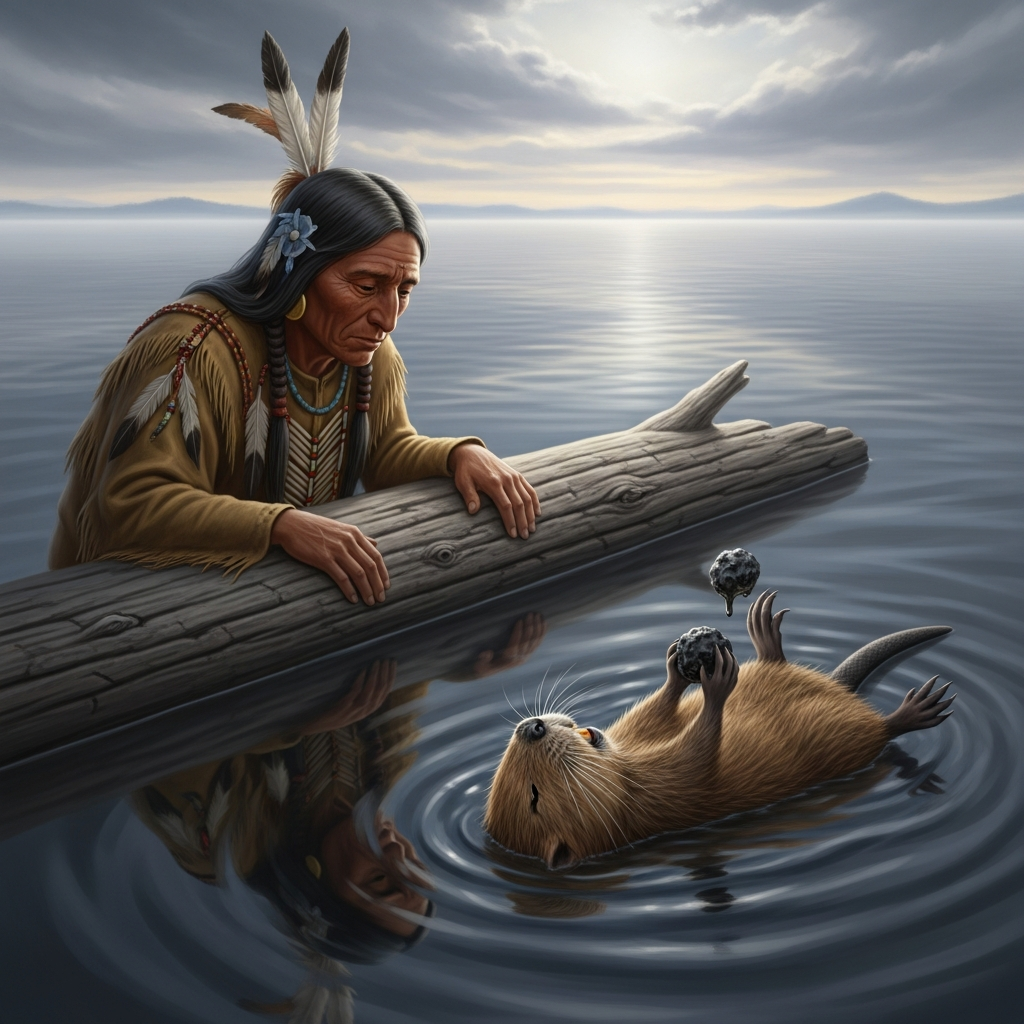
After the Great Flood destroys the old earth, Nanabozho floats on a log with the animals. He asks each one to dive for mud from the bottom — muskrat, otter, beaver each try and fail. Finally the muskrat surfaces, dead from the effort, but with a tiny ball of mud in its paw. Nanabozho breathes on the mud, and it grows. He dances on it until it becomes the world.
- When
- Ojibwe oral tradition; recorded by Henry Rowe Schoolcraft, 1839; and by Edward Benton-Banai, *The Mishomis Book*, 1988
- Where
- The primordial waters after the flood; the Great Lakes region
The flood comes because the world must end before it can begin again.
This is not a punishment, exactly — or not only a punishment. In the Ojibwe telling, the old world has become corrupt, yes, but the deeper truth is that the flood is part of a cycle, the way seasons are part of a cycle, the way a fire that burns a forest is part of the forest’s life. The flood does not destroy the world in order to leave nothing behind. It destroys the world in order to leave Nanabozho.
Nanabozho sees it coming.
He is the great transformer, the trickster-hero of the Anishinaabe people — born of a human mother and a spirit father, neither fully of the world of people nor fully of the spirit world, and therefore able to move between them. He is enormously powerful and regularly foolish and capable of genuine grief, which is the combination that makes him useful to the tradition: he is recognizably human in his failures and more-than-human in his recoveries.
He climbs to the tallest pine tree he can find. The water rises. He climbs higher. He speaks to the tree and asks it to grow, and it grows — the tradition allows him this — but the water rises faster than the tree. He reaches the top of the tree, and the water is at his feet, and the tree cannot grow any taller, and the sky is just above him, and the world is all water below.
He calls to the animals.
They come to him.
This is the intimacy of the Ojibwe version of the story — the animals come because Nanabozho calls, and they come not as servants or resources but as relations. The otter comes. The beaver comes. The muskrat comes. The great turtle rises from the deep water and offers its back, and Nanabozho steps onto it and the animals float with him on the surface of the drowned world.
He looks down through the water.
He knows — or senses, or the tradition gives him to know — that under the water, somewhere far below, the old earth still exists. The mud is there. The soil that was the world is there, still, waiting at the bottom. If someone could reach it, there would be something to build from.
He asks the otter to dive.
The otter is swift and strong, one of the finest swimmers in the world. He dives. He goes down and down and the animals watch the water for a long time, and eventually the otter surfaces, gasping, with nothing. The bottom is too far.
He asks the beaver.
The beaver is stronger and more patient than the otter, and the beaver dives and does not surface for longer than the otter, long enough that the watching animals begin to look at each other with the expression that means this might be the one — and then the beaver breaks the surface, lungs burning, with empty paws.
A silence settles over the floating log and the turtle’s back.
Nanabozho looks at the muskrat.
The muskrat is small.
This detail matters. He is not the most powerful diver, not the strongest swimmer, not the most obvious candidate for the thing the others have already failed at. The tradition is not unclear about this. The muskrat is chosen last, and there is no reason to believe he will succeed where the others could not.
He dives anyway.
He goes down. The animals watch. The time the otter was gone passes. The time the beaver was gone passes. More time passes. The surface of the water is still, and the muskrat is not visible, and the watching animals are quiet with the specific quiet of waiting for something that may not come.
Then the muskrat surfaces.
He is dead, or nearly so — his body has given everything it had to reach the bottom and come back. He floats on his back, still. But one small paw is clenched shut, and when Nanabozho opens it carefully, there is mud inside. A tiny ball of earth from the bottom of the drowned world. Enough to hold in the crook of a finger.
Nanabozho holds it up.
He breathes on it.
He begins to roll the mud between his palms.
It grows. This is not metaphor — the mud grows as he works it, as he blows his breath into it, as the intention of making a world enters the making. He places it on the turtle’s back. He walks around the edge of the turtle’s shell, stretching the mud outward, and where he walks the earth extends. He speaks to it. He sings, in some versions. He dances.
The dance is important.
It is not performance. Dancing, in the Anishinaabe understanding, is a form of prayer that involves the whole body, that puts the dancer in physical relationship with the ground, that calls the earth to recognize its own life by being touched and moved with intention. Nanabozho dances the world into being, which means the world’s being is a relationship, not a fact. It exists because someone stood on it and moved.
The earth grows. The turtle’s back grows. The islands form first, then the larger landmasses, then the great flat prairies in the middle and the mountains at the edges and the rivers running through everything. The world is not made in an instant — it takes time, and walking, and the continued attention of the one who is making it.
The animals come off the log and onto the new earth.
When the world is large enough, Nanabozho stops.
He buries the muskrat. In some versions he grieves over the body, and the grief is real grief — not the grief of a god observing a sacrifice but the grief of a being who has lost someone small and necessary. The muskrat died for the world. The world owes the muskrat a ceremony, and Nanabozho performs it.
This is the ethics built into the creation story: the world was rebuilt by the smallest creature’s sacrifice, and the correct response to standing on the earth is gratitude to the muskrat. Not to a remote god, not to an abstract principle, but to the small brown animal who dived further than its body could sustain and came back with everything.
The Great Turtle remains beneath the earth.
In the cosmology that flows from this story, the earth is not a dead object or an infinite resource. It is the back of a living being who agreed to be the foundation. The rivers that cross it are the turtle’s veins. The earthquakes are the turtle’s breath. The relationship between the people and the land is the relationship between a guest and a host — or between a weight and the back that carries it, which is a relationship that requires paying attention.
Nanabozho is still out there.
He is still transforming things, still making mistakes, still being punished for them by the spirit world and still recovering. He is the model for human existence in the Anishinaabe understanding: not a perfect being to be imitated from a distance but a relatable intelligence that fails and adapts and fails better, that took the gift of the dying muskrat’s paw and built the world from it.
The world fits in a fist.
This is what the story says. The whole world — every lake and ridge and cedar bog and wild rice bed of the Great Lakes country — fits in the clenched paw of a dead muskrat, waiting to be found by the right hands. This is the measure of creation: a small animal’s last effort, and someone patient enough to look.
Echoes Across Traditions
Entities
- Nanabozho (Nanabush)
- The Muskrat
- The Otter
- The Beaver
- The Great Turtle
Sources
- Henry Rowe Schoolcraft, *Algic Researches*, 1839
- Edward Benton-Banai, *The Mishomis Book: The Voice of the Ojibway*, 1988
- Basil Johnston, *Ojibway Heritage*, 1976
- Åke Hultkrantz, 'The Origin of Death: Studies in North American Indian Religion,' *Scripta Instituti Donneriani Aboensis* 3, 1957
- Alan Dundes, ed., *The Flood Myth*, 1988 (comparative analysis of earth-diver variants)