The Pukumani Poles and the Boundaries of the Dead
mythic time into the present — the Tiwi origin of mortuary ceremony · Bathurst Island and Melville Island, Northern Territory, Australia
Contents
The Tiwi people of northern Australia erect towering carved poles around the graves of their dead — the Pukumani ceremony that transforms the dangerous period after death into an ordered transition, protecting the living from the restless spirit while guiding it onward.
- When
- mythic time into the present — the Tiwi origin of mortuary ceremony
- Where
- Bathurst Island and Melville Island, Northern Territory, Australia
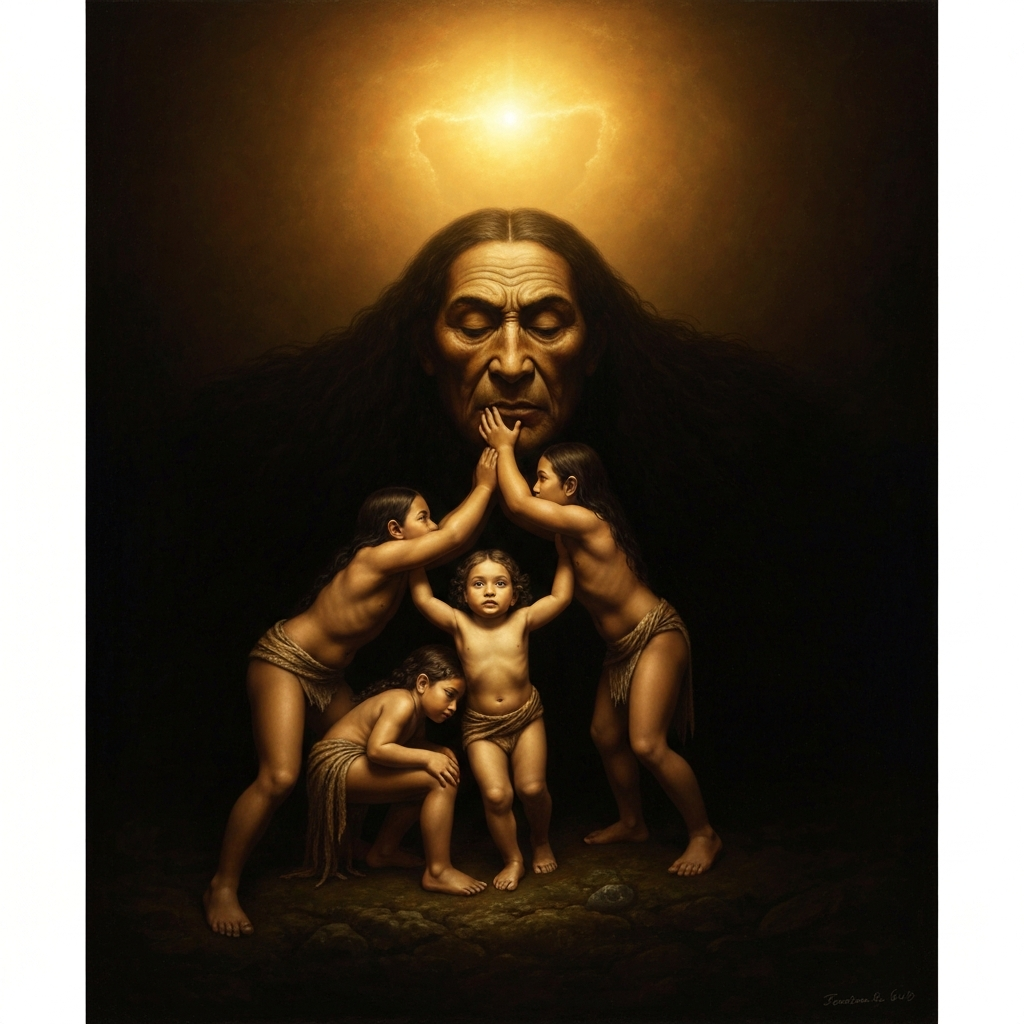
Purukupali’s son dies.
The child Jinaini dies because his mother Pima left him alone in the sun while she went to meet her lover Tjapara, the moon man. Jinaini, alone in the heat, died before his mother returned. Purukupali found his son’s body.
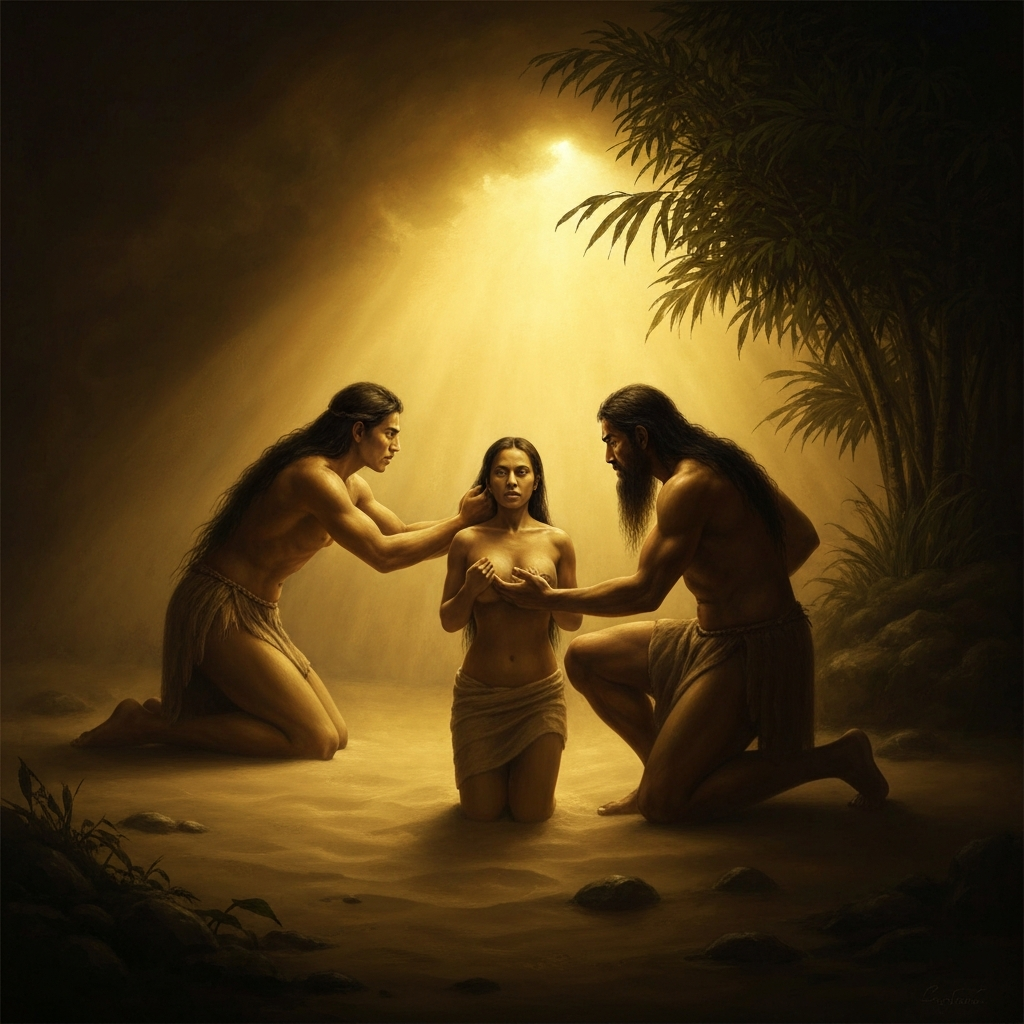
Tjapara offers to restore the child. He is the moon; he knows how to come back from death, how to wane and wax, how to disappear and return. He can do this for Jinaini. Give me the child for three days, he says. The child will live again.
Purukupali refuses.
This is the founding refusal. Purukupali’s grief is so complete and so fierce that he will not accept any diminishment of it, any negotiation with death, any offer to restore what was taken from him by his wife’s faithlessness. He takes his son’s body in his arms. He walks backward into the sea.
Before he walks into the sea, he makes a decree: from now on, everything that dies stays dead. All of you, he tells the people and the beings around him. You will all follow me. No one comes back.
Then he walks into the sea with his son in his arms.
Tjapara is left behind, unable to fulfill his offer. His consolation is the three-day cycle he intended for Jinaini — he still wanes for three days and returns. The moon’s return is the shadow of a restoration that was refused, the gesture that had nowhere to go.
The Pukumani ceremony was established by the events of Purukupali’s grief. The people who gathered at the moment of his refusal and watched him walk into the sea were the first mourners. They were the ones who had to figure out what to do next — how to mark the place where a person’s life ended, how to protect themselves from the spirit that was now loose in the world between life and death, how to eventually guide that spirit to wherever it was going.
The poles come from that figuring-out. They are carved and painted with designs specific to the deceased, the colors and patterns that encode who this person was in the living world. They are erected around the grave. They mark the boundary — inside the poles is the world of the dead person, the managed space of the burial and the transition. Outside is the world of the living. The poles hold that boundary during the period when the spirit is still close and still potentially dangerous.
The ceremony that accompanies the pole-raising — the singing, the dancing, the painting of mourners’ bodies, the exchange of goods — is the community’s work of managing the dangerous energy of fresh death. It takes time, multiple ceremonies across months. The poles mark the progress: as the ceremony moves through its stages, the boundary between the living and the dead is re-negotiated and eventually stabilized.
The poles are left at the grave when the ceremony ends. They weather, eventually. They fall. That falling is not neglect — it is completion. The spirit has moved on. The boundary is no longer needed. The wood returns to the earth the way everything returns.
Purukupali walked into the sea and death became permanent. The Pukumani ceremony is the response to that permanence: not a reversal, but an acknowledgment, a management, a way of saying yes to what cannot be changed while doing everything possible to soften the crossing.
Echoes Across Traditions
Entities
- Purukupali (the founding ancestor of the ceremony)
- Tjapara (the moon man)
- Pima (Purukupali's wife)
- Jinaini (their child)
Sources
- Charles Hart and Arnold Pilling, *The Tiwi of North Australia* (1960)
- Marcus Barber, *Where the Clouds Stand: Australian Aboriginal Relationships with Water* (various)
- Museum Victoria and National Museum of Australia, Pukumani exhibition materials