Contents
The Orisha of white cloth and purity is commissioned by Olodumare to create human bodies from clay — but he drinks too much palm wine on the way and sculpts many forms that are not perfect, which is why humans are born with disabilities.
- When
- The time of creation — when the earth was newly made and needed population
- Where
- Ile-Ife, the sacred city of origins — the first Yoruba city, the navel of the world
He drinks palm wine on the way.
This is the mistake, and the Yoruba do not soften it or explain it away. Obatala — the Orisha of white cloth, of purity, of the highest moral standards in the divine world — drinks palm wine during the journey to create humans, and the wine makes his hands less certain, and the humans he sculpts while intoxicated come out shaped differently from the humans he sculpted when he was sober.
Before the wine: limbs that move fully, eyes that see, minds that process the world without unusual difficulty.
After the wine: limbs that curve, spines that angle, eyes that see differently or not at all, minds that hold the world in different shapes.
Obatala arrives at creation, delivers the clay forms to Olodumare, who breathes life into them all. The forms shaped by drunk hands are alive and conscious and complete — they simply carry the mark of the unsteady sculpting that made them.
When Obatala sobers up and sees what he has done, he weeps.
He swears never to drink palm wine again.
He declares the humans shaped by his unsteady hand to be his special children, his specific responsibility, the people under his particular protection.
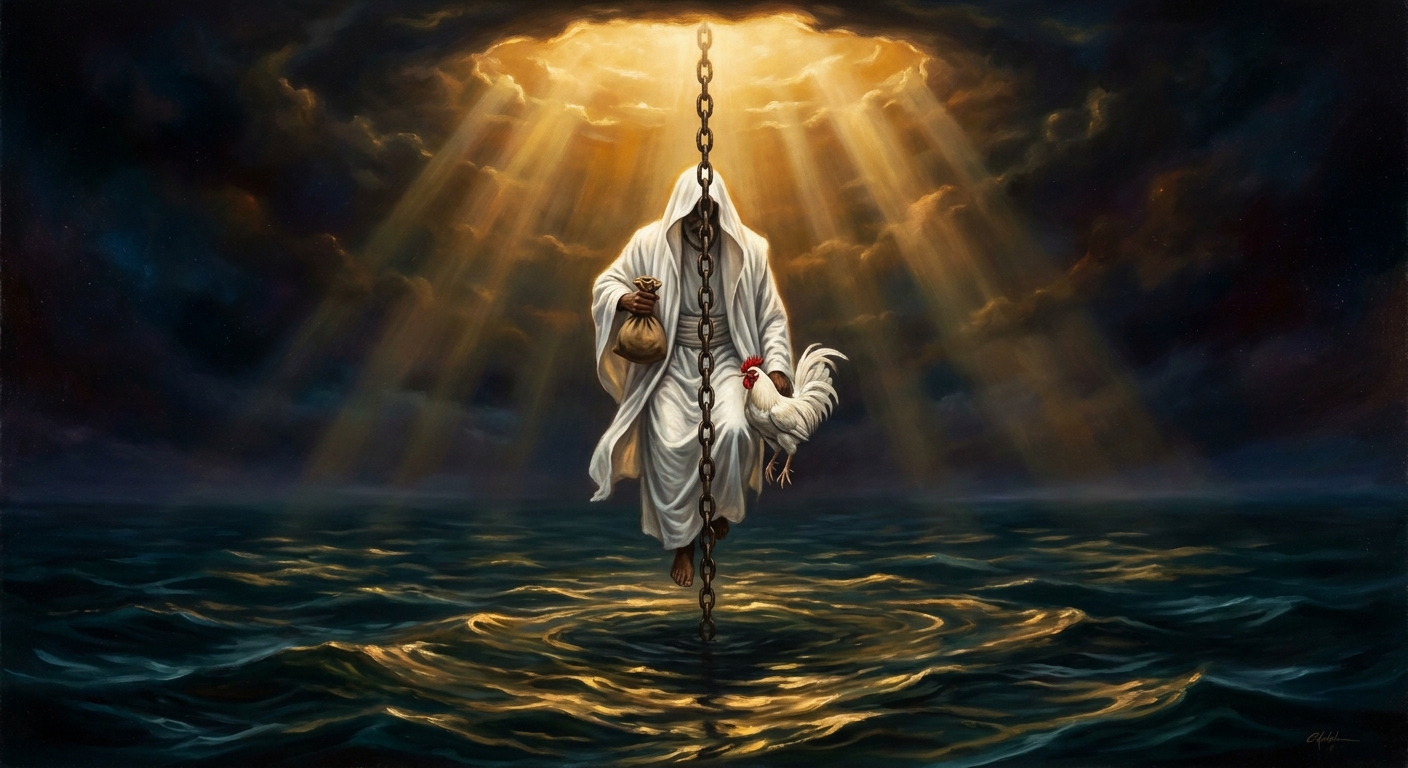
His color is white.
Obatala’s color is white, and white among the Yoruba means purity, morality, the absence of contamination, the divine light. His devotees wear white. His shrines are kept white. The coolness and clarity of white are his attributes.
This makes the palm wine episode theologically interesting: the purest Orisha committed the most ordinary human failing. His purity was aspirational rather than achieved — the white cloth he wears is the standard he holds himself to, not a description of what he has always been. The fall from that standard is not a fall from divinity but a fall from the divine ideal, which is exactly the kind of fall that mortal humans make every day.
Obatala’s devotees take his pledge: no palm wine. This is not primarily an ascetic practice but an identification — by not drinking what Obatala drank when he failed, they participate in his corrective commitment, his vow never to repeat the error. The abstinence is simultaneously the acknowledgment of the story and the devotee’s alignment with Obatala’s post-mistake character.
Albinos are Obatala’s children.
The Yoruba understanding of albinism is specific and sacred: a person born without melanin, with pale skin and light eyes, is one of Obatala’s special creations, a person who carries the white of his cloth in their body. They are not defective. They are sacred. The social consequences of this belief have been largely protective — albino individuals in Yoruba communities have traditionally been treated with the respect due to divine instruments.
This is very different from many other African traditional societies, where albinism has been associated with misfortune or even targeted for violence. The Yoruba story creates a sacred explanation that produces a protective social norm.
Ile-Ife is where he worked.
Ile-Ife, the ancient city in what is now Osun State, Nigeria, is the Yoruba city of origins — the place where creation happened, the navel of the world, the city whose royal line claims direct descent from the first Orisha who established themselves on earth. The extraordinary bronze heads found at Ile-Ife — some of the finest sculpture in human history, realistic portraits in cast brass of individuals with extraordinary poise and dignity — are associated with the royal ancestor cult but may also represent Obatala’s work: the human form as divine creation, rendered with technical mastery that mirrors Obatala’s careful sculpting.
These are humans made beautiful by skilled hands.
They exist alongside the humans made beautiful by unsteady hands.
Both are Obatala’s creation. Both are alive because Olodumare breathed into them. Both are under his protection.
The potter does not despise his crooked pots.
He keeps them closer.
Echoes Across Traditions
Entities
- Obatala
- Olodumare
- Oduduwa
- The humans with disabilities

Sources
- Abimbola, Wande, *Yoruba Oral Tradition* (University of Ife Press, 1975)
- Drewal, Henry John and John Pemberton III, *Yoruba: Nine Centuries of African Art and Thought* (Abrams, 1989)
- Awolalu, J. Omosade, *Yoruba Beliefs and Sacrificial Rites* (Longman, 1979)
- Idowu, E. Bolaji, *Olodumare: God in Yoruba Belief* (Longmans, 1962)