Combat Profile
Nine Trials
Mictlantecuhtli sets the dead through the nine layers of his realm — rivers, knives, beasts, winds — and only what survives all nine is finally dissolved into the substance of the cosmos.
Bureaucrat of the Dead
Mictlantecuhtli does not punish; he processes. His house receives the great ordinary majority of souls without judgment, holding them four years before the final dispersal.
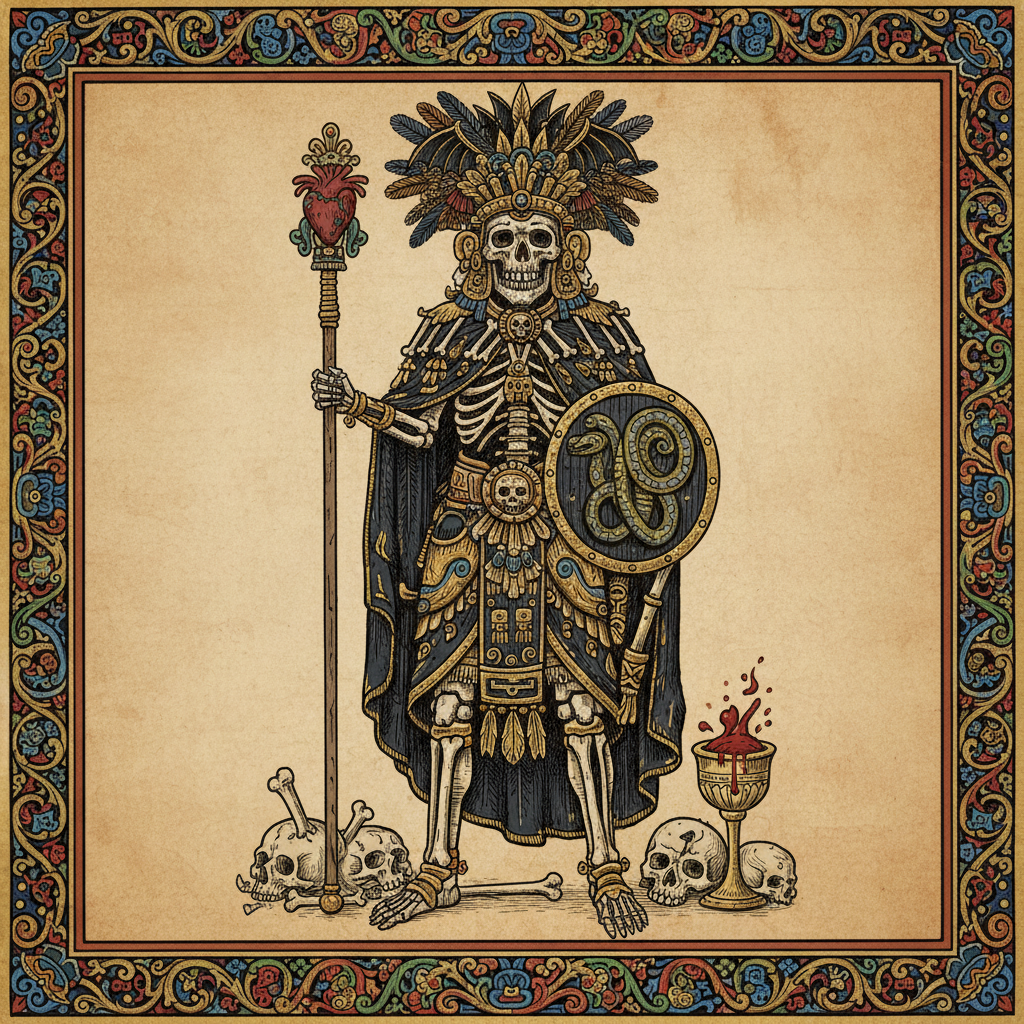
Mictlantecuhtli (“Lord of Mictlan”) rules the underworld together with his consort Mictecacihuatl. Mictlan is the destination of all who die ordinary deaths — anyone not killed in battle, not sacrificed, not drowned, not dead in childbirth. The vast majority. The dead must journey four years through nine layers of Mictlan, each presenting a trial: a river to cross, two grinding mountains, a wind of obsidian knives, a place where the heart is devoured, and so on. Only after the four-year passage is the soul finally dissolved — not punished, not rewarded, just dispersed back into the cosmic substance. Mictlan is not Hell. It is annihilation as the natural fate of the ordinary.
Mictlantecuhtli is depicted as a skeleton or as a fleshless face crowned with owl feathers, his liver hanging visibly from his ribcage (the liver, in Mexica psychology, was the seat of certain emotions, and the dead lord wears his openly). He is not malevolent — he is bureaucratic. His house is the natural floor of the cosmos. The dead come to him as a matter of course. Even the gods consulted him: when Quetzalcoatl came to retrieve the bones of the previous humanity to create the Fifth Sun’s people, Mictlantecuhtli set him a series of trials and ultimately had to be tricked into letting the bones leave.
Biblical Parallels: Mictlantecuhtli parallels the Hebrew Sheol and Greek Hades far more closely than the Christian Hell — his realm is a neutral underworld, not a place of punishment for sin. He resembles the angel of death of Jewish tradition (Malach ha-Mavet) and the gatekeeper aspect of Saint Peter in popular Christian imagination. The four-year journey through Mictlan parallels the Christian doctrine of purgatory — though Mictlan ends in dissolution rather than ascent.
Cross-Tradition: Mictlantecuhtli parallels the Egyptian Osiris (lord of the dead, judge of souls — though Osiris also rewards the righteous, which Mictlantecuhtli does not), the Greek Hades (lord of the underworld), the Sumerian Nergal, the Hindu Yama, and the Norse Hel. The motif of nine underworld layers parallels Dante’s nine circles of hell, the Mayan nine Xibalban trials of the Popol Vuh, and the Norse nine worlds.
2 min read