Combat Profile
Día de los Muertos
Mictecacihuatl opens the gates of Mictlan one night a year; the dead follow the marigold path home, eat the foods their families have set out, and return at dawn unforgotten.
Keeper of the Bones
Mictecacihuatl preserves the skeletons of those who have finished their journey through her realm; nothing is lost forever in her house, only set aside until the night of remembrance.
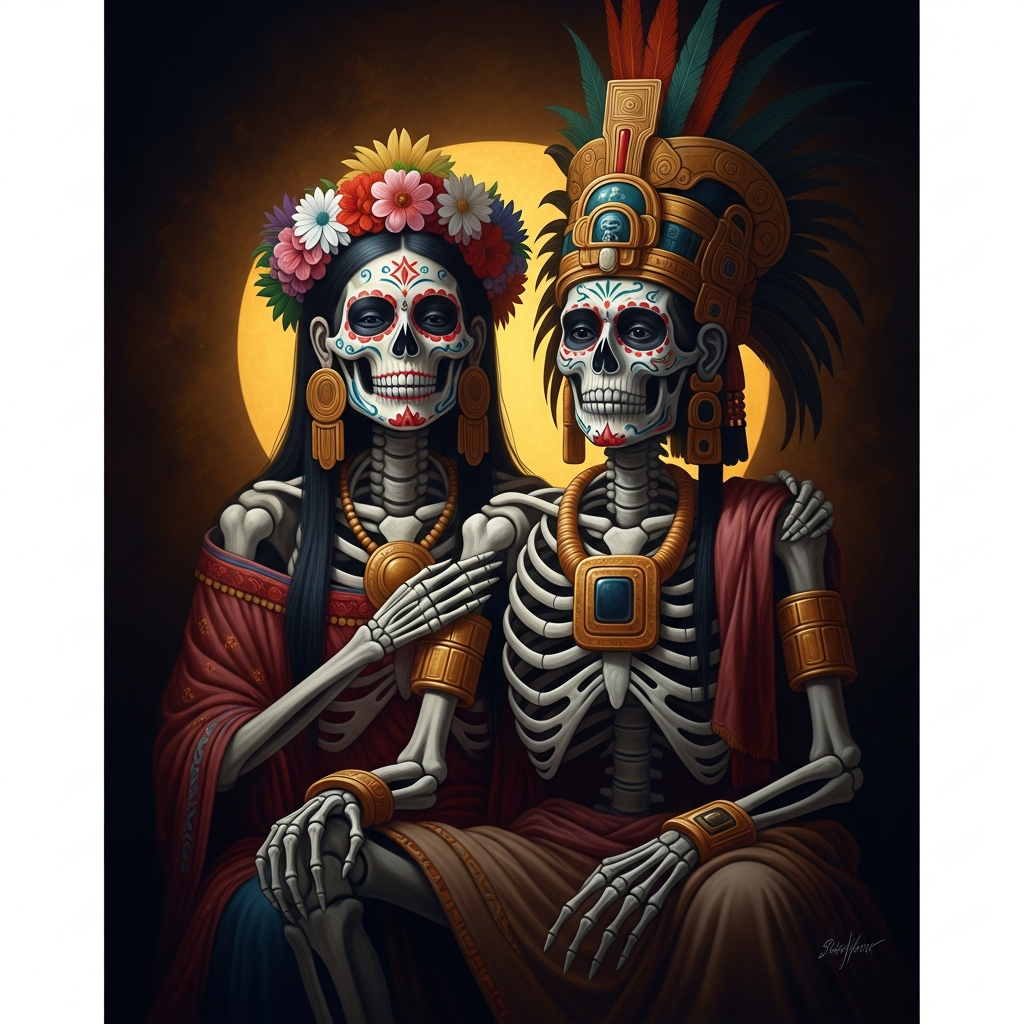
Mictecacihuatl (“Lady of Mictlan”) rules the underworld alongside her husband Mictlantecuhtli — but she has emerged in the centuries since the conquest as perhaps the most beloved Mexica deity in modern Mexican popular religion. She is the queen of the dead, charged with watching over the bones of those who have completed their journey through Mictlan, presiding over the festivals of remembrance. She is the deep root of the Día de los Muertos (Day of the Dead) — the November celebration in which Mexican families build ofrendas (altars), set out the favorite foods of the deceased, and welcome the dead home for one night of the year. La Catrina — the elegant skeleton-lady popularized by José Guadalupe Posada in 1910 and Diego Rivera in his murals — is recognizably Mictecacihuatl in modern dress.
Her iconography is stark: a flayed face, a fleshless mouth open wide, a crown of paper flowers. She is presented offerings of sugar skulls, marigolds (cempasúchil, the flowers whose scent guides the dead home), copal incense, and pan de muerto (bread of the dead). Unlike most death-deities of world mythology, Mictecacihuatl is not feared. She is loved. She is the mother who keeps the bones, who lets the dead return one night a year, who is the visible face of grief made tender. The conquest could not erase her. The Catholic friars folded her festival into All Saints’ Day and All Souls’ Day, but everyone in Mexico knows whose holiday it really is.
Biblical Parallels: Mictecacihuatl has no exact biblical parallel — the Hebrew Bible gives no female ruler of the dead, and Christian tradition has no enthroned queen of the underworld. She resembles the Catholic Virgin of Sorrows (Mater Dolorosa) in her role as the mother of those who have died, and All Souls’ Day (November 2) is now thoroughly intermingled with her festival. The biblical communion of saints (sanctorum communio) — the doctrine that the living and the dead share a single mystical body — provides the closest theological parallel to the Day of the Dead’s premise.
Cross-Tradition: Mictecacihuatl parallels the Sumerian Ereshkigal — queen of the underworld whose realm is the destination of all souls, including her own sister Inanna. She parallels the Greek Persephone (queen of the dead, but with the seasonal-return motif). She parallels the Hindu Kali in her death-aspect, though Mictecacihuatl is more domestic and less destructive. The Celtic Samhain festival — November 1, when the veil between worlds thins — is the ancestral parallel to Día de los Muertos in the Old World.
2 min read