Combat Profile
Tlacaxipehualiztli
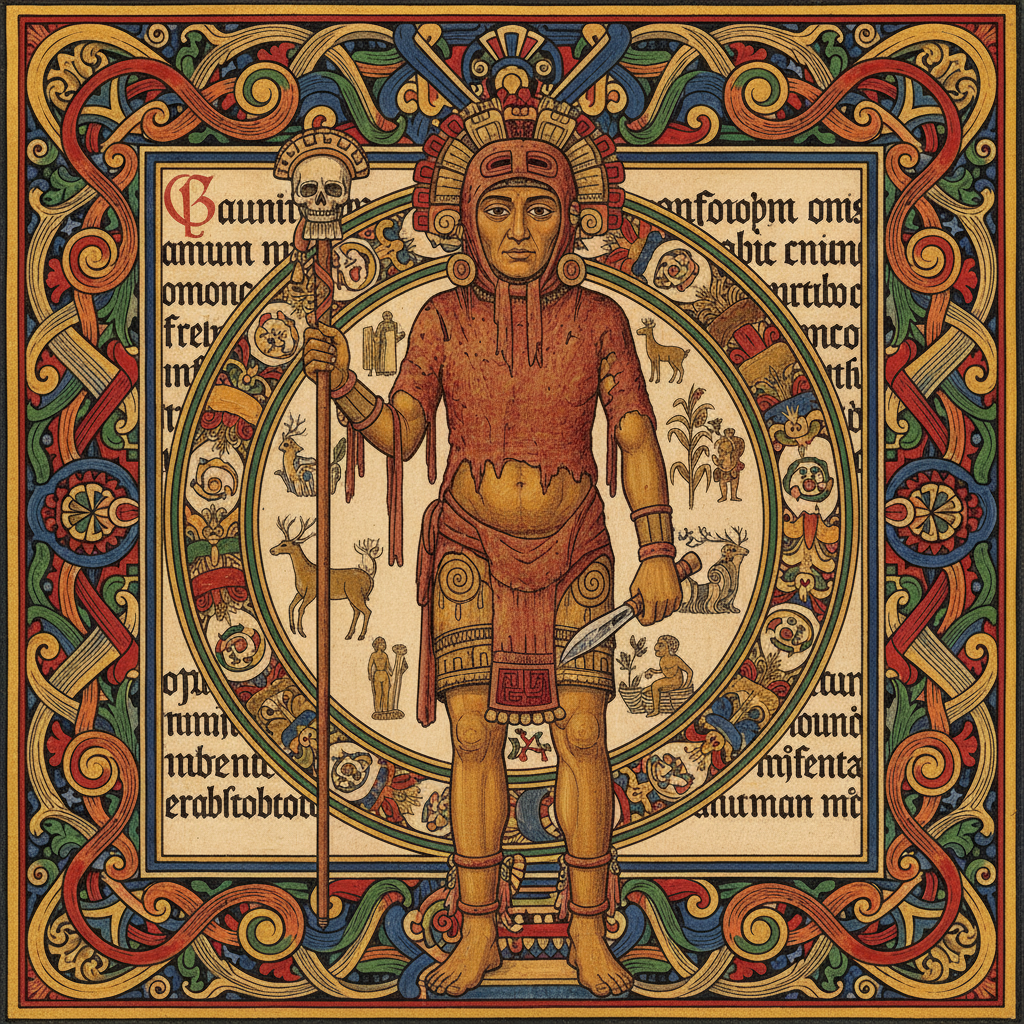
Xipe Totec wears the skin of the sacrificed; what dies in winter rises through his ritual as the new green corn pushes through the cracked husk of the world.
Seasonal Renewal
Xipe Totec's wearing-of-flesh sustains the cycle: every spring the earth rots its skin and emerges fresh, and his rite makes mythic what nature performs annually.
Xipe Totec (“Our Lord the Flayed One”) is the god of agricultural renewal, of seasons, of vegetation, of goldsmiths, and of the spring. His iconography is among the most disturbing in Mesoamerican art: a god depicted wearing the freshly flayed skin of a sacrificial victim, the dead skin’s eyes staring out, the dead skin’s mouth slack, the god’s living face peering through. His ritual was the Tlacaxipehualiztli (“Flaying of Men”), held in the spring at the planting season: captives were sacrificed, flayed, and priests donned the skins for twenty days as the skins slowly rotted off them — at which point new green corn was emerging from the earth. The theology: the earth in winter is a corpse; spring is the corpse splitting open as the new growth pushes through. Wearing the dead skin enacts the resurrection of the world.
Xipe Totec is also patron of those who suffer skin diseases — leprosy, smallpox, eye infections. His worship spread north from the Valley of Oaxaca, where the Zapotecs had honored him for centuries before the Mexica adopted him. Despite the brutality of his ritual, his theology is among the most poetic in the Aztec pantheon: every spring is a flaying. Every living thing wears the skin of what came before. The new green wheat is the dead body splitting at the seam.
Biblical Parallels: Xipe Totec’s ritual of putting on a new flesh-as-clothing parallels Paul’s “you have put on the new self” (Colossians 3:10) and the baptismal “putting on Christ” (Galatians 3:27) — though the Aztec literalization of skin-wearing is shocking to Christian sensibility. His role in agricultural resurrection parallels the Hebrew Tammuz / Adonis tradition that the prophet Ezekiel condemned (Ezekiel 8:14) — gods of spring vegetation whose deaths and risings track the agricultural calendar. The Pauline “if the seed does not die” (1 Corinthians 15:36) is a less violent statement of the same theology.
Cross-Tradition: Xipe Totec parallels the Sumerian Dumuzi/Tammuz, the Greek Adonis, the Phrygian Attis, the Egyptian Osiris — all agricultural-resurrection deities whose deaths sustain the seasonal cycle. The wearing of a skin or covering parallels shamanic traditions worldwide where the practitioner dons an animal hide or mask to become the god. His patronage of skin diseases parallels the Vedic Rudra — the storm god who is also the lord of healing herbs.
2 min read