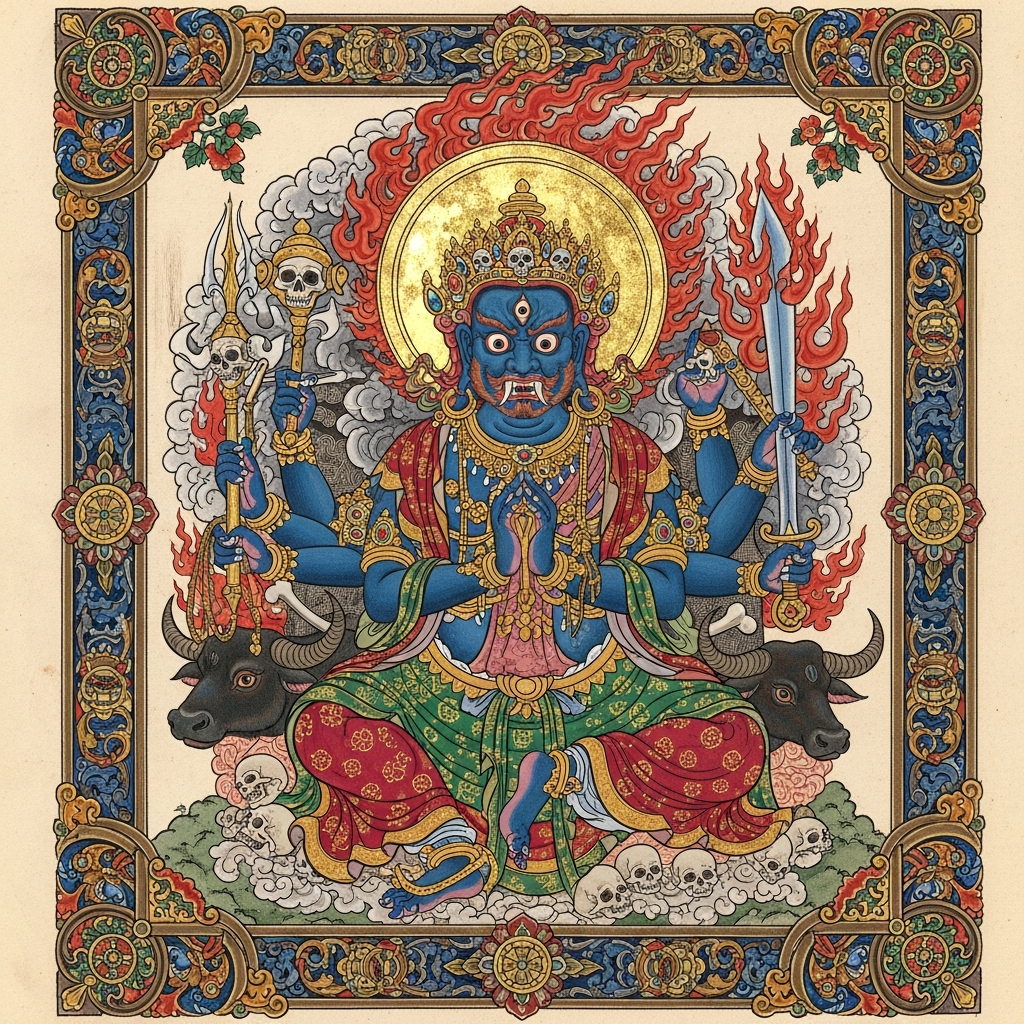
Combat Profile
Karmic Mirror
Yama reveals the true karmic weight of a being's actions, binding them to their deserved fate with absolute judgment.
Lord of Naraka
Yama's presence enforces the natural law of karma; all deception and moral transgression become transparent before him.
Subjugated by Yamantaka (wisdom conquers death); cannot hold beings whose karma is exhausted
Yama in Buddhist cosmology is the judge of the dead — a fearsome figure who presides over the transition between lives. When a being dies, Yama shows them the Mirror of Karma (yata-no-kagami in Japanese tradition): a perfectly clear reflection of every action, thought, and intention from their life. There is no advocacy, no defense attorney, no plea bargain. The mirror simply shows the truth, and the truth determines the next rebirth. This is judgment stripped to its essence: you are judged by what you actually did, not by what you believed or professed.
Yama is shared between Hinduism and Buddhism — one of the clearest examples of direct borrowing between traditions. The Vedic Yama (Rig Veda 10.14) was the first mortal to die and thus became king of the dead. Buddhist texts adopted him but softened his role: in Buddhism, Yama is not a punisher but an administrator. He takes no pleasure in hell — in some texts, he weeps at the suffering of the beings he must judge, and he himself is subject to karma.
The Christian parallels are multiple:
- The Judgment Seat: Yama’s mirror functions like the Final Judgment (Matthew 25:31-46) — your deeds are laid bare, and you go where your actions have earned you.
- Ma’at’s scales: In Egyptian judgment, the heart is weighed against the feather of truth. In Buddhist judgment, the mirror shows the truth of your karma. Both are mechanisms of perfect, impersonal justice.
- The Recording Angels: In Islamic tradition, Kiraman Katibin (the Noble Scribes) record every deed. Yama’s mirror serves the same function — total surveillance of moral action.
In the Tibetan Book of the Dead (Bardo Thodol), Yama appears during the bardo (intermediate state between death and rebirth) as a terrifying judge — but the text reveals that Yama IS the dead person’s own mind. The judgment comes from within. There is no external judge; there is only the inescapable confrontation with what you have become.
“Yama asked: ‘Did you not see the divine messengers — the old man, the sick man, the dead man? Did they not warn you?’ And the being had no answer.” — Devaduta Sutta (adapted)
2 min read
Yamantaka (his direct conqueror); enlightened beings pass through his realm freely
Pali Canon (Devaduta Sutta, Majjhima Nikaya 130); Petavatthu; Tibetan Book of the Dead (Bardo Thodol)