Combat Profile
Dreamtime Renewal
Floods the land to destroy and regenerate all life, reshaping geography and purifying existence in catastrophic cycles of death and rebirth.
Primordial Architect
Creates waterholes, rivers, and rainfall while simultaneously embodying the devouring serpent that swallows the unworthy and enforces cosmic law.
Can be offended by pollution of waterways, violation of sacred law, or disrespect to water sources. When angered, brings floods and destruction
“That rainbow, he’ll come out, you see him sitting on top of that waterhole. He’s there. He’s living there.” — Bill Neidjie, Story About Feeling
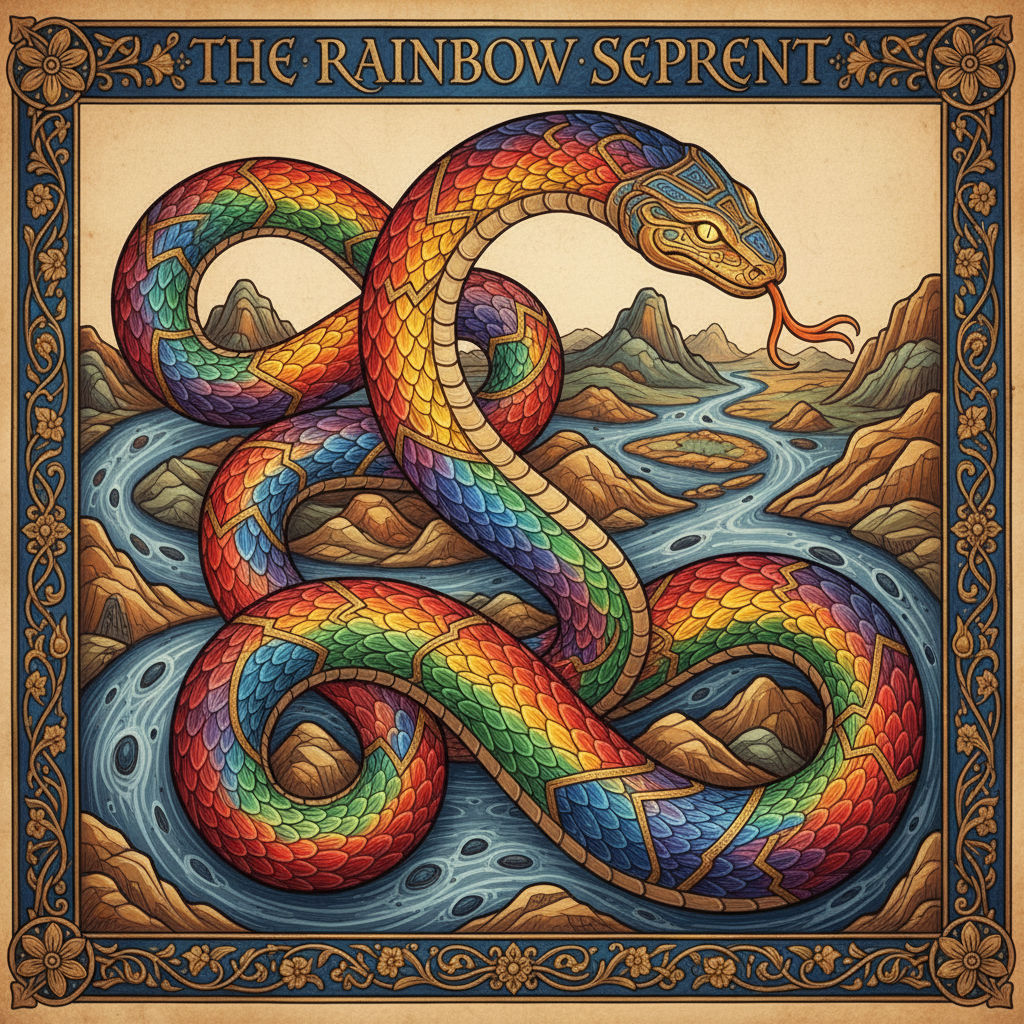
Lore: The Rainbow Serpent is the most widespread and ancient figure in Aboriginal Australian tradition — and, given the antiquity of Aboriginal culture, possibly the oldest continuously venerated being in human history. Rock art depicting serpentine figures in Arnhem Land has been dated to at least 6,000 years ago, but the oral tradition almost certainly extends far further. The Rainbow Serpent appears under dozens of names across the continent: Yurlunggur (Yolngu), Almudj (Gunwinggu), Wagyl (Noongar, Western Australia), Borlung (Miali), Ngalyod (Kunwinjku), Wollunqua (Warumungu). The names change. The serpent does not.
In the Dreaming, the Rainbow Serpent moved across the flat, featureless earth. As it slithered, it carved the riverbeds. Where it pushed the earth up, hills and mountains formed. Where it rested, waterholes appeared. It is, in a literal sense, the creator of the Australian landscape’s waterways — and in a continent where water is the difference between life and death, the Rainbow Serpent is the giver and withholder of life itself.
But the Rainbow Serpent is not gentle. It is not a benevolent deity in the Christian sense. It is powerful, and power is dangerous. When angered — by pollution of water, by violation of law, by improper behavior at sacred sites — the Rainbow Serpent brings floods, storms, and destruction. It swallows people. It drowns the disobedient. It is creator and destroyer in one being, which is precisely the point: in Aboriginal understanding, creation and destruction are not opposites. They are aspects of the same force. Water gives life and takes it. The river that feeds you can drown you.
Parallel: Every culture has its great serpent. Jormungandr (Norse) encircles the world. Leviathan (Hebrew) embodies primordial chaos. Tiamat (Mesopotamian) is the salt-sea mother slain to create the cosmos. Quetzalcoatl (Mesoamerican) is the feathered serpent of wind and wisdom. Mucalinda (Buddhist) shelters the meditating Buddha. But the Rainbow Serpent differs from all of these in one crucial respect: it is a creator. In nearly every other tradition, the great serpent is either a chaos monster to be defeated (Tiamat, Leviathan, Jormungandr), a tempter (Eden’s serpent), or a neutral figure. The Rainbow Serpent creates life. It makes the rivers. It brings the rain. The serpent as giver of life rather than bringer of death — this inverts the dominant mythological pattern of the rest of the world.
The other remarkable feature is the Rainbow Serpent’s gender fluidity. Across different nations and traditions, the Rainbow Serpent is male, female, both, or neither. This is not inconsistency. It is the tradition’s way of encoding the truth that the fundamental creative force transcends gender categories — a theological position that most other traditions arrived at only after centuries of philosophical development (the Ein Sof of Kabbalah, the nirguna Brahman of Hinduism).
2 min read
None -- the Rainbow Serpent is not defeated. It is appeased, respected, and maintained through proper ceremony
Neidjie, *Story About Feeling*; Radcliffe-Brown, *The Rainbow Serpent Myth of Australia* (1926); Mountford, *The Dreamtime*; Taconelli et al., rock art dating studies