Combat Profile
Lunar Judgment
Khonsu marks a target with moonlight, healing allies while slowly draining the marked enemy's vitality over the course of a lunar cycle.
Night's Passage
Khonsu's presence accelerates time in darkness; all divine healing and exorcism effects gain increased potency during night hours.
“His name means ‘Traveler’ — he crosses the sky each night, measuring the months, devouring the unworthy.”
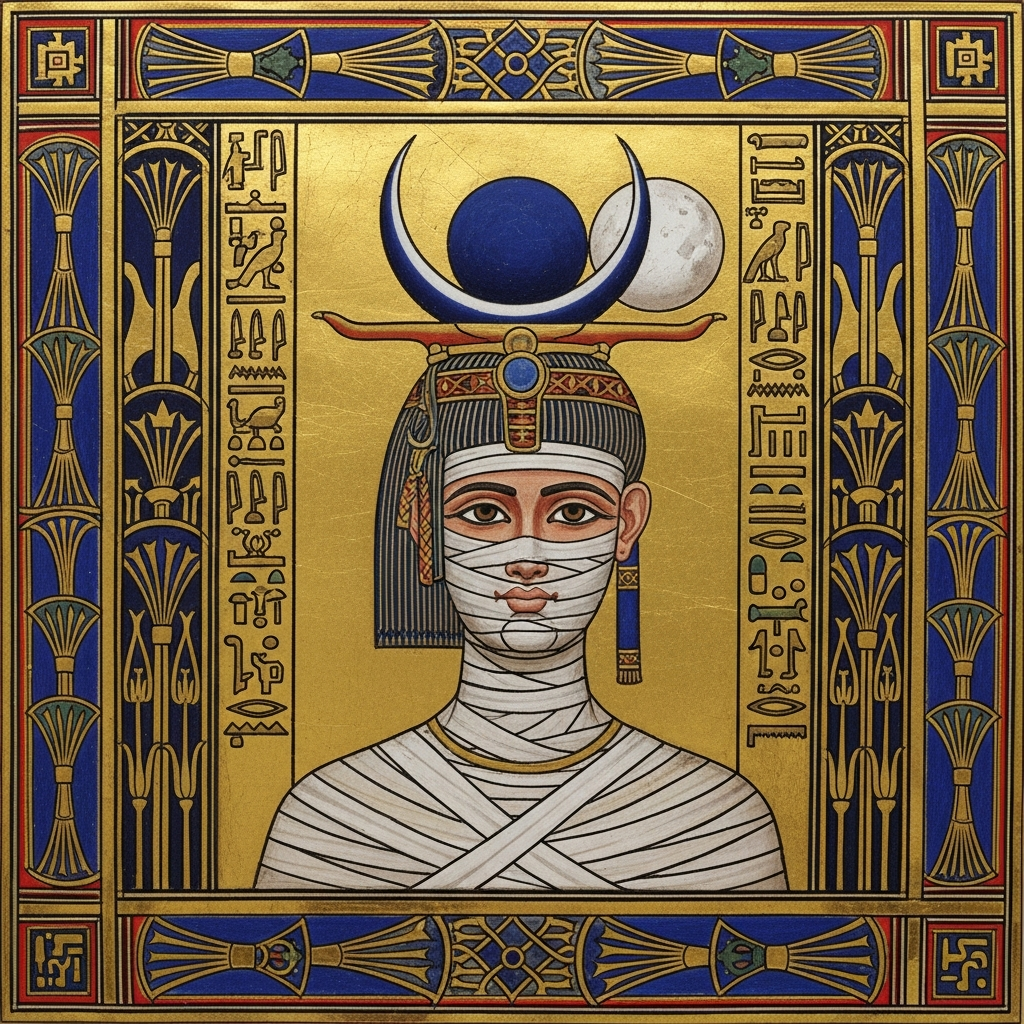
Khonsu’s name (ḫnsw) means “the traveler” or “wanderer” — the moon as it crosses the sky. He is the son of the great Theban triad (Amun and Mut), depicted as a young man with the side-lock of youth, holding the crook and flail, with the lunar disk and crescent on his head. His double nature is striking: in the Pyramid Texts, he is a fearsome deity who helps the dead pharaoh hunt and devour other gods to absorb their potency (Pyramid Texts 273-274 — the so-called “Cannibal Hymn”); in later periods, he is the gentle healer-exorcist whose statue, sent to a foreign princess in the Bentresh Stela, drives a demon out of her by sheer presence. The Theban temple of Khonsu at Karnak was one of the most important healing centers in late-period Egypt.
Cross-tradition parallels: Chandra (Hindu moon god, also a “wanderer,” also tied to time-measurement and fertility); Sin/Nanna (Mesopotamian moon god); Selene (Greek moon-goddess); Christ as exorcist (Mark 1:23-27, Mark 5:1-20) — the lunar exorcism tradition was a domain Khonsu had owned.
1 min read
Pyramid Texts (Spells 273-274, the "Cannibal Hymn"); the Bentresh Stela (a healing exorcism narrative, 4th century BCE); Karnak Khonsu Temple inscriptions