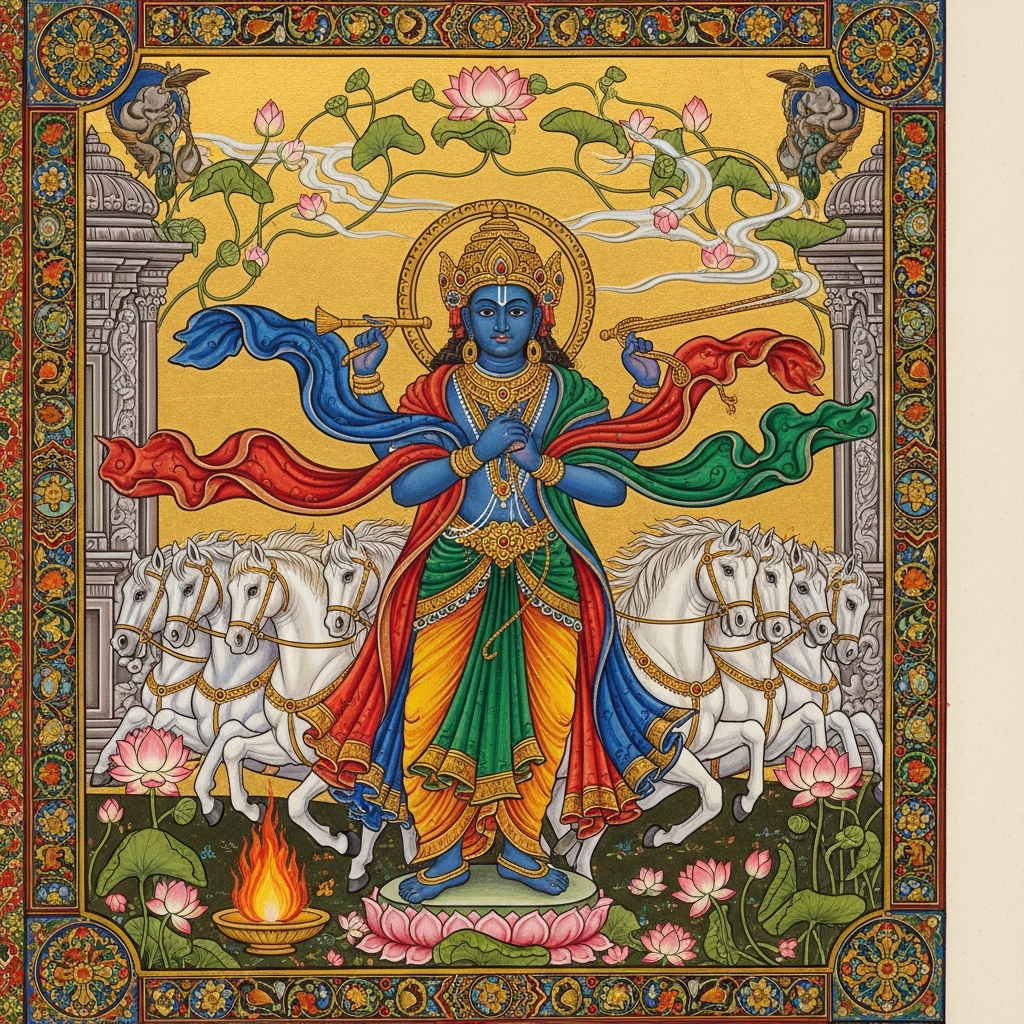
Combat Profile
Prana Vortex
Vayu unleashes a devastating cyclone that strips enemies of vital energy while empowering allies with supernatural speed and endurance.
Lord of Breath
All allies gain enhanced movement speed and resistance to suffocation; Vayu's attacks cannot be blocked by physical barriers.
Vayu is wind, breath, and life-force conceived as a single divine principle (Rig Veda 1.134). Without breath, no living thing exists; without wind, fire cannot rise to the gods. He is therefore the silent partner of Agni in every Vedic sacrifice. He rides a chariot pulled by a thousand horses, or a deer/antelope, and carries a banner and goad (Vayu Purana 1.30).
His mythological children are among the mightiest figures in Hindu epic. Hanuman, the monkey god of the Ramayana, was conceived when Vayu blew sacred pudding into the womb of Anjana (Ramayana, Bala Kanda). Bhima, the second Pandava and the strongest warrior of the Mahabharata, was born when Kunti invoked Vayu (Mahabharata 1.114). Both inherit their father’s wind-speed and earth-shaking strength.
Cross-tradition parallels: Aeolus (Greek lord of the winds); the Hebrew ruach (wind / breath / spirit — the same triple meaning that Vayu embodies); the Holy Spirit’s manifestation as “a sound like a mighty rushing wind” at Pentecost (Acts 2:2); Enlil (Mesopotamian lord of wind and breath of command).
1 min read
Rig Veda, Vayu Purana, Mahabharata, Ramayana