Combat Profile
Wrath of the Dissenter
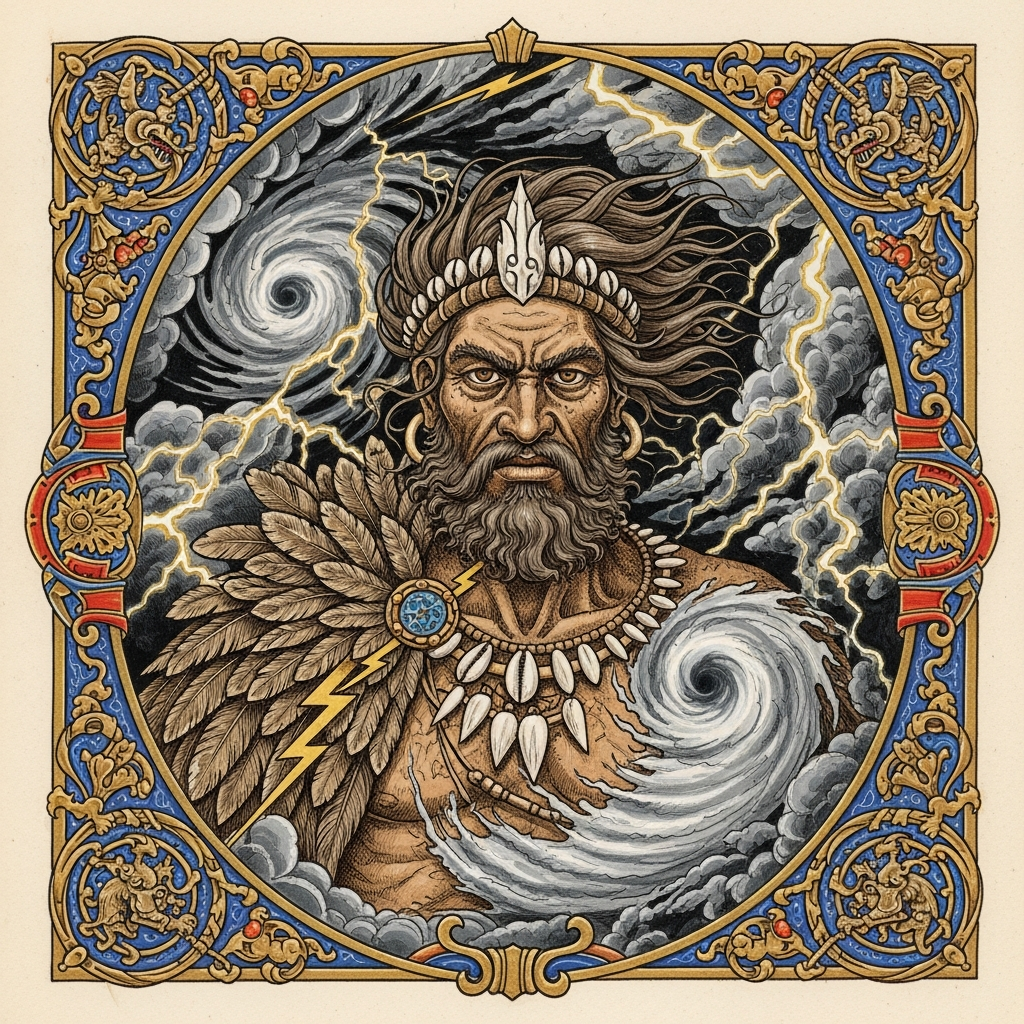
Unleashes a devastating tempest that strikes all enemies with lightning and wind, dealing damage proportional to how many allies have been defeated
Filial Vengeance
Automatically retaliates with lightning strikes when allies are harmed, and gains power each time a sibling deity (or allied god) takes damage
His loyalty to his parents blinds him to his siblings' suffering. Tāwhirimātea fought for love, but love made him destructive. He could not see that his brothers needed light to live
“Tāwhirimātea alone refused. He would not part his father from his mother. And when they were torn apart, his grief became rage, and his rage became the storm.”
Lore: Tāwhirimātea is the most morally complex figure in the Māori creation narrative — and in a narrative where every figure is morally complex, that is saying something. He is the storm god, the god of wind and weather, and the only child of Rangi and Papa who opposed the separation of the primordial parents. His brothers wanted light. Tāwhirimātea wanted his parents to remain together. When the separation happened anyway — when Tāne pushed the sky from the earth — Tāwhirimātea did not accept it. He tore out his own eyes (a self-mutilation that echoes Odin sacrificing his eye for wisdom, except that Tāwhirimātea’s sacrifice was not for knowledge but from grief) and hurled them into the heavens, where they became stars. Then he followed his father upward and from the heights launched a war against his siblings.
His storms shattered everything. Tāne’s forests were broken, trees uprooted and split. Tangaroa’s sea was churned into chaos, and his children split into two groups — those that fled into the deep ocean (fish) and those that fled onto the land (lizards and reptiles), a division that has never healed. Rongo and Haumia hid in Papa’s body, burrowing into the earth. Only Tū stood and fought. The war between Tāwhirimātea and Tū was the first war, and it has never ended. Every storm continues that original battle. Every gale that tears at the world is Tāwhirimātea still raging against what his siblings did to his parents.
Parallel: The most obvious comparison is Lucifer — the one who rebelled against the new order. But the comparison reveals a profound difference. Lucifer rebels against God out of pride (Milton) or jealousy (Islamic tradition). Tāwhirimātea rebels against his siblings out of love for his parents. He is not the adversary. He is the loyal son. He is the child who looked at his weeping father and his grieving mother and said: you were wrong to do this. And he has been saying it ever since, in every cyclone, every hurricane, every gale that tears the roofs off houses. The storms are not chaos. They are a son’s grief.
2 min read
Tū-mata-uenga (the only sibling who stood against his storms and did not break)
Grey, *Polynesian Mythology*; Best, *Maori Religion and Mythology*; Te Ara -- "Tāwhirimātea"