Combat Profile
Tears of Papatūānuku
channels deep sorrow into catastrophic earthquakes and landslides that reshape the physical world
Mother's Embrace
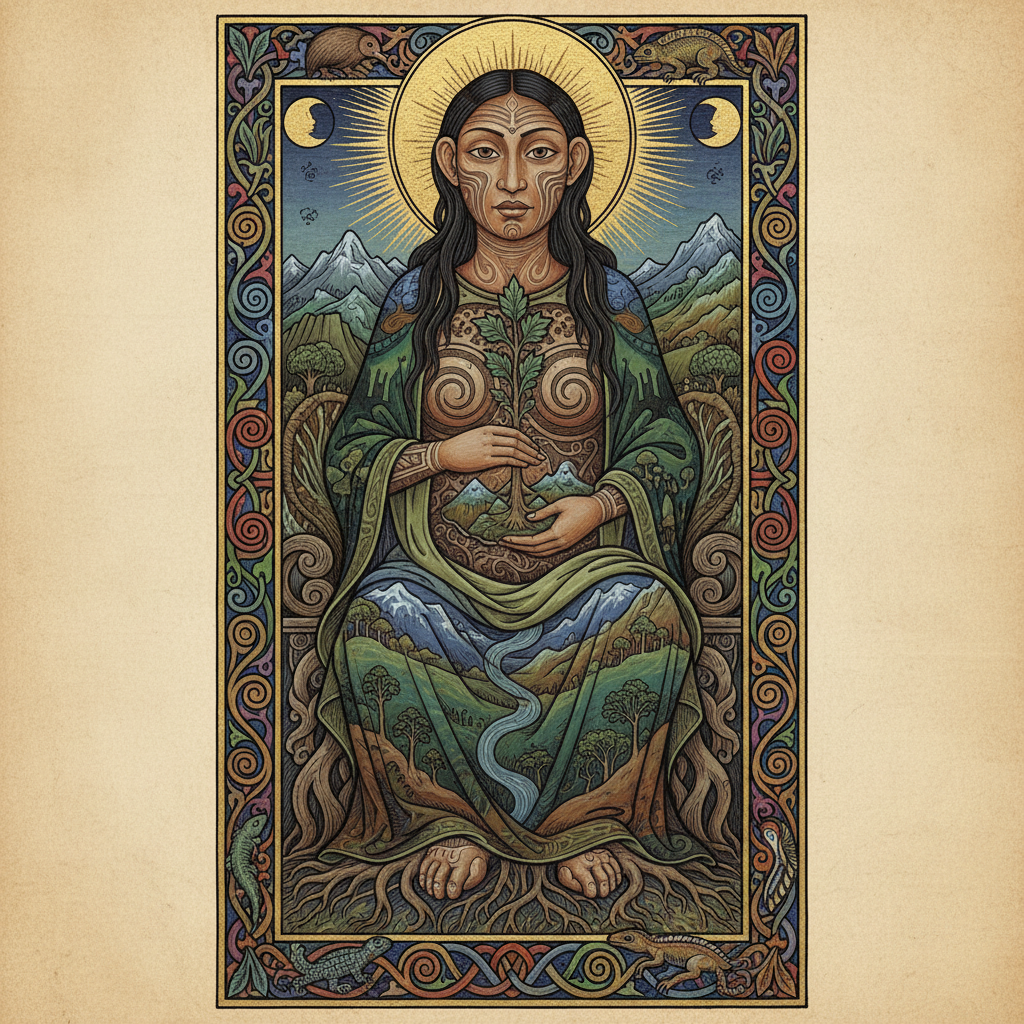
all beings born of or dwelling upon her domain gain resilience, fertility, and connection to ancestral memory
Immobile. Papa lies on her back, separated from Rangi, unable to reach him. Her grief is as eternal as his
“The earth lies still beneath us, but she is not dead. She breathes. Her rivers are her blood, her forests her garments, and when the land shakes, it is Papatūānuku, turning in her sleep, reaching for the sky.”
Lore: Papatūānuku is the earth — and in Māori understanding this is not metaphor. The land you stand on is her body. The rivers in the valleys are her veins. The forests on the hills are her cloak. The geothermal springs and volcanic vents of the North Island are her body heat rising to the surface. When an earthquake strikes, Papa is moving — shifting, turning, reaching upward toward Rangi, whom she can feel but never touch.
This is why the Māori relationship to land is not ownership but kinship (Mead, Tikanga Māori). You do not own Papatūānuku any more than you own your mother. The concept of land as commodity — bought, sold, exploited — was incomprehensible in traditional Māori thought because land is an ancestor (Royal, Te Ara). The rivers have genealogies. The mountains have names and personalities and relationships with each other. When the Whanganui River was granted legal personhood by the New Zealand government in 2017 (Te Awa Tupua (Whanganui River Claims Settlement) Act, 2017), Western media treated it as novelty. For Māori, it was the legal system catching up with reality. The river had always been a person. It had always had rights. The law took 177 years to notice.
Parallel: Earth mother figures appear universally — Gaia (Greek), Ki (Sumerian), Prithvi (Hindu), Pachamama (Andean), Coatlicue (Aztec). But the parallels reveal by contrast. Gaia is powerful and sometimes wrathful but not grieving. Prithvi endures. Pachamama provides. Papatūānuku mourns. She is a mother whose children tore her from her husband, and she lies beneath them, feeding them, clothing them in forests, giving them rivers to drink from — and she has not forgiven them, and she has not stopped grieving, and when the earth shakes, you are feeling her loss. No other earth goddess is this emotionally specific.
2 min read
Nothing counters the earth. But her children's decision to separate her from Rangi is the wound that never heals
Grey, *Polynesian Mythology*; Orbell, *Illustrated Encyclopedia of Māori Myth and Legend*; Te Ara -- "Papatūānuku"