Combat Profile
Celestial Bridge
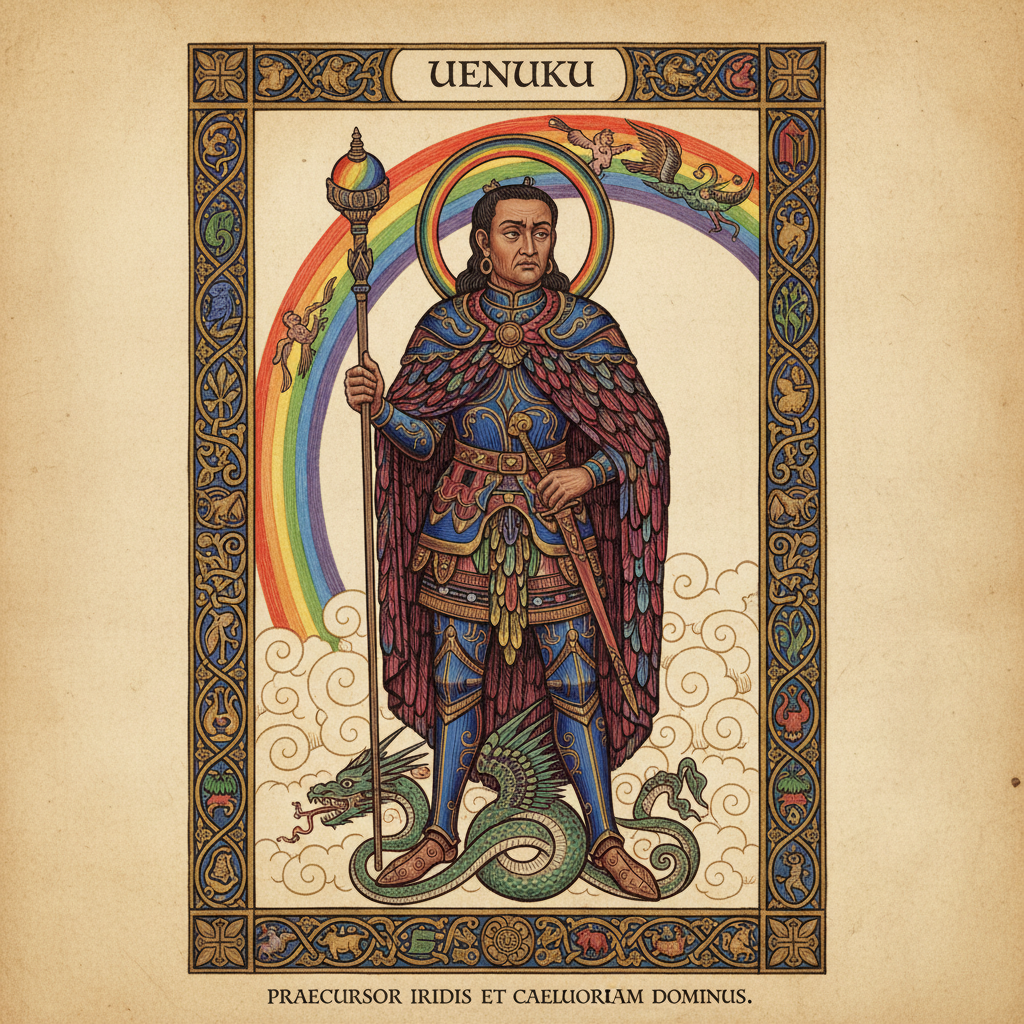
Uenuku manifests as a rainbow to guide souls between the world of the living and the realm of ancestors, granting passage or revelation to those deemed worthy.
Omen's Clarity
All omens and portents become visible in Uenuku's presence, and warriors see visions of coming battles reflected in rainbow light, never entering conflict unprepared.
He cannot hold what he loves. His wife was a mist maiden who vanished at dawn. The rainbow appears and fades. Uenuku's existence is defined by reaching for what dissolves
“Uenuku stretches across the sky after rain, and we call that the rainbow. He is still looking for her. She is still hiding in the mist.”
Lore: Uenuku is one of the most haunting figures in Māori mythology — a chief of immense mana whose love story became the origin of the rainbow. Uenuku began to notice someone sharing his sleeping mat at night. He could feel her warmth, hear her breath, but she was always gone before dawn. Night after night she came. Night after night she vanished. Uenuku fell in love with a woman he had never seen.
He devised a plan. He blocked every window and opening so no light could enter. When morning came, his wife — Hinepūkohurangi, a woman of the mist, a spirit being who existed only in darkness and moisture — found herself trapped. The light revealed her. She was furious. She had trusted the darkness. She had given herself to Uenuku on the condition (spoken or unspoken) that the boundary between their worlds would be respected. Uenuku broke that trust. Hinepūkohurangi dissolved into mist and never returned.
Uenuku’s grief transformed him. In some versions he died of sorrow and became the rainbow — a great arc of color that appears after rain and reaches across the sky, beautiful and untouchable, appearing only when sun and moisture meet. The rainbow is Uenuku’s eternal search. The mist is Hinepūkohurangi’s eternal hiding. They exist in the same meteorological conditions — rain, sun, moisture — but they can never touch again.
Parallel: Iris (Greek) is the rainbow personified as a messenger of the gods, but there is no tragedy in it — Iris is functional, not emotional. The closest parallel is Orpheus and Eurydice (Greek: a man who loses his wife to the underworld and fails to bring her back because he breaks the one rule he was given). Uenuku, like Orpheus, breaks the condition of his love — don’t look back, don’t let in the light — and loses everything. But the Māori version is built into the weather. You don’t need to read a book to encounter this story. You see it every time the sun comes out after rain. The rainbow is a love story. The mist is a woman hiding. Every New Zealander who looks at a rainbow is looking at Uenuku’s grief.
2 min read
Dawn. Uenuku's wife Hinepūkohurangi was a mist spirit who could only exist in darkness. When sunlight touched her, she evaporated. Love that cannot survive the light
Grey, *Polynesian Mythology*; Orbell, *Illustrated Encyclopedia*; Best, *Maori Religion and Mythology*