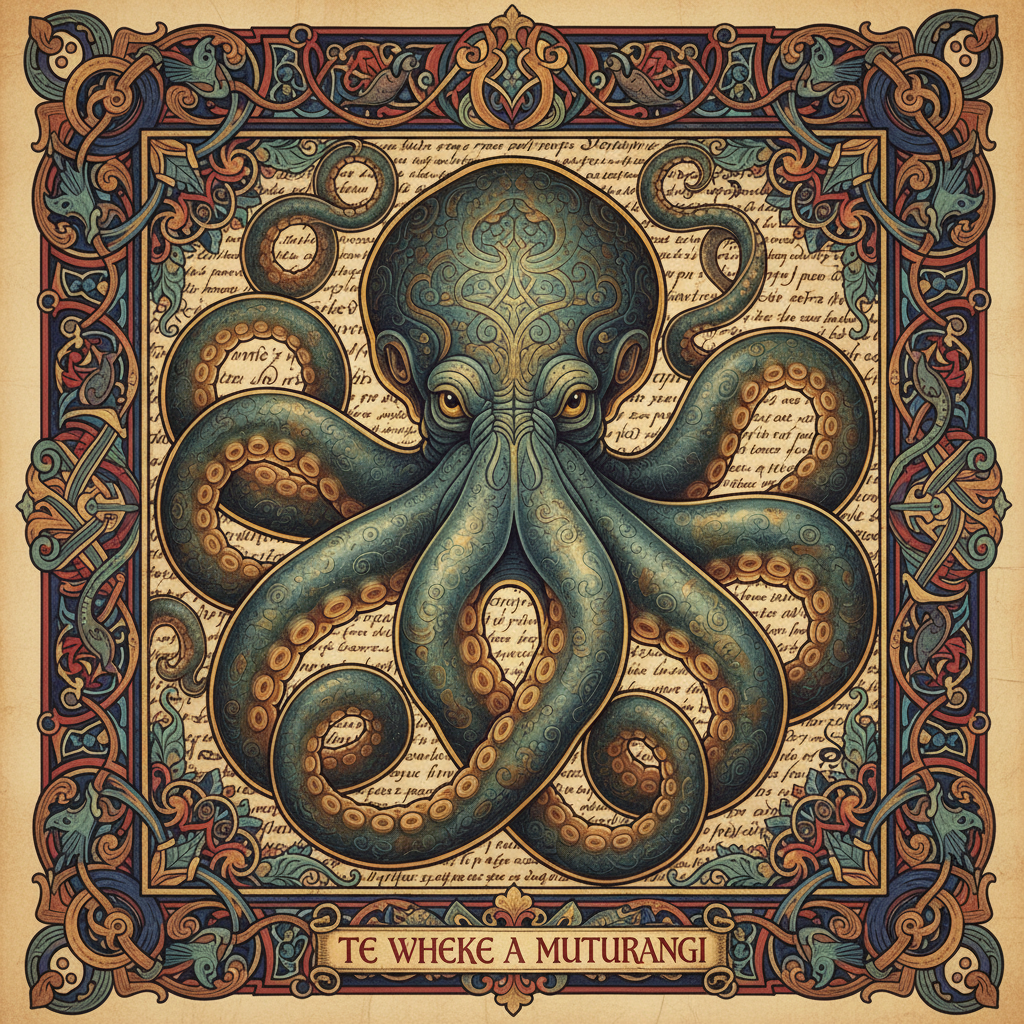
Combat Profile
Kaitiaki's Wrath
Te Wheke unleashes a devastating tidal surge that destroys all in its path while simultaneously guiding worthy voyagers to their destination.
Taniwha's Domain
Te Wheke commands absolute sovereignty over ocean waters, gaining strength in maritime territories and the ability to sense all vessels crossing its realm.
Mortal despite its size. The great navigator Kupe hunted it, fought it, and killed it. The monster that terrorized the seas was, in the end, just an animal -- extraordinary, but killable
“Kupe followed the great octopus across the ocean, and the octopus led him to a land no one had seen. The monster’s flight was the path to paradise.”
Lore: Te Wheke-a-Muturangi is a giant octopus — a taniwha, a supernatural water creature — and its story is the Māori discovery narrative. In the homeland of Hawaiki (the mythologized origin point of all Polynesian peoples), the octopus had been stealing the catch of fishermen, reaching its enormous tentacles into canoes and stripping them clean. The great navigator Kupe determined to hunt it. He loaded his waka, gathered his family, and set out across the open Pacific.
The chase was epic. The octopus fled south and west. Kupe followed, navigating by stars, currents, the flight of seabirds. The pursuit led him to an unknown land — a pair of great islands, mountainous, forested, wreathed in cloud. Kupe’s wife, Kuramārōtini, saw the long white clouds banked on the horizon and said: “He ao, he ao, he Aotearoa!” — “A cloud, a cloud, a long white cloud!” That is New Zealand’s name to this day: Aotearoa, the Land of the Long White Cloud, named by a woman from a canoe while her husband hunted a sea monster. Kupe cornered the octopus in the strait between the two islands (now Cook Strait) and killed it. He explored the coastline, then returned to Hawaiki to report his find, providing the sailing directions that would later guide the great migration fleet.
Parallel: The monster-pursuit-leading-to-discovery is a unique mythological structure. Compare Jörmungandr (Norse — the world serpent that encircles the earth, but no one chases it to a new land), the Kraken (Scandinavian folklore — a sea monster that destroys but does not lead), and Scylla and Charybdis (Greek — sea monsters that guard a passage but don’t motivate a journey of discovery). The closest parallel might be Moby Dick (a great white whale pursued across the ocean), but Melville’s version ends in destruction. Kupe’s version ends in New Zealand. The monster’s flight was the path to paradise. This is a discovery narrative where the villain is also the guide, where the thing you chase in anger becomes the thing that gives you a home.
2 min read
Kupe (the great Polynesian navigator who pursued the octopus across the Pacific and killed it in the waters around Aotearoa)
Grey, *Polynesian Mythology*; Orbell, *Illustrated Encyclopedia*; Te Ara -- "Kupe"