Combat Profile
Sacrifice's Abundance
their death and dismemberment across generations transforms flesh into the fertile earth that yields endless crops and sustenance for mortals.
Cycle of Renewal
death and life are eternally bound; crops and tubers grow from sacred soil where Dema bodies rest, making destruction itself generative.
They are defined by their vulnerability. The dema are *killed* -- their power comes not from strength but from what grows from their death
“They killed her and buried her and from her body the food grew. This is the secret: every meal is a funeral. Every harvest is a remembrance of murder.”
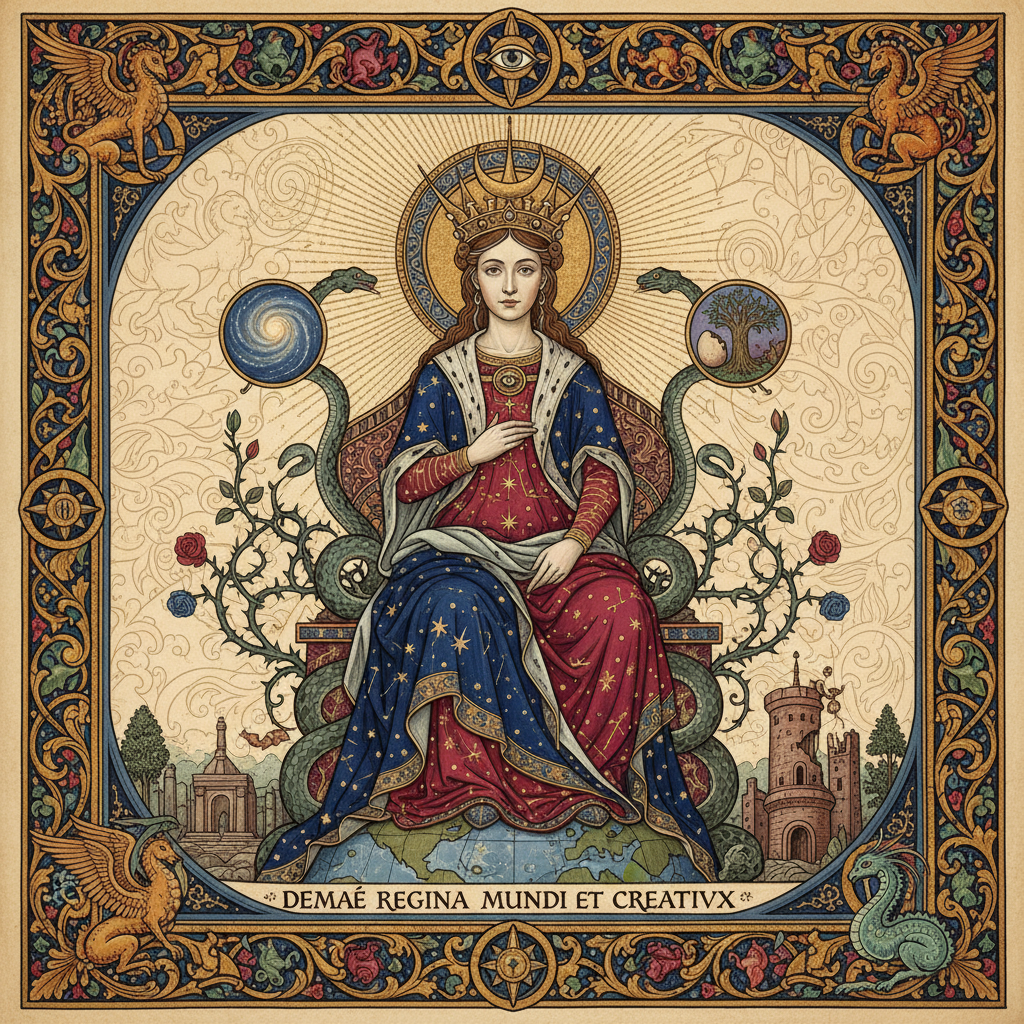
Lore: The dema deities are a category of mythological being identified by German ethnographer Adolf Ellegard Jensen among the Marind-anim of Papua New Guinea (Jensen, Myth and Cult Among Primitive Peoples), later documented across Melanesia and eastern Indonesia. The word dema comes from the Marind-anim language and means “primordial ancestors” or “divine beings of the first time.” The defining feature: dema are killed, and from their death — specifically from the dismemberment and burial of their bodies — food plants emerge. The original dying-and-rising gods, except they do not rise. They become something else. The god dies so the yam can live.
The most famous dema myth is Hainuwele from Ceram (Maluku Islands, eastern Indonesia, culturally Melanesian) (Jensen, Myth and Cult Among Primitive Peoples). Hainuwele was born from a coconut palm that a man named Ameta had watered with his own blood after cutting his finger. She grew rapidly and had a miraculous power: she defecated valuable objects — coral, Chinese porcelain, bush knives, golden earrings, copper gongs. During the great Maro dance, she stood at the center and distributed her gifts to the dancers. But the villagers grew uneasy, disturbed by her strangeness. On the ninth night, they dug a pit, pushed her in, and buried her alive as the dancers trampled the earth above her. Ameta discovered the murder, exhumed her body, and cut it into pieces, which he buried throughout the village. From each piece grew a different tuber plant. Hainuwele’s death is the origin of agriculture. Every yam is her flesh. Every meal is her body, consumed (Jensen, Myth and Cult Among Primitive Peoples).
Parallel: The pattern of creation from a dismembered divine body is one of the most widespread motifs in world mythology: Purusha (Hindu — the cosmic man dismembered in the first sacrifice, from whose body the world is formed, Rig Veda 10.90), Ymir (Norse — the frost giant killed by Odin and his brothers, from whose body the earth, sea, sky, and clouds are made), Tiamat (Mesopotamian — the primordial dragon split by Marduk, her body becoming heaven and earth), and Pan Gu (Chinese — the cosmic giant whose body becomes the world at death). The dema myths are specifically about food, not the whole cosmos. This makes the parallel with Christian Eucharistic theology uncomfortably precise: “This is my body, broken for you” (1 Corinthians 11:24). Christ’s body is consumed in the Eucharist so that the communicant may have life (1 Corinthians 11:24). Hainuwele’s body is consumed as tuber plants so that the community may eat. The theological structure is identical: a divine being dies, and from the death comes sustenance for the living. The difference is that the Melanesian version does not pretend to be metaphorical.
2 min read
The community that kills them. The dema are murdered by the people they will feed. This is the foundational paradox: the creators are destroyed by their creations
Jensen, *Myth and Cult Among Primitive Peoples*; Eliade, *Patterns in Comparative Religion*; Lindstrom, *Knowledge and Power in a South Pacific Society*