Combat Profile
Crown of Hubris
Kay Kavus grants himself and allies immense power for three turns, but each use increases the cost of future abilities
Mortal King's Delusion
Kay Kavus believes himself invincible, gaining bonus ATK but suffering reduced DEF when facing divine or superior foes
Lack of wisdom; overconfidence in his power; inability to accept limits
“I am the king, and I command the sky itself to yield to me. I shall ride to heaven on eagles and sit in judgment over all creation.” — Kay Kavus
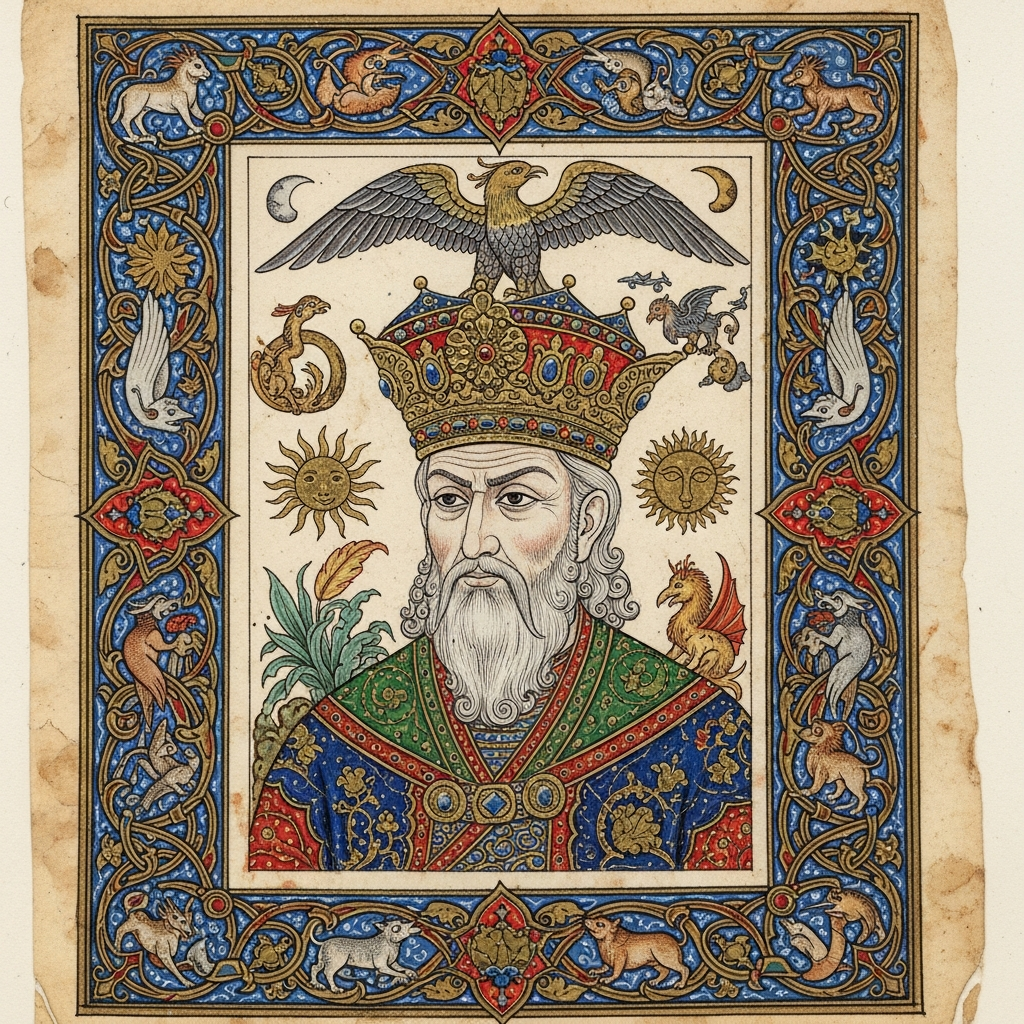
Kay Kavus is the king of kings, a powerful ruler in his own right, yet his greatest adventures are marked by folly and delusion (Shahnameh). Most famously, he attempts to fly to heaven by building a throne carried aloft by four eagles, each held by a cord of raw meat that the eagles reach for, carrying the throne ever upward (Shahnameh). This mad scheme nearly succeeds but ultimately fails, and Kay Kavus falls back to earth, his pride and ambition thwarted (Shahnameh).
Kay Kavus’s low INT (40) reflects his strategic foolishness — despite his authority as a king, his decisions are driven by ego rather than wisdom. He is advised by Rostam, one of the wisest as well as strongest of heroes, yet he often ignores this counsel in favor of his own prideful impulses.
Kay Kavus serves as a contrast to both Jamshid (who ruled wisely for 700 years before pride corrupted him) and Fereydun (who established justice). Kay Kavus’s rule is marked by occasional wisdom but more often by folly, yet he is not evil — merely foolish, ambitious, and bounded by the limits that confine all mortals.
Biblical Parallel: The Pharaoh who hardens his heart against Moses; Nebuchadnezzar (the king whose pride leads to madness and loss of his kingdom); the rich fool in Jesus’s parable (plans great things, not knowing what the next day will bring).
Cross-Tradition Connections: Daedalus (whose ambition to fly leads to tragedy); Prometheus (reaching beyond the proper limits of human/mortal power); Icarus (flying too close to the sun).
1 min read
Reality itself; the limits of mortal existence; Rostam (his advisor and ally, whose counsel he ignores)
Ferdowsi, *Shahnameh*