Combat Profile
Banner of Justice
grants divine protection and martial victory to rulers who govern with fairness and righteousness, turning the tide against tyranny.
Symbol of Sovereignty
radiates unwavering authority that inspires loyalty in the just and strikes fear in the hearts of oppressors.
Can be lost in battle (though it has never been permanently captured)
“The Derafsh Kaviani flies above every righteous army, and beneath its standard, Persia has never been truly conquered. It is the apron of a common blacksmith, yet it has power greater than kingdoms.” — Ancient Persian saying
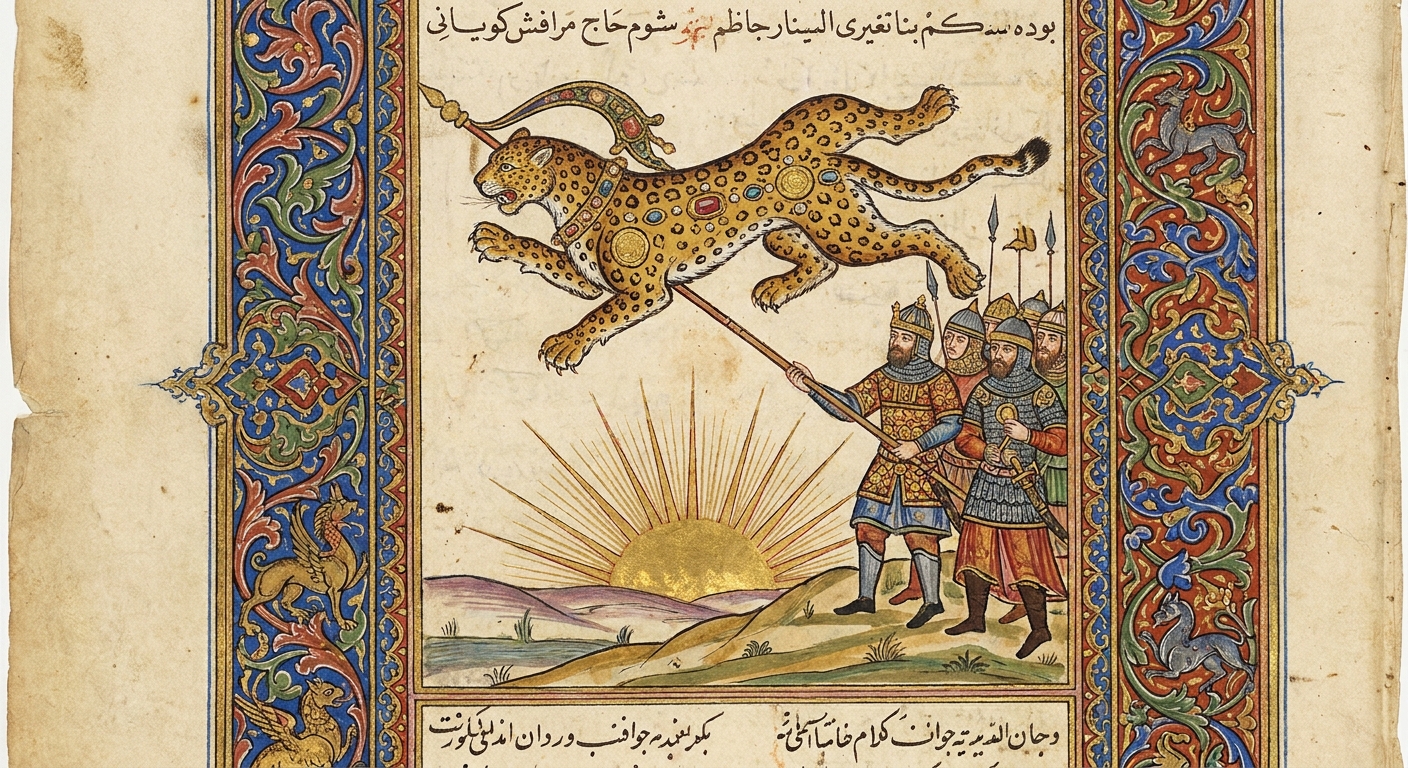
The Derafsh Kaviani is not a being but a sacred object — the leather apron that Kaveh the Blacksmith wore, which he tore off and tied to a spear when he rose against Zahhak (Shahnameh). When the tyrant was defeated and Fereydun established his righteous kingdom, Kaveh’s apron was elevated to the status of the royal standard, to be carried into battle before every legitimate Persian army (Shahnameh).
The Derafsh Kaviani becomes the symbol of legitimate rule in Persia (Shahnameh). To carry it into battle is to declare that one’s cause is just; to lose it in battle is to lose the blessing of Persia itself (Shahnameh). Throughout the Shahnameh and subsequent history, great significance is attached to the standard. It is said to have been embroidered with golden images and gems, and later, during the Sassanid period, it was studded with a great ruby that was said to blaze like fire (Denkard; Sasanian inscriptions).
The Derafsh Kaviani’s DEF (100) reflects its inviolability against just causes — it protects those who fight under it with righteousness. Its SPR (95) reflects its spiritual authority as a symbol of just rule and national sovereignty.
The object illustrates a key theme in Persian mythology: power comes not only from strength or divinity but from the legitimacy conferred by the people and by just rule. A common man’s apron, raised by collective resistance against tyranny, becomes more valuable than the thrones of kings.
Biblical Parallel: The Ark of the Covenant (the sacred object that symbolizes God’s covenant with Israel; its presence blesses the righteous and curses the wicked); the Menorah (symbol of Israel); the Holy Grail (sought after, sacred, source of blessing).
Cross-Tradition Connections: The Excalibur (the sword that proves legitimacy of rule); the Crown Jewels (symbols of legitimate sovereignty); national flags and standards across cultures.
2 min read
Tyrants and those who rule unjustly (it will not protect them)
Ferdowsi, *Shahnameh*; Zoroastrian texts