Hitchhiker's Guide to Religion
Roman

Silvanus

Roman Archaic Roman — one of the most personally beloved rural Roman deities throughout the Republic and Empire; Cato, Pliny, and later inscriptions confirm his cult's extraordinary breadth and persistence All of rural Italy and the Latin provinces; his cult was the most personally beloved of all Roman countryside deities, attested by more private votive inscriptions than almost any other Roman god
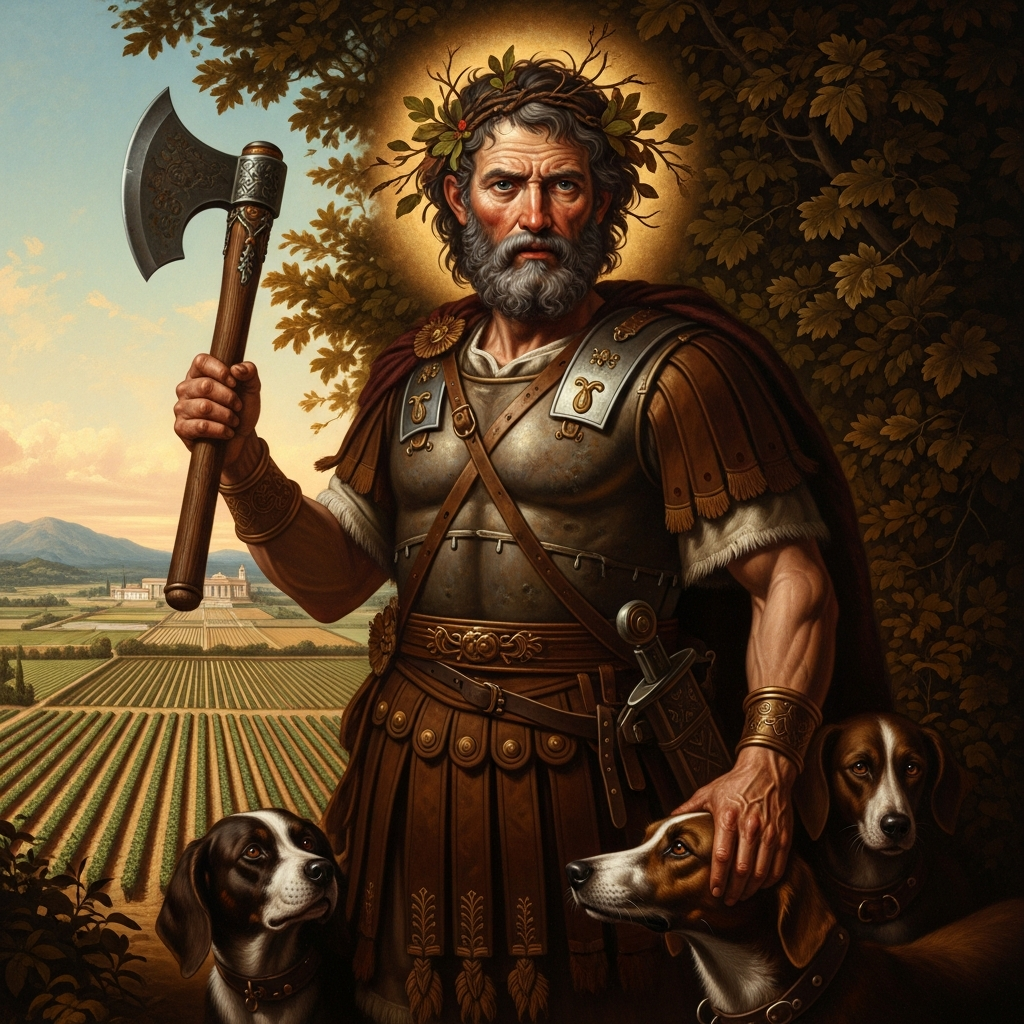
Portrait of Silvanus
Combat
ATK 6
DEF 9
SPR 8
SPD 6
INT 7
Element Nature
Role Guardian
Rarity Epic
Threat Medium
LCK 7
ARC 7
Special Forest's Edge — Silvanus blesses the boundary between cultivated and wild land; under his protection, wild beasts cannot cross into the farmstead, and farm animals do not stray into the dangerous woods
Passive Wood-Cutter's Friend — Workers who pray to Silvanus before entering the woods are protected from falls, animal attacks, and the malice of forest-spirits; the trees they cut bear no curse
Epithets "Silvanus" (Latin: *silva* = forest, woodland), "Domesticus" (*Silvanus Domesticus* — the tame, household Silvanus who guards the cultivated garden's edge), "Agrestis" (*Silvanus Agrestis* — the wild Silvanus of uncultivated forest)
Sacred Animals Cypress (tree) — he is associated with the cypress as the boundary-marker between cultivated and wild; the dog (his companion in his woodland domain)
Sacred Objects The pine branch and flowers (his offerings); the *falx* (pruning hook — symbol of the managed woodland edge); a rough stone image in the woods (his cult-object, deliberately unelaborated)
Sacred Colors Green (forest), Brown (bark and earth)
Sacred Number 3 (he has three aspects — *Domesticus* guarding the home garden, *Agrestis* of wild land, *Orientalis* of the eastern field boundary)
Sacred Sites Every farm's woodland edge throughout Italy and the Latin-speaking provinces; no great urban temple (his cult was private and rural); especially associated with the forests of Latium and Campania
Festivals No fixed state festival; offerings made personally by farmworkers, herdsmen, and woodcutters before entering the woods — grain, milk, meat, wine poured at a woodland shrine or rough stone; June (summer woodland work season) was his most active time
Iconography Rugged mature man with a pine branch or pruning hook; sometimes with a dog; rough stone image in a forest clearing; no elaborate statuary — his cult deliberately unpolished and natural
Period Archaic Roman — one of the most personally beloved rural Roman deities throughout the Republic and Empire; Cato, Pliny, and later inscriptions confirm his cult's extraordinary breadth and persistence
Region All of rural Italy and the Latin provinces; his cult was the most personally beloved of all Roman countryside deities, attested by more private votive inscriptions than almost any other Roman god

Silvanus is the god of the woodlands, forest borders, and uncultivated land — distinct from Faunus in domain and character. Where Faunus is wild, dangerous, prophetic, half-domesticated, Silvanus is a steady, beneficent presence: the god of the sylvae, the woods that border the cultivated field. He guards the edge of the farm from the wilderness, watches over wood-cutters and herdsmen, and protects the boundary between the human and natural worlds.

Silvanus had no major state-cult and no great festival, but he was probably the most personally beloved of the rural Roman deities — every farm in the Italian countryside had a small shrine to Silvanus on its forested edge, and offerings of grain, wine, and milk were made to him by the men who worked the fields (his cult was specifically male; women were excluded from his rites for reasons the Romans no longer fully remembered). He is the Roman expression of the universal human need to acknowledge the forested margin as a sacred boundary.

Biblical Parallels: Silvanus parallels the cherubim who guard the boundary of Eden (Genesis 3:24) more than any other Roman god — both are guardians of the boundary between the human and the wild-sacred. The biblical principle that the forest is dangerous (2 Kings 2:24, the bears that eat the youths) and that its margin requires reverent acknowledgment (Deuteronomy 20:19) parallels the Silvanus-cult.

Cross-Tradition: Parallels Finnish Tapio (forest-lord), Greek Hermes-of-the-boundary (Hermes’s herm-pillars marked forest borders), Slavic Leshy in his benevolent aspect, and various Native American forest-guardian spirits. The “kindly guardian of the forest-edge” is a near-universal feature of agrarian religions.


1 min read

Combat Radar

ATK DEF SPR SPD INT
← Back to Roman