Combat Profile
Ancestral Communion
temporarily grants allies access to the wisdom and skills of their departed lineage, enhancing abilities for three turns.
Spirit Embodiment
exists simultaneously in physical and spectral form, gaining resistance to mundane harm and the ability to perceive hidden spiritual threats.
Title: Household Spirits, The Watchful Dead, The Embodied Lineage
Tradition: Siberian Sacred | All Turkic-Mongol peoples
Description:
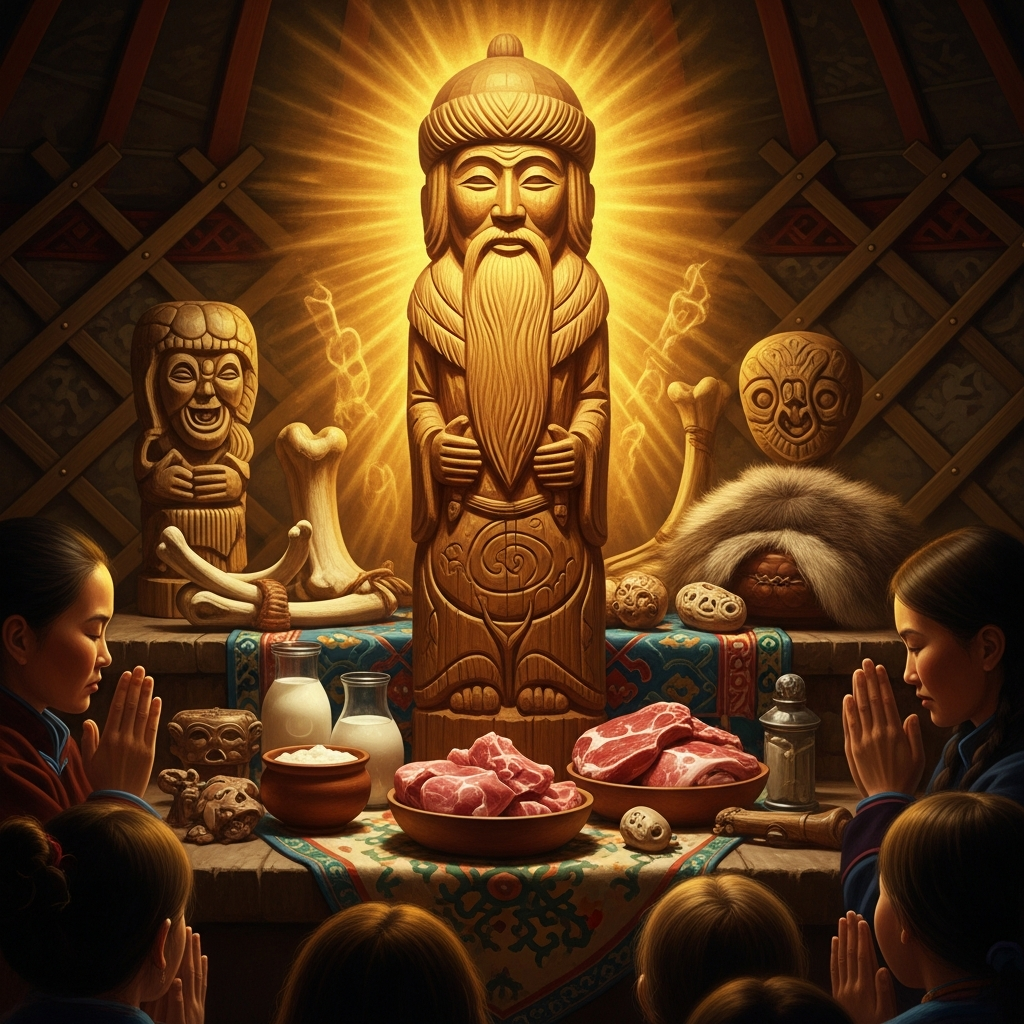
An ongon (or onggon) is not a ghost—it is a spirit voluntarily taking residence in a physical object: a carved figurine, a wooden stick, a preserved animal pelt or skull, a bone carving. The ancestor (or protective spirit) literally lives in this object. It is fed, honored, consulted, and feared.
A Mongol warrior might carry a small ongon figurine into battle, speaking to it before combat: “Protect me. Grant me victory. I will honor you upon return.” The ongon of a deceased shaman is more powerful than the ongon of a commoner—shamanic lineages can persist through their objects for generations.
Ongons require maintenance: regular placement in the best position of the house, offerings of fermented milk or meat, songs of gratitude. A neglected ongon becomes resentful, vengeful. A respectfully maintained ongon becomes a family guardian.
Christian missionaries specifically targeted ongons, desecrating them to prove that “the spirits cannot defend themselves”—a calculated psychological attack. Many Siberian families hid their ongons, transferring them secretly through generations.
In RPG Context: Ongons are relics and fetishes. A character can bind an ancestor spirit into an object, creating a magical familiar with specific properties inherited from the ancestor’s life. Destroying an ongon can anger or free the trapped spirit.
STAT BLOCK:
| Stat | Score |
|---|---|
| ATK | 35 |
| DEF | 65 |
| SPR | 72 |
| SPD | 48 |
| INT | 58 |
| CHA | 61 |
| WIS | 64 |
| END | 67 |
| Element | Psychic |
| Role | Guardian |
| Rarity | Uncommon |
| Threat | Minor |
| LCK | 78 |
| ARC | 72 |
| Special | Ancestral Communion — temporarily grants allies access to the wisdom and skills of their departed lineage, enhancing abilities for three turns. |
| Passive | Spirit Embodiment — exists simultaneously in physical and spectral form, gaining resistance to mundane harm and the ability to perceive hidden spiritual threats. |
| Epithets | ”Ongon” (Mongol/Buryat), “Onggon” (alternative spelling), “Itigin” (Buryat household spirit variant), “The Embodied Ancestor,” “The Household Watcher” |
| Sacred Animals | The specific animal whose pelt or skull forms the ongon — reindeer, wolf, bear, or horse skulls are common; a shaman’s ongon may be housed in a preserved bird (eagle, owl) |
| Sacred Objects | The physical ongon object itself (carved wood, bone, preserved pelt, skull); the household shrine where it is placed; offerings of fermented mare’s milk (kumiss) and meat |
| Sacred Colors | Red (life force, blood — the offering color); blue (Tengri’s blessing); no single sacred color — the ongon carries the colors of its ancestor’s lineage |
| Sacred Number | Variable — a household might maintain 3, 7, or 9 ongons depending on lineage and tradition |
| Consort(s) | N/A — ongons are ancestral spirits, not personal deities |
| Sacred Sites | The household (ger/yurt) — the ongon lives in the honored north or northwest position of the dwelling; the family hearth; grave sites of the ancestor it represents |
| Festivals | New Year ceremonies (Tsagaan Sar in Mongolia) — ongons are cleaned, re-fed, and re-honored; before and after hunts and battles; at births and deaths in the family |
| Iconography | Small carved wooden or bone figures (roughly humanoid or animal); sometimes a bundle of objects tied together; preserved skulls with fur; painted with protective symbols; kept on the highest shelf or honored position of the home |
| Period | Attested in Mongol and Turkic records from at least the 13th century CE (Marco Polo documented them); ethnographic studies from the 17th century onward; practice continuous in rural Mongolian communities |
| Region | Mongolia, Buryatia (Russia), Inner Mongolia (China), southern Siberia broadly — Mongol, Buryat, Evenki, and Yakut traditions all maintain ongon-like practices |
Power Tier: C — Lesser (varies by ancestor’s original power)
Alignment: Depends on ancestor, usually Neutral Good or Lawful Good
Domain: Family protection, ancestral continuity, household magic, lineage wisdom
Sacred Symbols: Carved figure, animal pelt, bone carving, household shrine
Cross-Tradition Parallels: Lares (Roman household gods), Kami in objects (Shinto), Reliquaries (Catholic), Familiar spirits (European witchcraft), Totem objects (Native American)
Ability: An ongon grants its owner +25 SPR when defending family members and +20 DEF against hostile spirits. If the ongon is destroyed, the owner suffers -40 SPR and the ancestor may seek vengeance.
3 min read