Combat Profile
Tongue of the Rivers
Grants the recipient eloquence in any tongue, the ability to compose perfect verse, and speech that cannot be misunderstood by the listener
Flowing Wisdom
Sarasvati's knowledge increases continually like a river; she cannot be cornered intellectually and gains insight from every question put to her
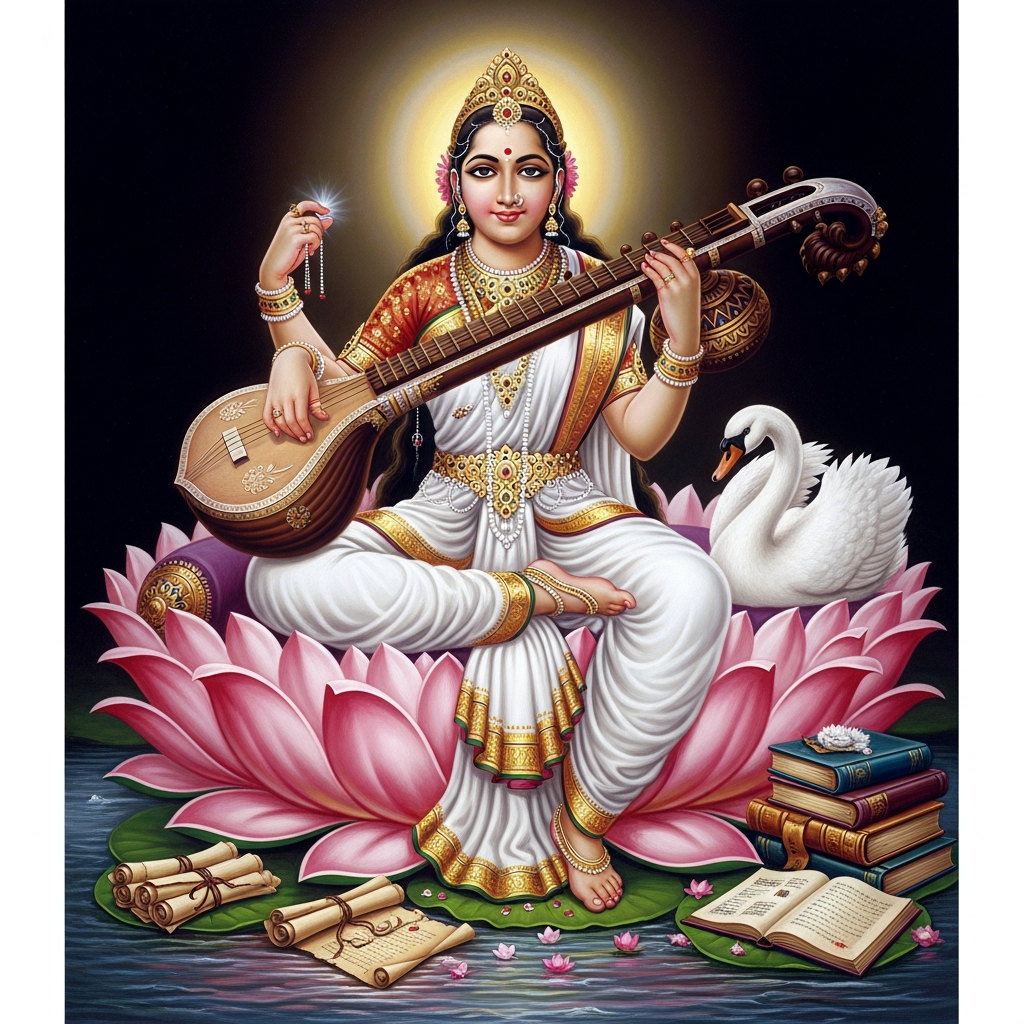
Sarasvati is, in the Rigveda, primarily a river — the mighty Sarasvati that flowed through the Vedic homeland in northwest India and is now mostly dry, a paleochannel traceable by satellite imagery and probably the same river the texts call “best mother, best river, best goddess” (RV 2.41.16). She is invoked for water, for fertility, for the speech that flows like water. Already in the late Rigveda she begins her transformation: from river to goddess of speech, from goddess of speech to goddess of wisdom, from goddess of wisdom to the patroness of poetry and music she becomes in the Puranic age.
In the Vedic period she is fierce as well as nurturing. She is invoked alongside the Maruts in war-hymns, and her flowing water is described as cleansing, purifying, and even slaying enemies. The later image of Sarasvati seated serenely on a lotus playing the vina belongs to a different millennium. The Vedic Sarasvati is a river goddess of formidable power whose voice is the rush of water itself.
Biblical Parallels: Sarasvati parallels the personified Wisdom (Hokhmah) of Proverbs 8 — present at creation, delighting in humanity, the source of right speech and just rule. The “rivers of living water” promised by Christ (John 7:38) carry the same metaphorical logic: water as wisdom, wisdom as water. The four rivers of Eden (Genesis 2:10-14) echo the Vedic reverence for sacred rivers as fonts of life and knowledge.
Cross-Tradition: Cognate with the Iranian Aredvi Sura Anahita (the great cosmic river-goddess of Zoroastrianism). Parallels Greek Athena (wisdom personified, born from the head of the sky-god), Mesopotamian Nabu (god of writing), Egyptian Seshat (goddess of writing and measurement), and Celtic Brigid (poetry, smithing, wisdom).
1 min read