Combat Profile
Maternal Tide
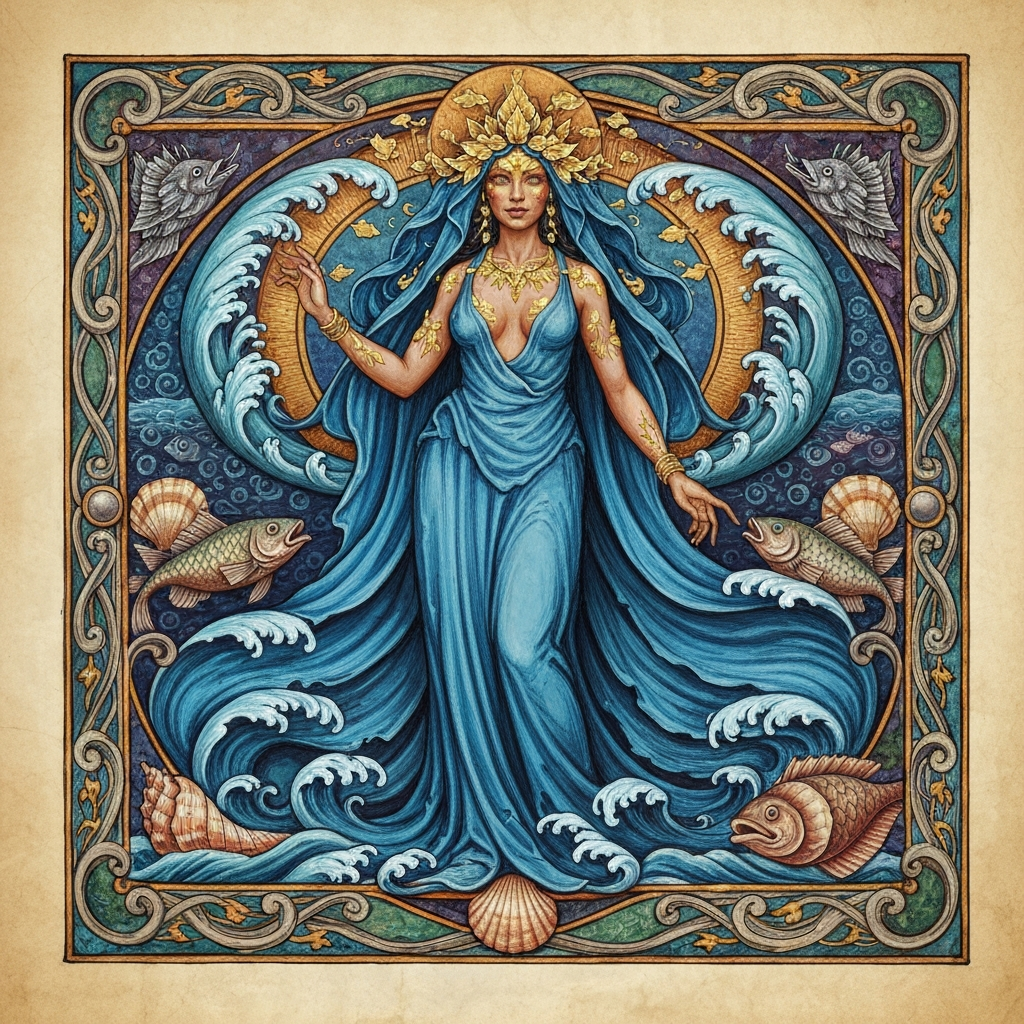
Yemoja channels the primordial waters to heal all allies and purify corrupting influences from their bodies and spirits.
Mother of Waters
Yemoja's presence calms the unconscious mind and grants women and children within her domain resistance to fear and psychological harm.
Her protectiveness can become possessiveness. Like the ocean, Yemoja gives life and takes it -- she is not gentle when her children are threatened. Her grief over the Middle Passage (the forced transport of her children across the Atlantic) is a central theme in diaspora theology
“The ocean never dries. Yemoja never abandons her children.” — Yoruba proverb
Lore: Yemoja (Yemaya in Cuba, Iemanja in Brazil, La Sirene in Haiti) is the great mother of the Yoruba pantheon — the Orisha of the ocean, the womb of the world, the protector of women and children, the cosmic mother whose waters are the source of all life. In Yoruba tradition, she is the mother of many Orishas (the exact genealogy varies by lineage). Her domain is the ocean in all its aspects: nurturing and terrifying, life-giving and death-dealing, warm on the surface and cold in the depths. She is invoked during pregnancy and childbirth, during storms at sea, during any crisis involving the safety of children. In the diaspora, Yemoja took on an additional dimension of meaning that cannot be separated from the Middle Passage. The Atlantic Ocean — her domain — was the site of one of the greatest crimes in human history. An estimated 12.5 million Africans were shipped across the Atlantic; roughly 2 million died during the crossing. Yemoja’s theology absorbed this trauma: she became the mother who wept for her stolen children, the protective force that kept some alive through the horror, the ocean that holds the bones of the dead.
Parallel: Yemoja is the divine mother — a role shared by the Virgin Mary (protector of the faithful, Queen of Heaven, Our Lady of the Sea), Isis (Egyptian mother goddess whose cult spread across the Roman Empire), Tiamat (Mesopotamian primordial ocean-mother from whose body the world was made), and Parvati/Durga (Hindu mother who is both nurturing and fierce). The Mary parallel is especially significant: in Cuba, Yemoja was syncretized with Our Lady of Regla, a Black Madonna associated with the sea, and in Brazil with Our Lady of the Immaculate Conception. This was not merely strategic disguise — many practitioners genuinely experience Yemoja and Mary as aspects of the same maternal divine reality.
1 min read
Nothing directly counters Yemoja -- the ocean cannot be defeated. But she can be moved by sincerity, and she can be enraged by the abuse of children or women, at which point her "counter" becomes the thing that provoked her
Odu Ifa; Joseph Murphy, *Santeria: African Spirits in America* (1988); Migene Gonzalez-Wippler, *Santeria: The Religion* (1989)