Combat Profile
Crossroads Sovereignty
Baron Samedi commands absolute dominion over the boundary between life and death, allowing him to resurrect the fallen or claim souls for the underworld.
Gede's Laughter
Baron Samedi's presence invokes both terror and mirth; he shields his allies from death magic while rendering their profane oaths and ribald jests irresistible to mortals.
His appetites -- rum, tobacco, sex, profanity. Baron Samedi is deliberately offensive, and this is the point: death does not care about your sensibilities. But his excesses can be exploited by those who understand his patterns
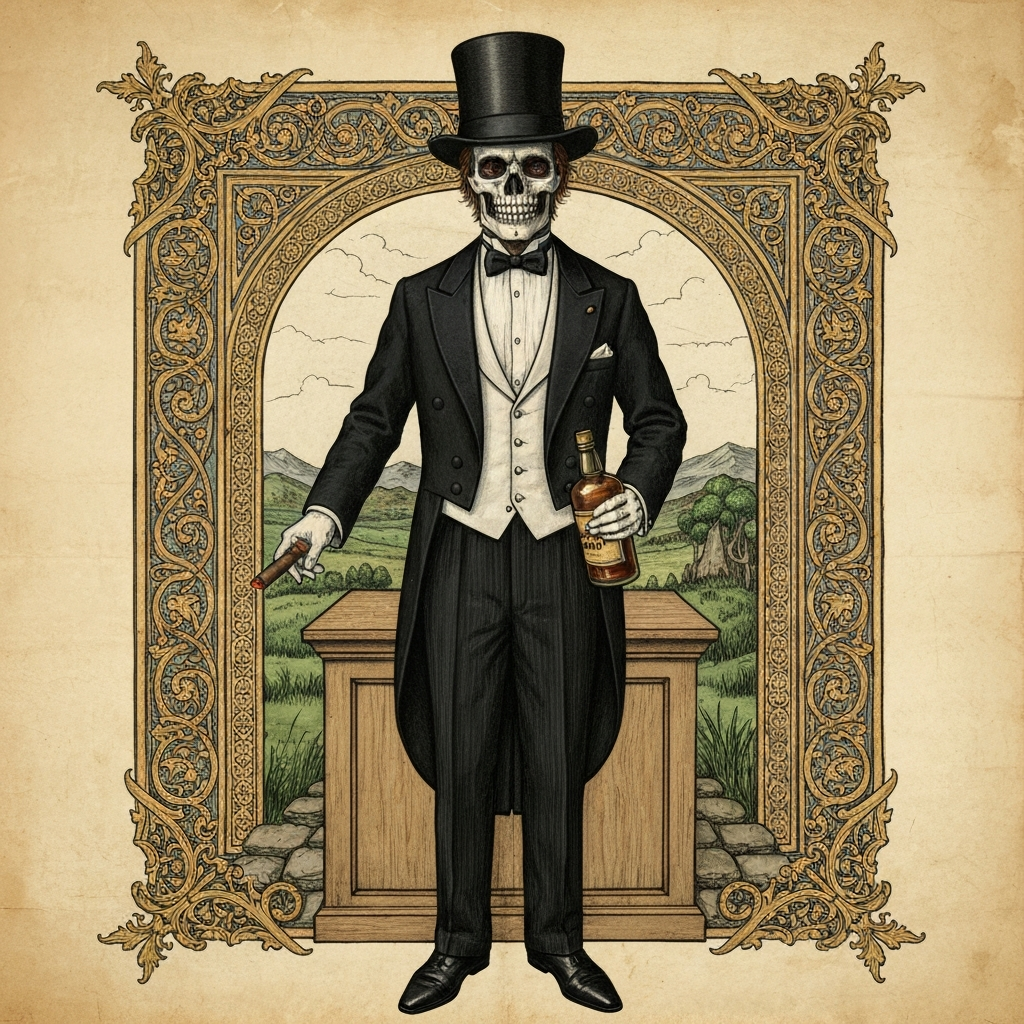
“Baron Samedi stands at the crossroads of life and death, wearing his top hat and dark glasses, smoking a cigar, and laughing at everyone who thinks they can avoid him.” — Vodou tradition
Lore: Baron Samedi is the head of the Gede — the family of death spirits in Haitian Vodou. He is depicted as a tall man in a black top hat, tuxedo or tailcoat, with a skull-like face (sometimes painted white), dark glasses (often missing one lens — he watches both the world of the living and the world of the dead), a cigar in one hand and a bottle of rum in the other. He is simultaneously the most terrifying and the most hilarious figure in Vodou. He makes obscene jokes at funerals. He propositions mourners. He drinks excessively. He is crude, loud, and deliberately shocking — because death is crude, loud, and shocking, and pretending otherwise is dishonest. But he is also a healer (especially of those near death), a protector of children (who has not yet dug their graves), and the ultimate leveler: he reminds the rich and powerful that they, too, will end up in his cemetery. Baron Samedi is unique to Haitian Vodou — he has no direct Yoruba prototype, though he inherits the crossroads-and-death functions that belong to Eshu and Oya in the Yoruba system.
Parallel: Baron Samedi parallels Anubis (Egyptian guardian of the dead, lord of the cemetery), Hel (Norse ruler of the dead), Ereshkigal (Mesopotamian queen of the underworld), and Yama (Hindu/Vedic lord of death). But his unique combination of death and humor, fear and laughter, has no exact parallel in any other tradition in this compendium. He is the theological insistence that death is not only tragic but absurd, and that the only honest response to mortality includes laughter. His top hat and tailcoat mock the European colonial elite — even in death, Vodou resists.
1 min read
Only God (Bondye, from French *Bon Dieu*) is above him. The living fear him; the dead answer to him. He can be bargained with but never cheated
Karen McCarthy Brown, *Mama Lola: A Vodou Priestess in Brooklyn* (1991); Maya Deren, *Divine Horsemen: The Living Gods of Haiti* (1953); Alfred Metraux, *Voodoo in Haiti* (1959)