Kumarbi Swallows the Storm: The Hurrian Song of Emergence
Song of Kumarbi (Kingship in Heaven) — cuneiform tablets from Hattusa, c. 1400 BCE; Hurrian origin, possibly much older · The divine realm — the heavens before creation was settled
Contents
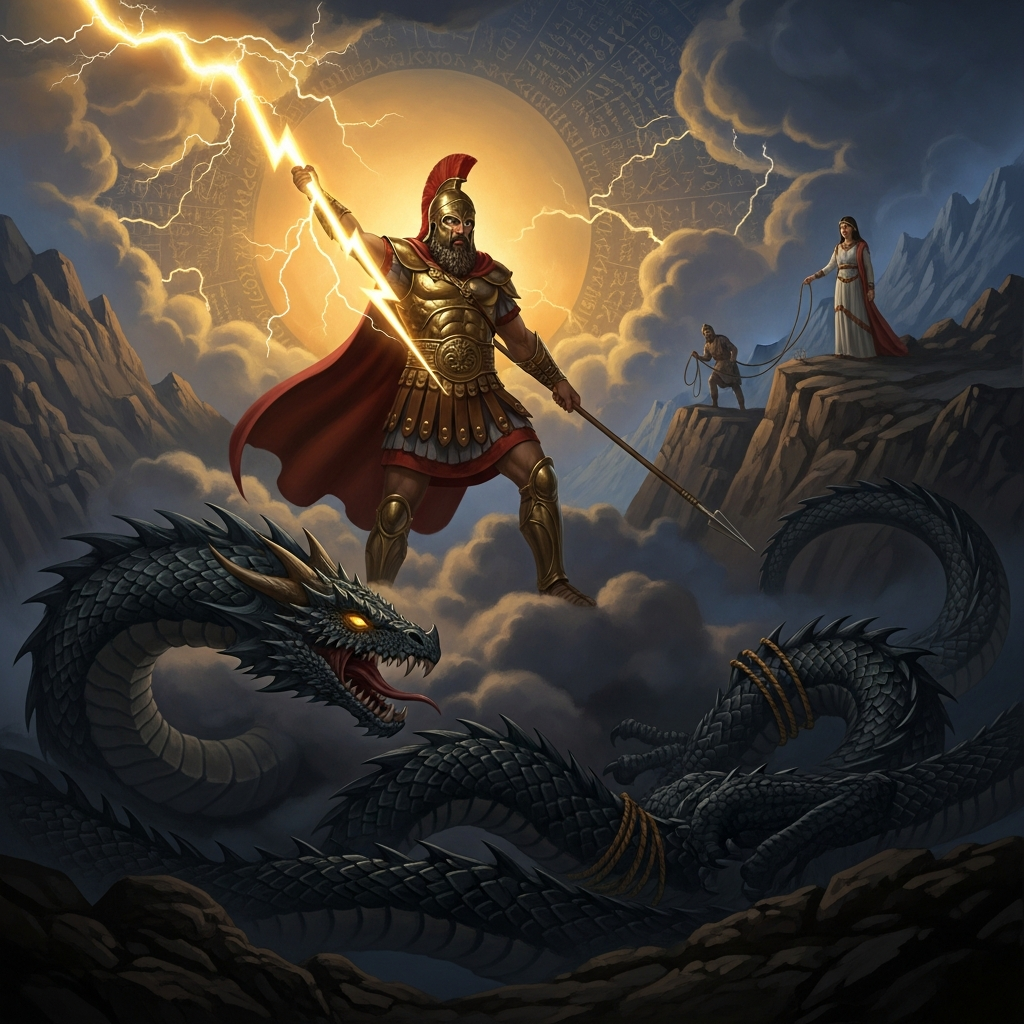
Before Teshub ruled the gods, Anu ruled, and before Anu, Alalu. The kingship of heaven passed through violence across three generations until Kumarbi — who would become the great adversary of the storm god — seized it by biting off Anu's genitals and swallowing them. From that act of terrible consumption, three divine beings were born into Kumarbi's body, including Teshub the storm god. The cosmos is founded on a swallowing.
- When
- Song of Kumarbi (Kingship in Heaven) — cuneiform tablets from Hattusa, c. 1400 BCE; Hurrian origin, possibly much older
- Where
- The divine realm — the heavens before creation was settled
Before Teshub ruled the gods, Anu ruled the sky.
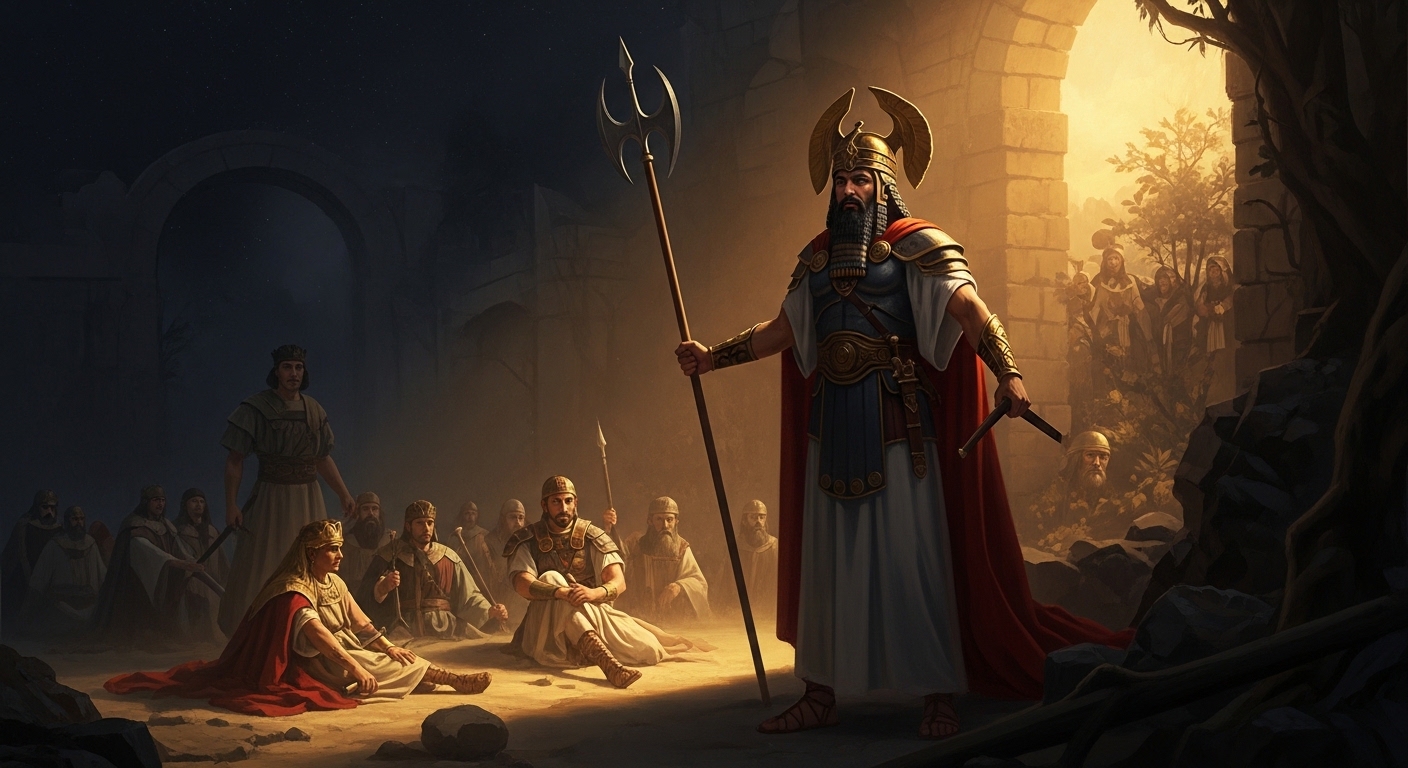
Before Anu, there was Alalu — the first king of heaven, who sat on the great throne for nine counted years while the mighty gods bowed at his feet. Anu himself served him, standing before him like a cup-bearer stands before a king. In the ninth year, Anu fought Alalu and Alalu fled: he fled downward, away from the sky, descending until he reached the dark earth, the place below. And Anu sat on the great throne.
Before Anu there had been a king. Before that king, presumably, another. The Hurrian cosmos was not created; it was inherited, through violence, by the one who could hold it.
Anu ruled for nine years. In the ninth year, Kumarbi fought him.
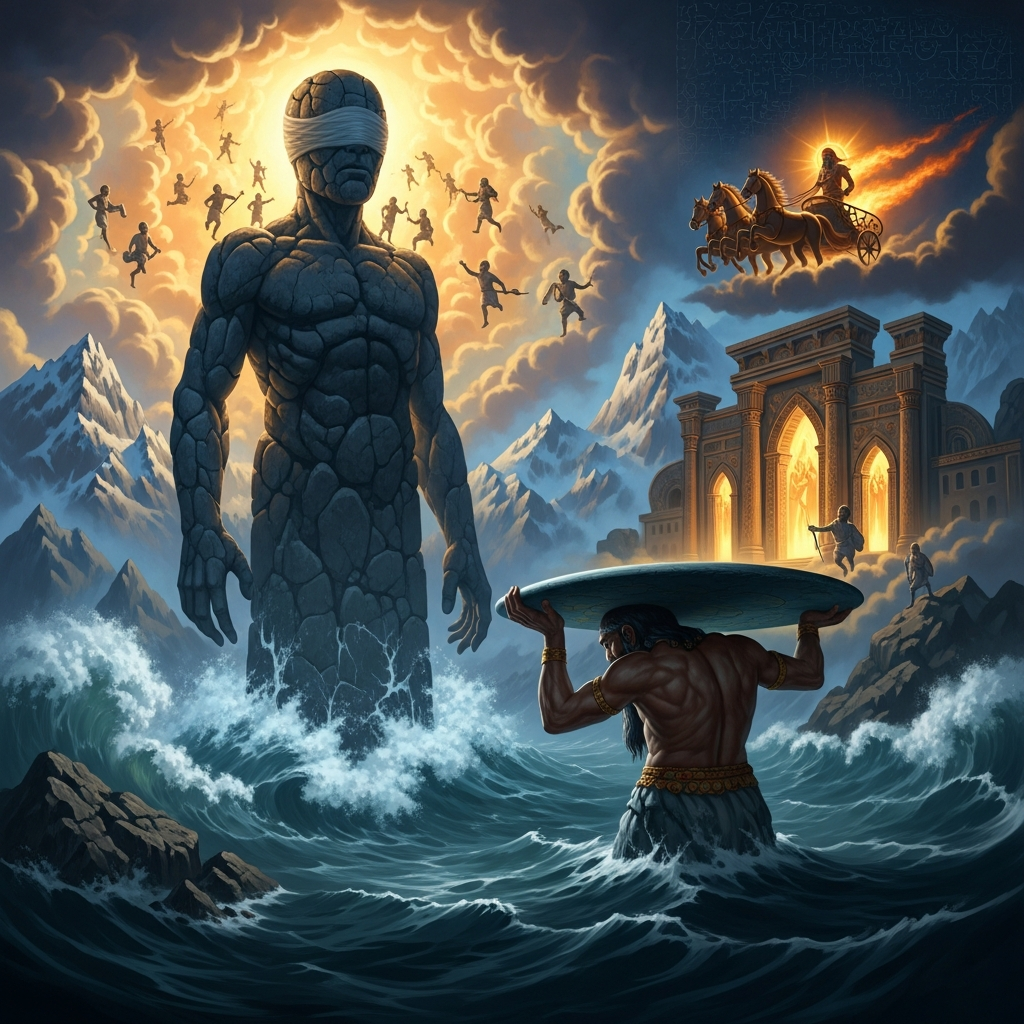
Kumarbi was the son of Alalu — the son of the deposed king, carrying the grudge of the displaced dynasty. He fought Anu and Anu fled. He fled upward, into the sky, away from the earth: the direction opposite to his predecessor’s retreat, as if the escapes of deposed gods follow some cosmic logic of dispersion. Anu fled into the sky and Kumarbi pursued him and seized him by his feet and pulled him down.
Then Kumarbi bit off Anu’s genitals.
The tablets record this act without euphemism. Kumarbi bit off Anu’s genitals and swallowed them. He laughed. He stood and laughed because he believed, in this moment of triumph, that he had done everything necessary — that the kingship of heaven was now his by conquest, and that what he had swallowed was simply the proof of his victory.
Anu was not finished with him.
Anu, falling, called out to Kumarbi what Kumarbi had swallowed.
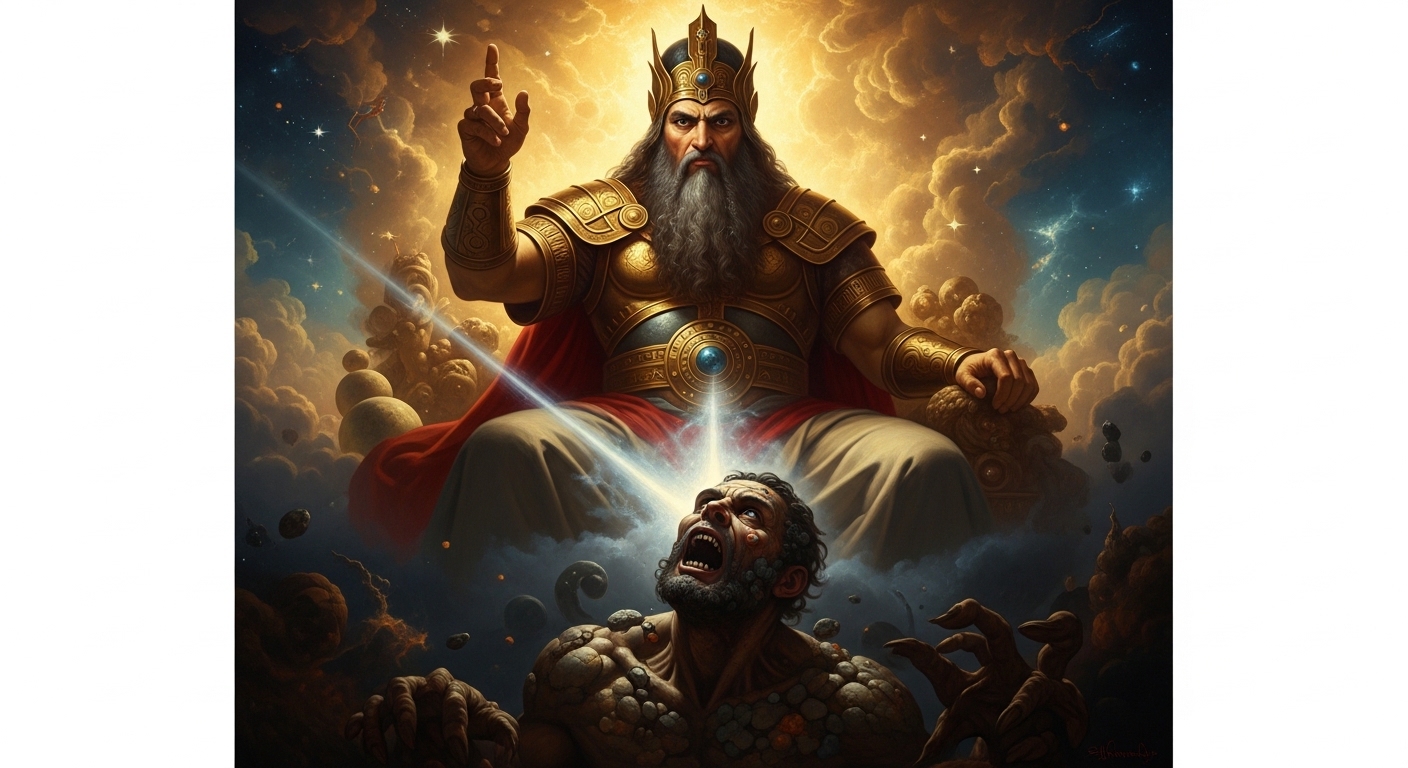
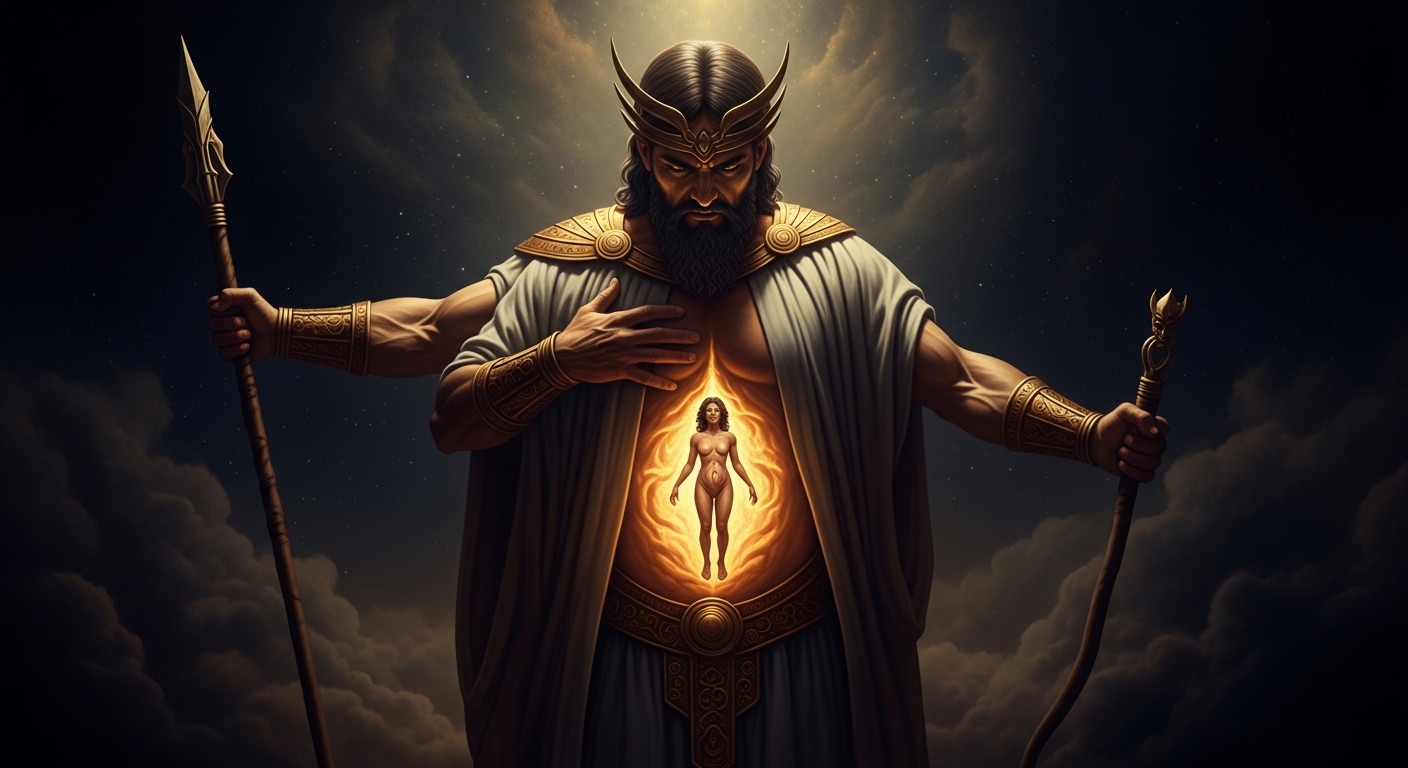
The tablets are fragmentary here, but the argument Anu makes is clear in structure: You have swallowed something you did not intend to swallow. You thought you swallowed my defeat. You swallowed my children. From the divine seed that Kumarbi consumed in that act of triumphant violence, the sky god named what was now growing in Kumarbi’s body. The storm god Teshub. The Aranzah river (deified). A third deity whose name is damaged in the tablets.
Kumarbi spat.
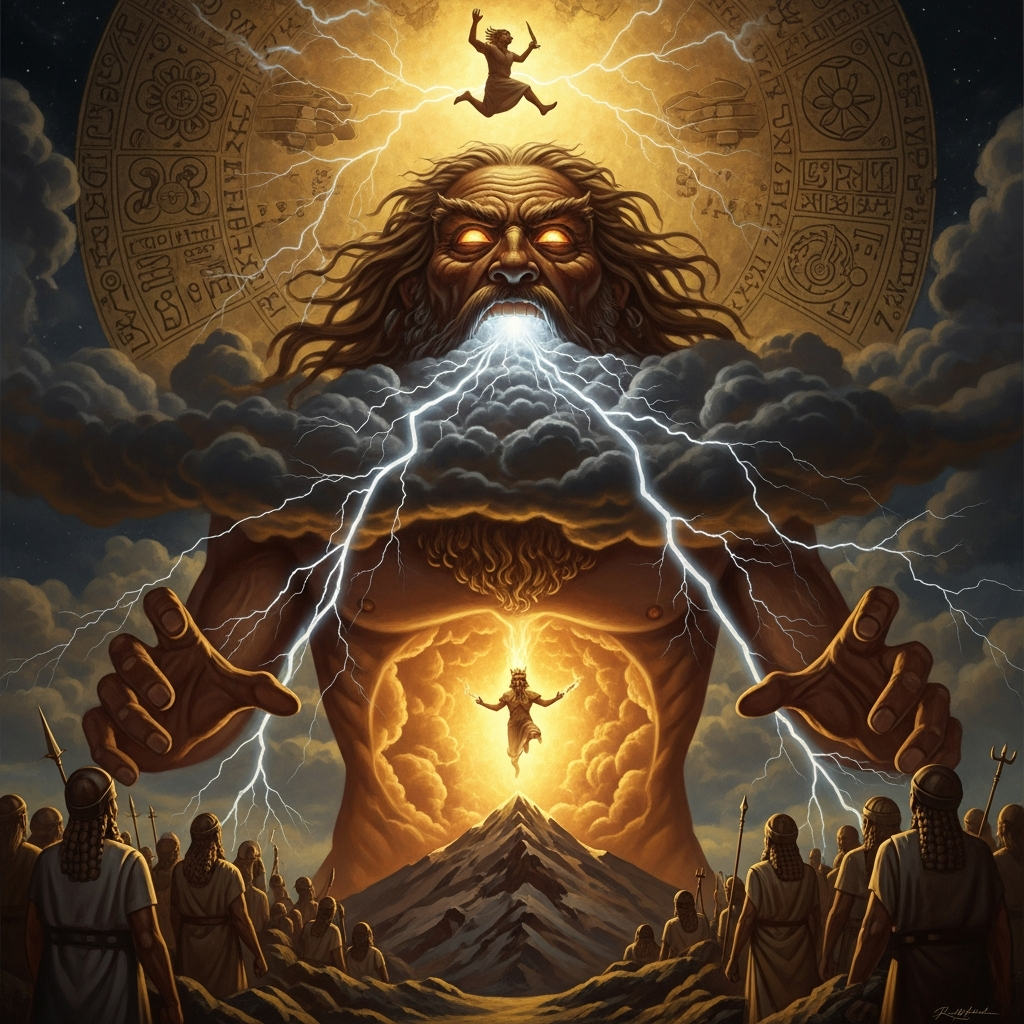
He spat on the ground, trying to expel what he had swallowed. The tablets describe this moment: the great adversary god, the new king of heaven, spitting desperately on the ground, trying to reverse what he had done. He could not. The divine seed had already entered him. The storm god was already growing inside him.
The problem Kumarbi now faced was the same problem that every generation of divine rulers in this mythological cycle faced: the one who displaces you is already inside you, growing toward the moment of challenge. Alalu had been displaced by Anu; Anu had been displaced by Kumarbi; Kumarbi had swallowed the very being who would displace him.
He went to Ea for counsel.
Ea — the god of wisdom and magic, the Hurrian version of the Sumerian Enki, the counselor figure who appears across the mythologies of the ancient Near East as the one who knows what cannot be simply known — received Kumarbi. The counsel Ea gave is damaged in the tablets. What survives makes clear that the birth of the storm god from Kumarbi’s body was the subject: how it would happen, what it would cost, what it would mean.
Teshub was born. The tablets record multiple possible birth sites — from Kumarbi’s body directly, from the earth where Kumarbi’s spittle landed, from the skull of Kumarbi himself, split open. Different versions of the text preserve different traditions. In all of them, Teshub emerges and begins immediately to consolidate his power. The nine-year-cycle of divine kingship continues.
What the Hurrians recorded in this text — and what the Hittites preserved when they absorbed Hurrian religion into their own, which they did extensively and with remarkable theological openness — is a cosmological argument about the nature of power.
Power is inherited. Power is always taken from someone who had it. The violence of succession is not an aberration from the divine order; it is the divine order, at least until it reaches a state of stability the myth calls the current age. Teshub, who rules in the current theological moment, rules because his father’s act of conquest against his grandfather contained, without knowing it, the seed of Teshub’s own birth. The grandfather who fled downward, the father who swallowed his own displacement — both of them participated in producing the god who now sits on the throne of heaven.
The Greek scholars who read the Theogony and noted how closely its structure matched the Hurrian text did not yet know that the resemblance was historical rather than coincidental. The Hurrians traded with the Hittites; the Hittites traded with the Luwians and the Mycenaean Greeks; the Mycenaean Greeks traded with the Phoenicians; the stories moved with the goods. By the time Hesiod assembled the Theogony from the oral traditions of archaic Greece, he was working with material that had traveled across four civilizations over six centuries.
The bite. The swallowing. The birth from an unlikely vessel.
The storm god came into the world through the defeat of one generation and the inadvertent generosity of another.
He did not know, and the tablets do not record whether the matter was explained to him.
Scenes
Echoes Across Traditions
Entities
- Kumarbi (father of gods, adversary)
- Anu (sky god)
- Alalu (first king of heaven)
- Teshub (storm god, born from Kumarbi)
- Ea / Enki (counselor god)
Sources
- Albrecht Goetze, 'Kingship in Heaven' in *Ancient Near Eastern Texts*, ed. J.B. Pritchard (Princeton University Press, 1969)
- Gary Beckman, 'Primordial Chronology: The Hurrian Kumarbi Cycle' in *Hittite Studies in Honor of Harry A. Hoffner Jr.* (Eisenbrauns, 2003)
- Mary Bachvarova, *From Hittite to Homer: The Anatolian Background of Ancient Greek Epic* (Cambridge University Press, 2016)
- Harry A. Hoffner Jr., *Hittite Myths*, 2nd ed. (Scholars Press, 1998)
- M.L. West, *The East Face of Helicon: West Asiatic Elements in Greek Poetry and Myth* (Oxford University Press, 1997)