The Song of Ullikummi: Stone Born to Destroy Heaven
Song of Ullikummi — cuneiform tablets from Hattusa, c. 1400 BCE; Hurrian origin · The primordial sea; the shoulder of the giant Upelluri; the road to heaven
Contents
Defeated again and again in his war against Teshub the storm god, Kumarbi schemes a final revenge: he impregnates a great rock with divine seed and from the union a stone monster is born — Ullikummi, a column of diorite rising from the sea, blind, deaf, and growing without limit. As the monster reaches toward heaven, the gods discover that the only thing that can cut it is the ancient copper blade used to separate earth from sky at the beginning of creation.
- When
- Song of Ullikummi — cuneiform tablets from Hattusa, c. 1400 BCE; Hurrian origin
- Where
- The primordial sea; the shoulder of the giant Upelluri; the road to heaven
Kumarbi had lost before.
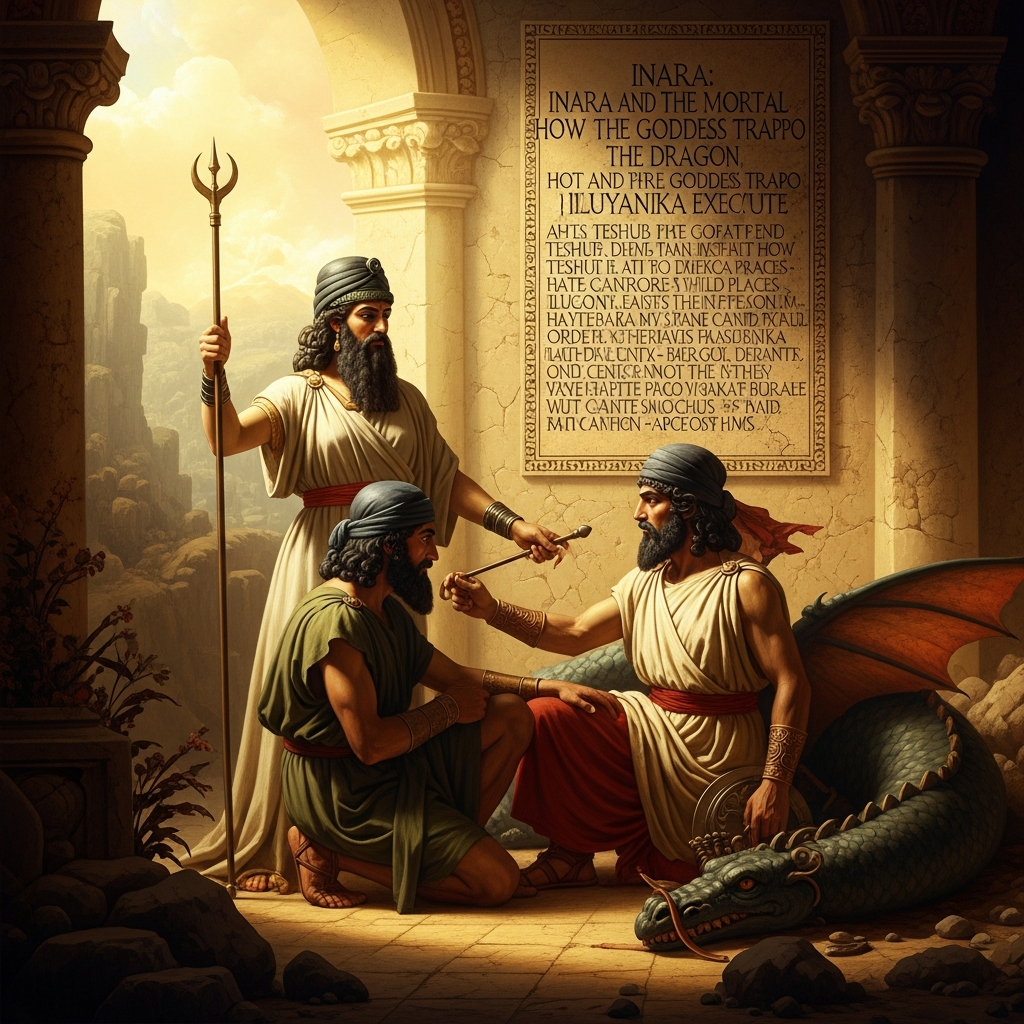
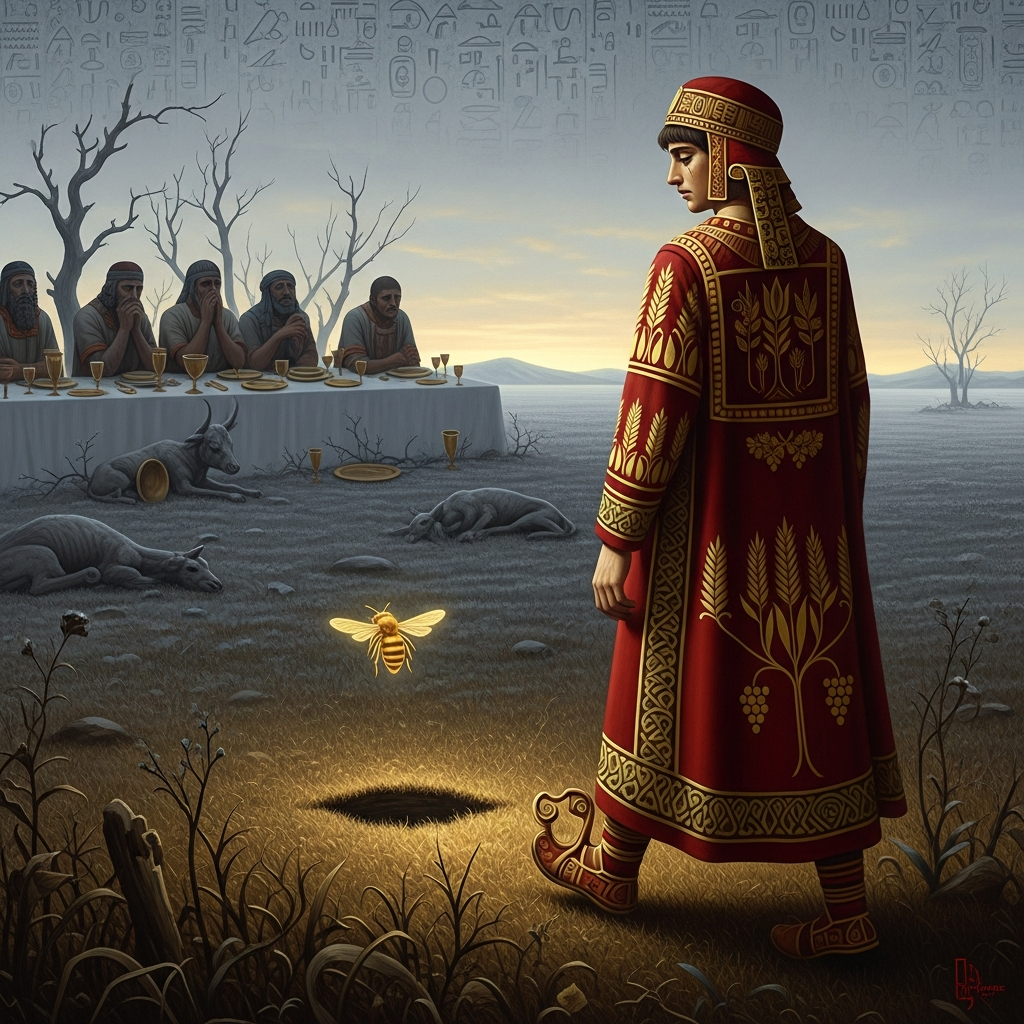
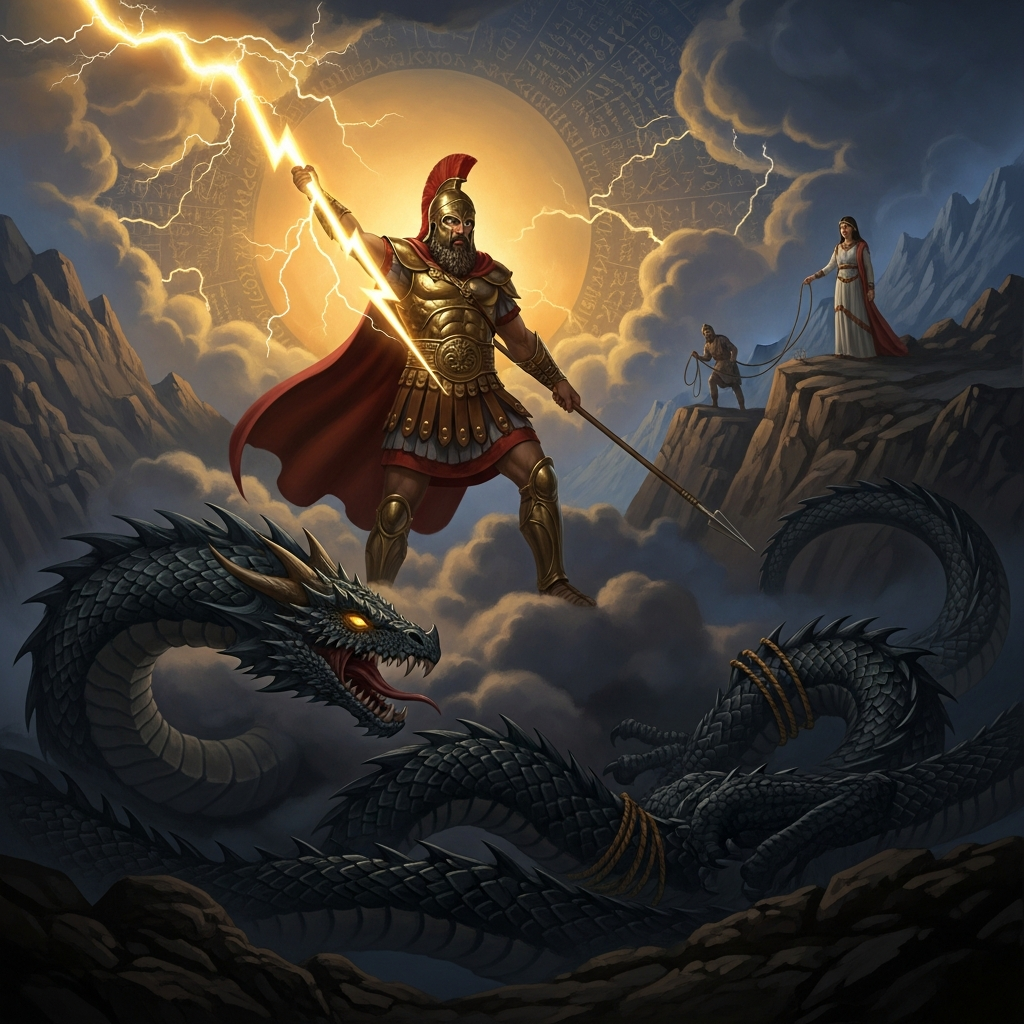
He had lost to Teshub in the great succession war. He had been defeated when the storm god emerged from his own body, when the child he had inadvertently swallowed grew into the divine principle that displaced him. He had made alliances and lost them. He had sent Illuyanka the dragon — and Illuyanka had been defeated by wine, by a mortal, by a rope. Every weapon he had tried against the gods of the current order had failed.
So he made a weapon that was not a weapon. He made a child that was not a child. He found a great stone — a stone of diorite, the hard dark stone the ancient Near East associated with permanence and royal monuments — and he lay with it, and he implanted his seed in the rock.
The rock conceived.
From the stone a child was born: Ullikummi, the column of diorite, the stone giant, the creature without senses. Kumarbi’s instructions to the primordial deities who carried Ullikummi were precise: Do not show him to Teshub. Do not show him to Ea. Do not show him to Shaushka. Carry him to Upelluri.
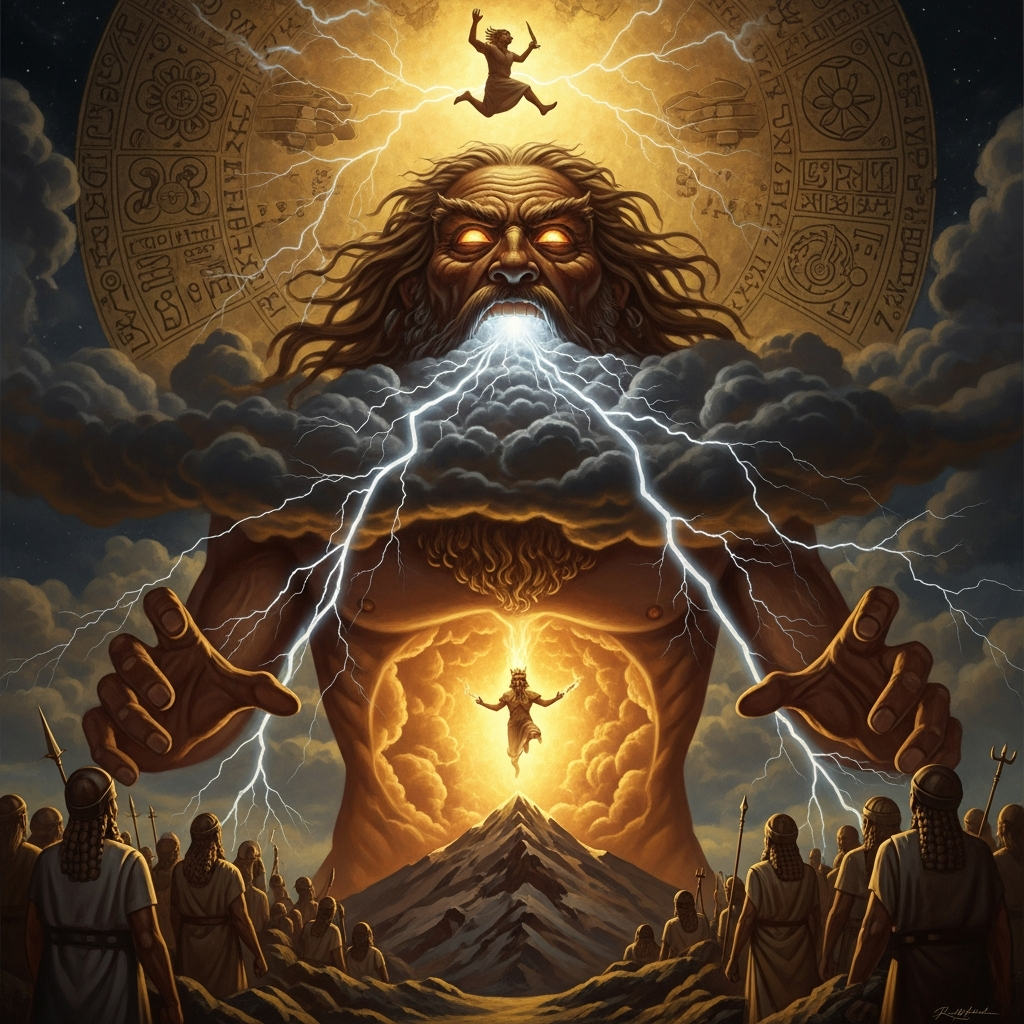
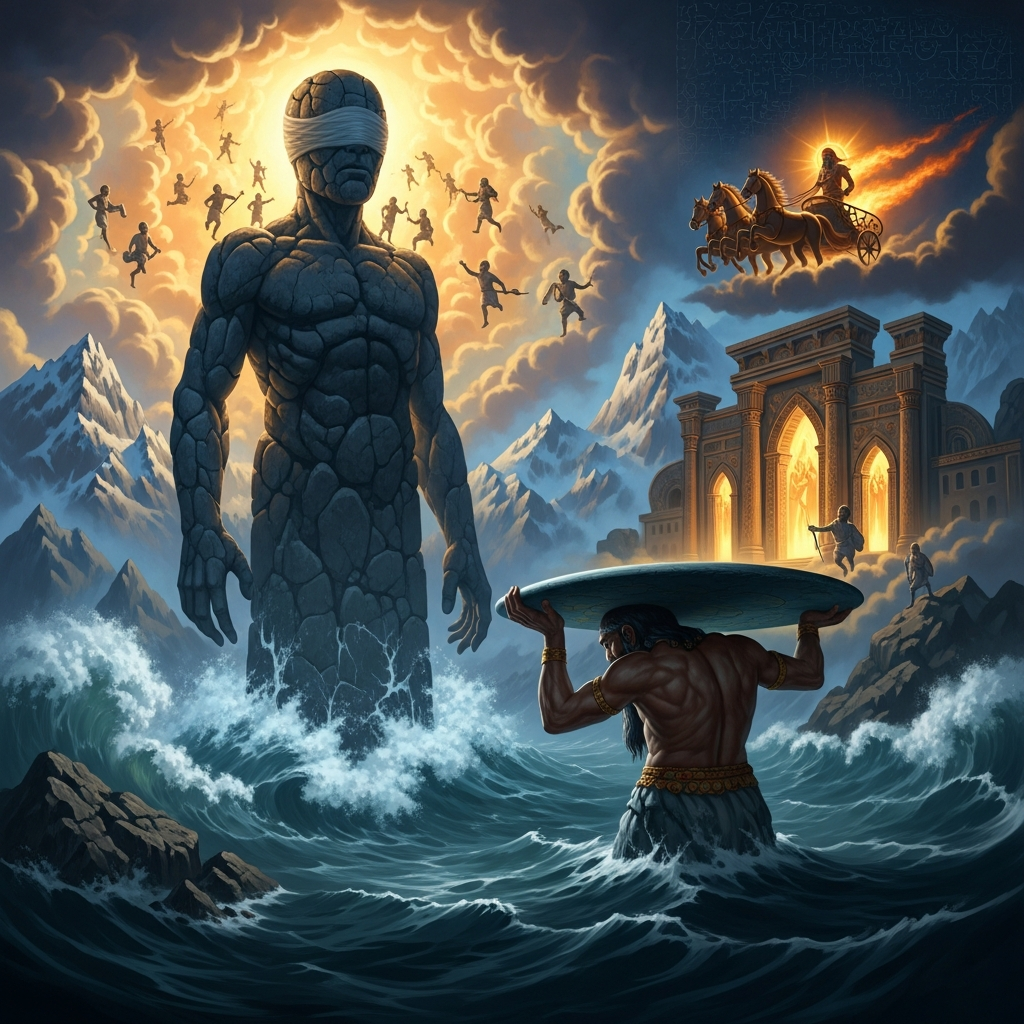
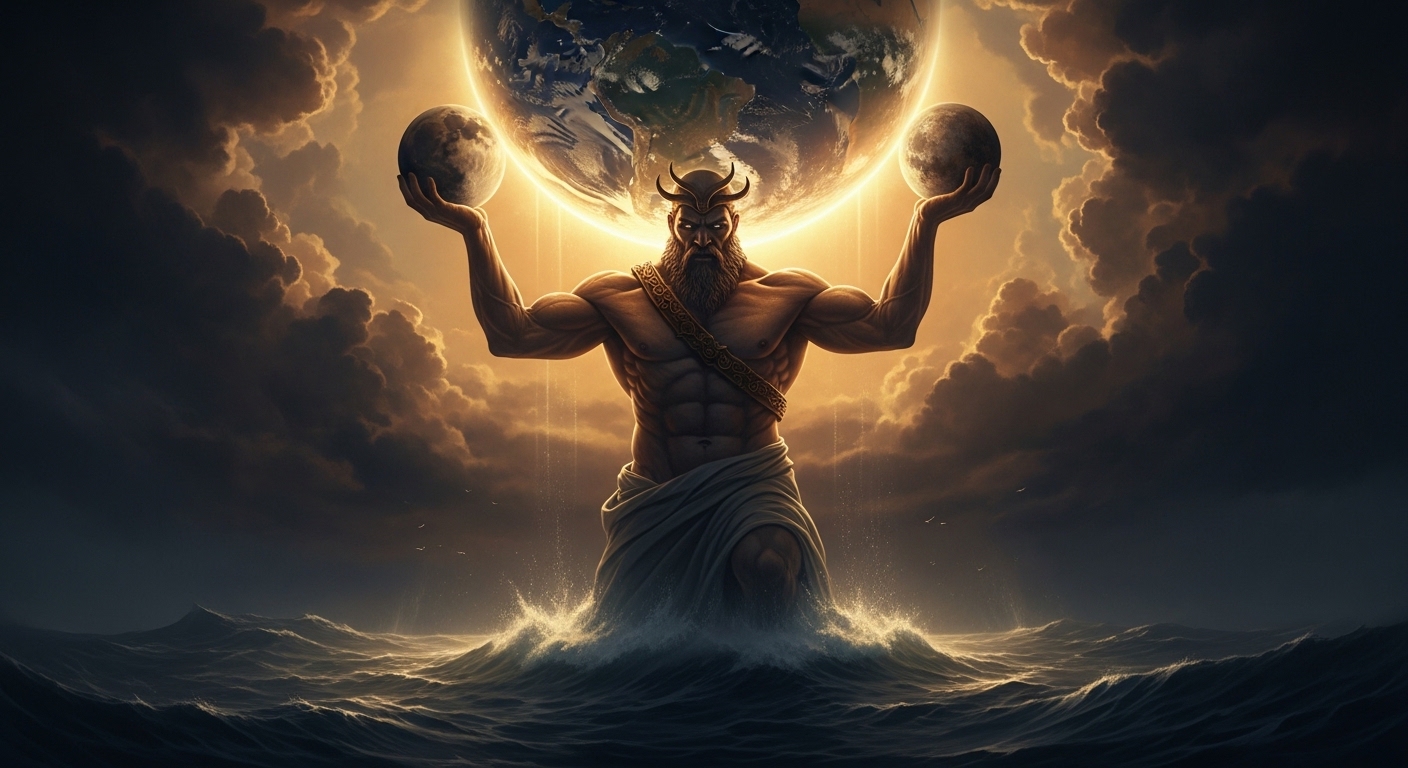
Upelluri is the giant who stands in the primordial sea and holds the earth and the sky on his shoulder. The Hittite texts describe him as being so enormous, and so preoccupied with his task, that he is barely aware of events in the divine world above him. He is the substrate; the foundation; the thing beneath the things. He carries the world without caring much what the world is doing.
The divine figures who carried Ullikummi placed the stone child on Upelluri’s right shoulder, in the primordial sea. And there Ullikummi grew.
He grew every day. The tablets describe the growth in specific terms: fifteen hundred leagues per month, at his smallest growth rate. He was blind — stone is blind. He was deaf — stone is deaf. He could not be reasoned with, threatened, or seduced, because he had no ears for reasons, no organs for fear, no capacity for the kind of relationship that cunning relies on. He grew in the sea on Upelluri’s shoulder, and the water of the sea came up to his knees, and then his waist, and then his shoulders, and he kept growing.
The sun god Shimegi, traveling his daily path across the sky, looked down one morning and saw the stone column rising from the sea and understood immediately what he was seeing. He went to Teshub.
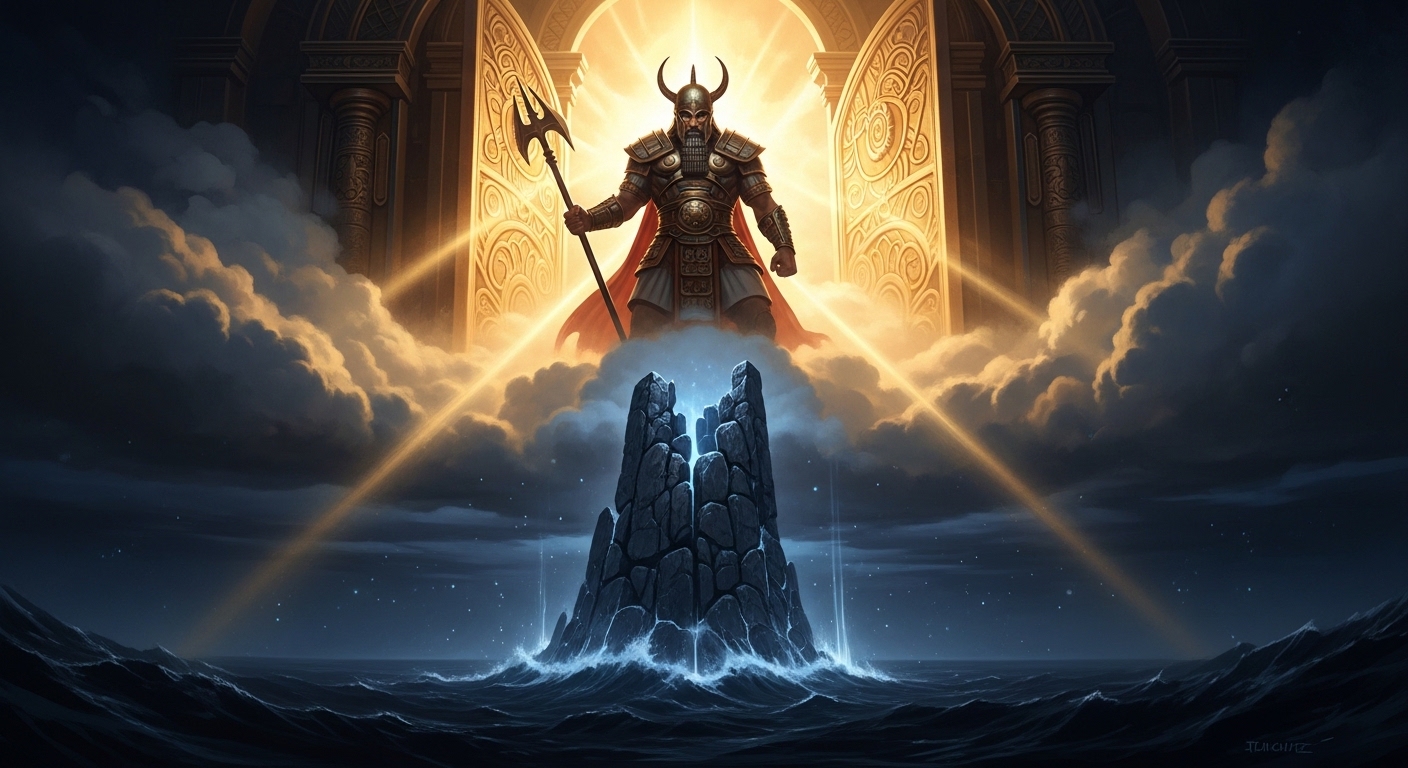
Teshub looked down at Ullikummi from the gates of heaven.
The stone giant had grown so tall that he was level with the mountains. He was still growing. Teshub wept — the tablets record this directly — the storm god who had defeated the dragon Illuyanka, who had won the succession war against Kumarbi, who wielded thunder and rain and the bull-chariot of the sky, stood at the gates of heaven and wept at what he saw.
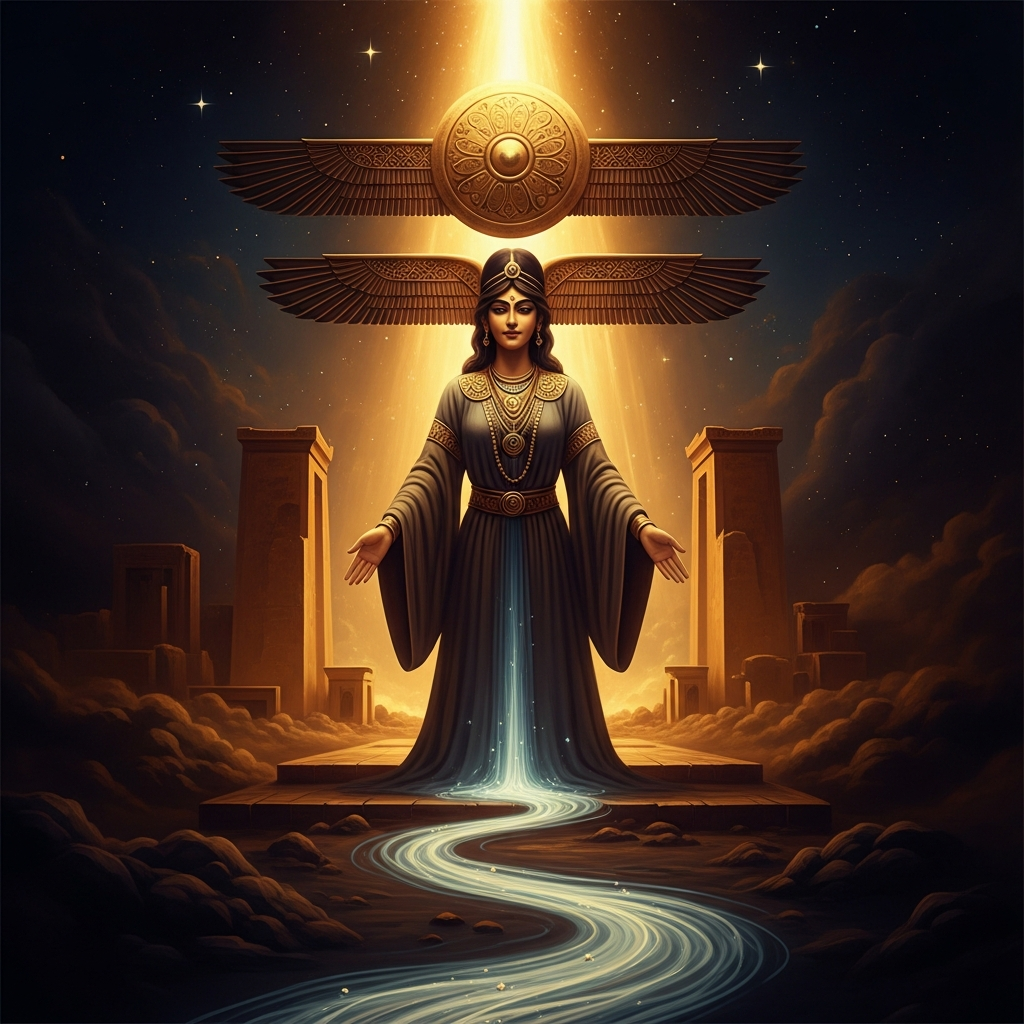
Shaushka — the goddess of love and war, the Hurrian equivalent of Ishtar, Teshub’s sister — decided to try her approach. She walked to the shore of the sea with her handmaidens and she sang. She sang the songs that her divine power commanded, the songs that the cuneiform texts associate with her capacity to move hearts and redirect desires.
Ullikummi did not hear her.
She sang toward a being without ears. The stone grew. Shaushka returned to Teshub and told him what had happened. The tablets preserve her report with a directness that reads like defeat acknowledged cleanly: He cannot hear. He cannot see. He has no mercy. He is not that kind of adversary.
Teshub assembled the gods. He assembled the storm: the lightning, the thunder, the weapons of the sky, the bull-chariot, the full mobilization of divine atmospheric power. He went to fight Ullikummi.
The stone did not notice.
The tablets are fragmentary at this point, and the exact details of the combat are incomplete, but the result is clear: Teshub’s attacks could not defeat Ullikummi. The stone was growing past the gates of heaven now. The divine palace was being pushed from its foundations. The monsters and the adversary forces of Kumarbi’s camp were positioned at strategic points.
Teshub retreated.
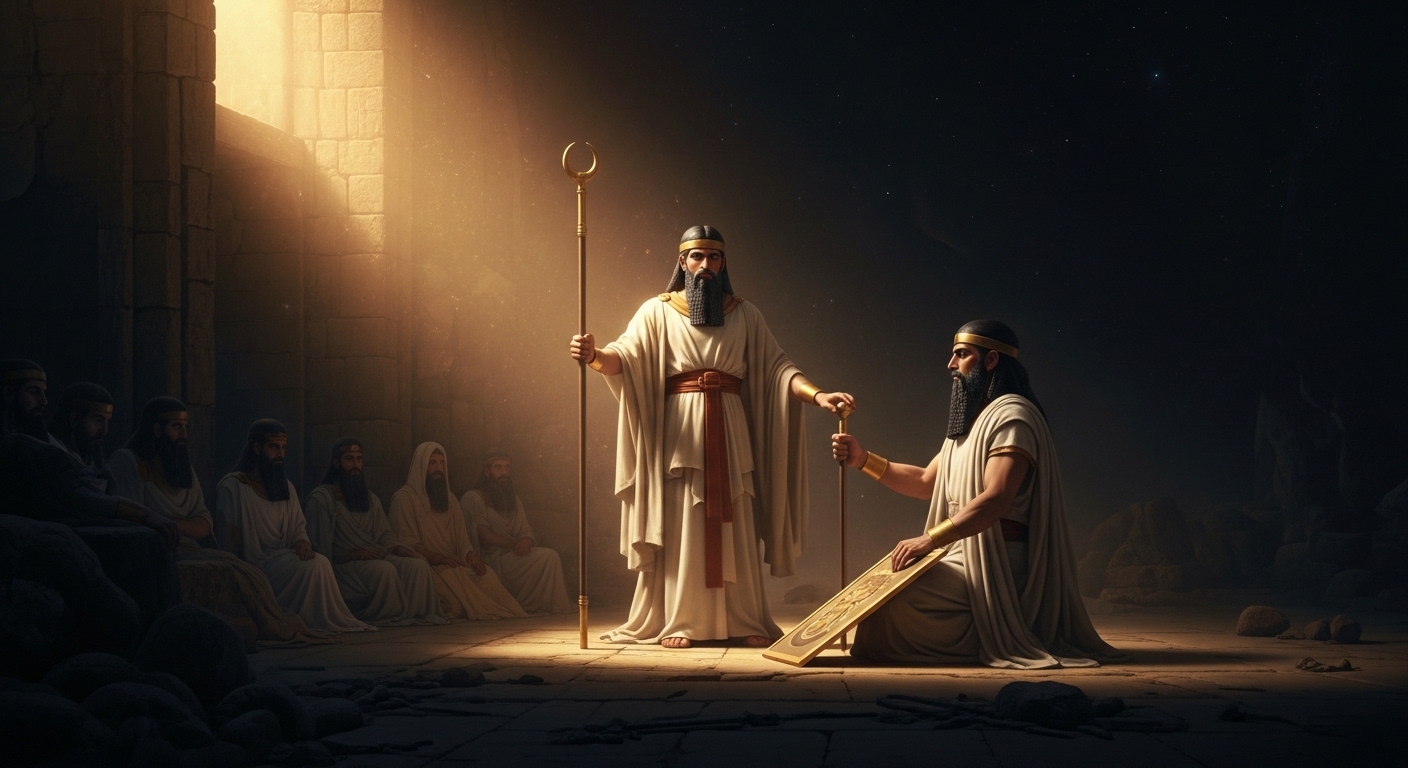
It was Ea — the counselor, the god of wisdom, the figure in every Hurrian and Babylonian myth who knows what the others do not — who understood what had to be done.
Ea went down to Upelluri.
The giant who holds the world on his shoulder had barely noticed that there was a stone column growing from his right shoulder. He was occupied with the weight he carried. Ea pointed out what was on him. Upelluri, in the way of very large beings concentrating on very large tasks, said something that amounts to: When they separated heaven and earth at the beginning, they cut something on my shoulder. I felt it. Since then I haven’t noticed much. He didn’t know there was a stone giant. He didn’t know there was a war.
The word Upelluri used — when they separated heaven and earth, they cut something — was the key.
Ea went to the storehouse of the ancient gods.
In this storehouse, kept by the deities called the former gods — the Primordial gods, the generation before the Kumarbi generation, before the succession wars — there was a copper blade. This blade had been used at the beginning of creation to cut apart the earth and the sky, to establish the separation that made the cosmos habitable for divine and human life. After the separation was accomplished, the blade had been put away. No one had needed it since. The gods who kept it had nearly forgotten it existed.
Ea took the blade and brought it to where Ullikummi stood in the sea.
He cut through the feet of the stone giant.
The exact conclusion of the Song of Ullikummi is damaged in the surviving tablets. The text breaks off at points that scholars have spent a century trying to reconstruct from parallel sources and context. What the surviving text establishes is the logic: once the feet were cut, Ullikummi’s power was broken. The connection to Upelluri’s shoulder — the substrate that had allowed the monster to grow using the giant’s own ancient strength — was severed. The stone giant could no longer draw on primordial force.
Teshub fought again.
The gods reconvened. Ea addressed them: the problem was solved by the old blade, the tool from before the current order existed, the thing they had made and put away and might have needed to use again. Let us defeat Ullikummi, Ea said to the assembly, with the quiet precision of someone who has just located the resource that was always there.
The thing older than the storm god’s power — older than the adversary’s cunning, older than the succession wars, older than Kumarbi’s grudge — was the blade that separated earth from sky. It was in the storehouse. It had been there the whole time.
Kumarbi lost again.
He would keep trying. The Hurrian mythological cycle is a series of Kumarbi’s defeats, each more elaborate than the last, each requiring the gods to find a resource they didn’t know they had. The pattern is the myth’s instruction: the adversary force that cannot be defeated by current power is always defeated by ancient resource. The old tool in the back of the storehouse is always the answer to the problem that current tools cannot solve.
The sky was still separated from the earth. The blade had done that work and would now do this work. The stone giant’s feet were cut.
Ullikummi, blind and deaf as diorite, could not have known when it happened.
Scenes
Echoes Across Traditions
Entities
- Ullikummi (the stone giant)
- Kumarbi (adversary god)
- Teshub (storm god)
- Shaushka / Ishtar (goddess)
- Ea (god of wisdom)
- Upelluri (giant who holds earth and heaven)
Sources
- Harry A. Hoffner Jr., *Hittite Myths*, 2nd ed. (Scholars Press, 1998)
- Albrecht Goetze, 'The Song of Ullikummi' in *Ancient Near Eastern Texts*, ed. J.B. Pritchard (Princeton University Press, 1969)
- Mary Bachvarova, *From Hittite to Homer: The Anatolian Background of Ancient Greek Epic* (Cambridge University Press, 2016)
- Gary Beckman, 'Gilgamesh in Hatti' in *Hittite Studies in Honor of Harry A. Hoffner Jr.* (Eisenbrauns, 2003)
- M.L. West, *The East Face of Helicon* (Oxford University Press, 1997)