The Churning of the Ocean: Poison Before Nectar
The Mahabharata version c. 400 BCE-400 CE; the Puranic elaborations c. 400-1000 CE; the narrative tradition likely much older · The cosmic ocean (Kshira Sagara, the ocean of milk); Mount Mandara as the churning rod; the serpent Vasuki as the rope; the bottom of the ocean where Kurma the tortoise avatar of Vishnu provides the pivot
Contents
Gods and Asuras together use a mountain as a churning rod and a cosmic serpent as a rope to churn the primordial ocean. From it comes both the deadliest poison in existence and the nectar of immortality.
- When
- The Mahabharata version c. 400 BCE-400 CE; the Puranic elaborations c. 400-1000 CE; the narrative tradition likely much older
- Where
- The cosmic ocean (Kshira Sagara, the ocean of milk); Mount Mandara as the churning rod; the serpent Vasuki as the rope; the bottom of the ocean where Kurma the tortoise avatar of Vishnu provides the pivot
Before there can be nectar, there must be poison.
The story begins with an insult.
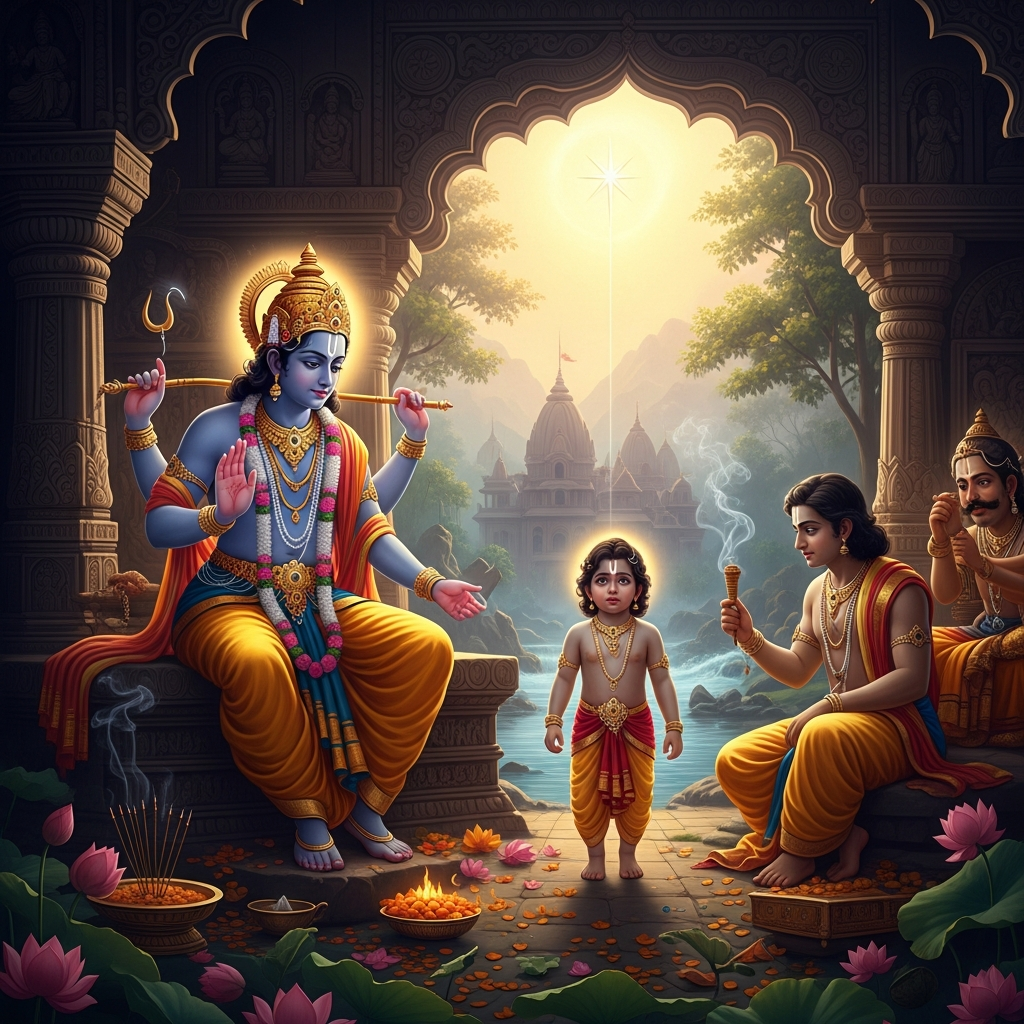
The sage Durvasa is walking through the heavens. He is carrying a garland of flowers given to him by a forest nymph, and he gives it to Indra, king of the gods. Indra places it on the head of his elephant Airavata. The elephant, maddened by the garland’s fragrance or by bees attracted to it, throws the garland to the ground.
Durvasa curses the gods.
His curse is thorough: the three worlds will lose their splendor, the gods will be stripped of their strength, Lakshmi (goddess of fortune and abundance) will leave the cosmos. In the time that follows, the Asuras — the demons, the gods’ eternal rivals — grow strong while the gods grow weak. The Asuras begin to win the battles that determine cosmic order.
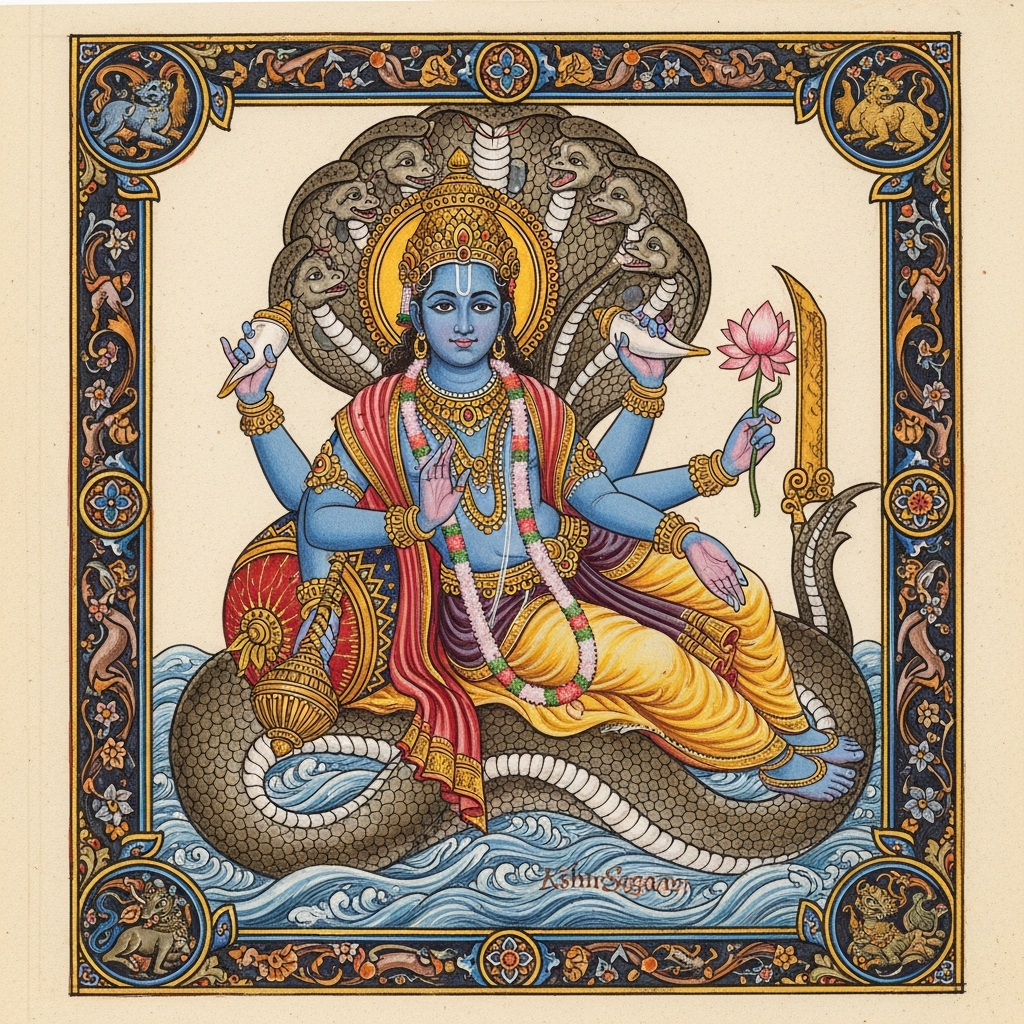
Indra, humiliated and weakened, goes to Vishnu.
Vishnu gives a specific, strange piece of advice: cooperate with the Asuras. Make a truce. Together, churn the ocean.
The setup requires engineering at cosmic scale.
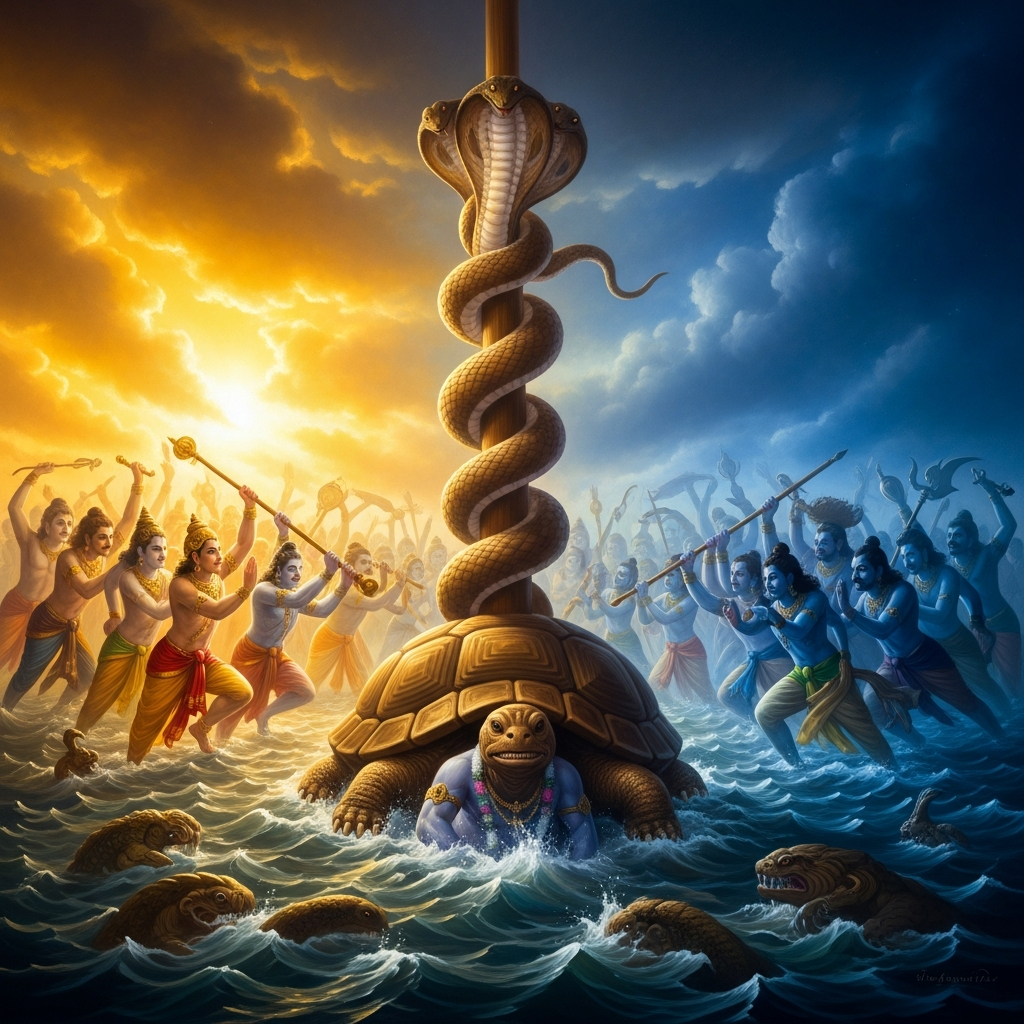
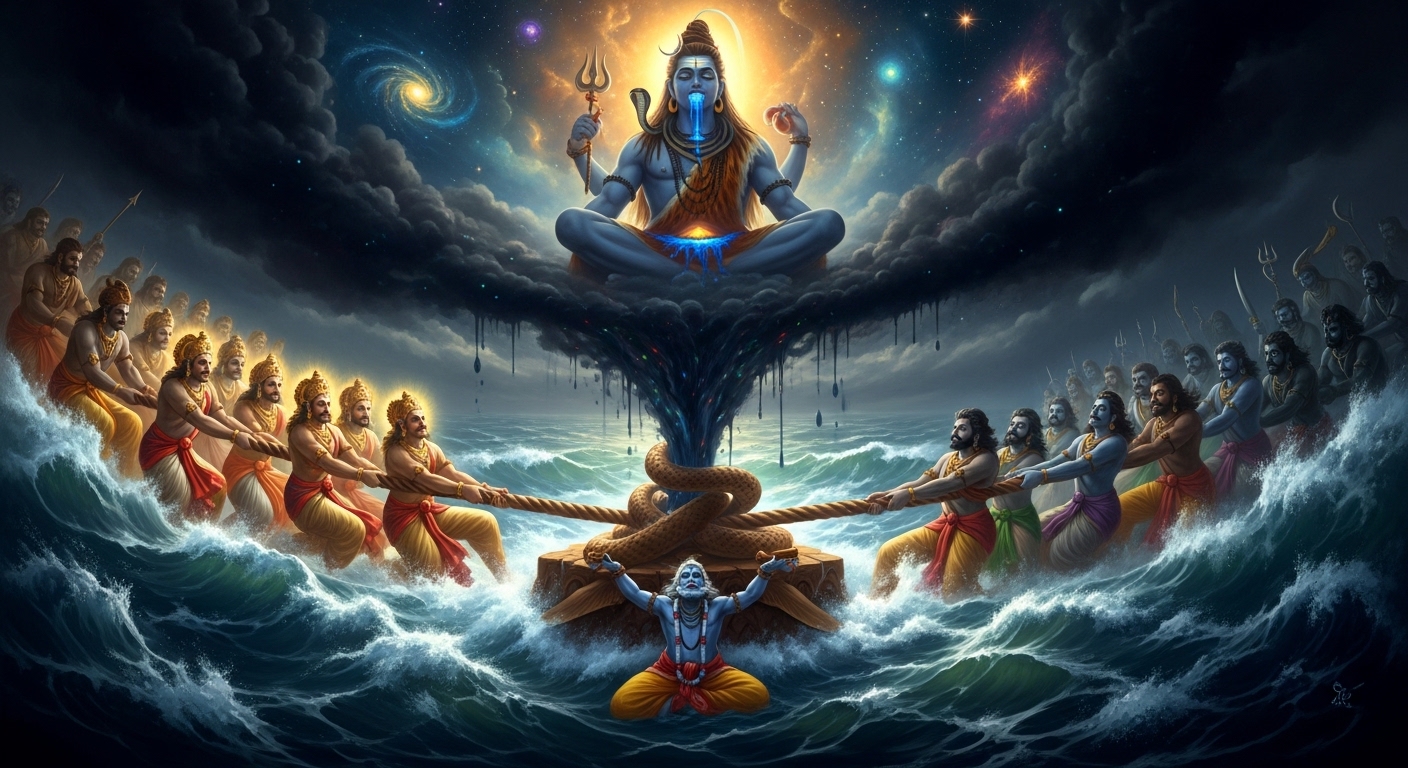
Mount Mandara is uprooted from the earth and placed in the ocean as the churning rod. It is an enormous mountain — the sources differ on its exact height but agree on its scale: the kind of mountain that, when uprooted, leaves a crater that fills with water. The serpent Vasuki, king of the nagas, is wrapped around the mountain as the rope.
The gods take one end of Vasuki. The Asuras take the other.
The mountain sinks. Vishnu descends to the ocean floor as Kurma, the tortoise, and holds the mountain on his back as a pivot point. The churning begins.
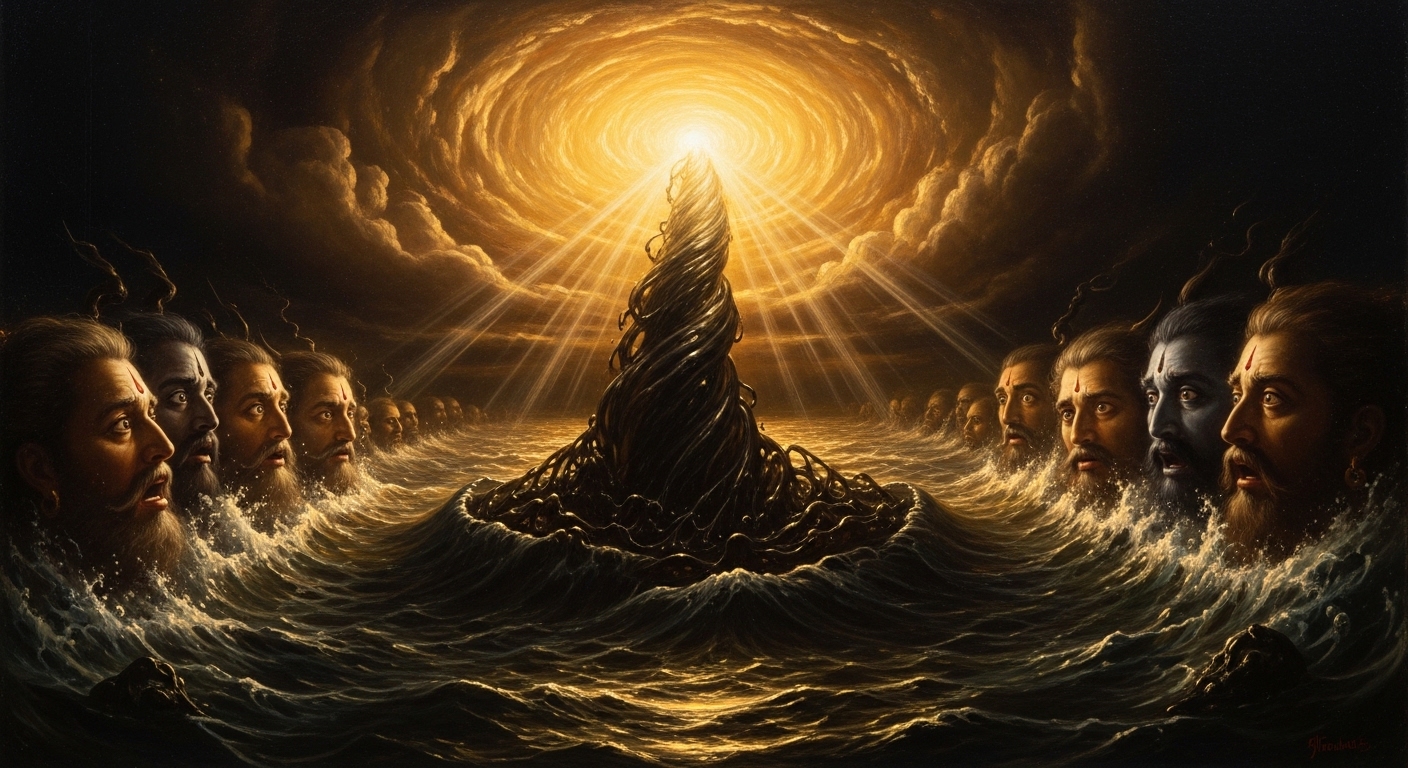
The Asuras pull. The gods pull. The mountain spins. The ocean agitates.
The first thing that rises from the churned ocean is Halahala.
It has different names in different texts — Kalakuta is one, meaning “pot of time” or “black peak” — but the description is consistent: a poison so powerful that its emergence causes the three worlds to shake. Breathing its fumes, gods and Asuras alike begin to collapse. The ocean itself cannot contain it; it spreads through the air like a dark cloud. If it is not stopped immediately, it will destroy everything that exists — gods, demons, humans, the world.
There is a pause in the churning.
The gods go to Shiva.
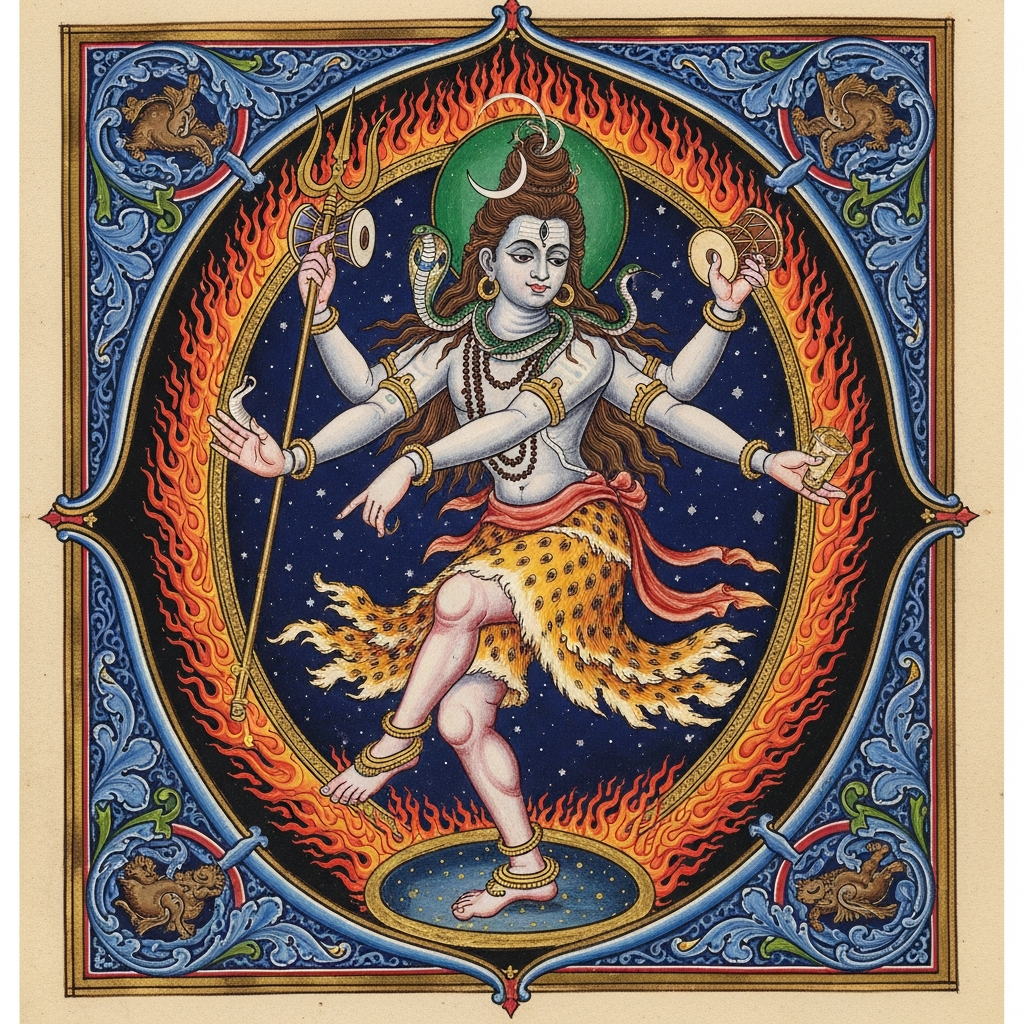
Shiva is the destroyer, the ascetic, the one who sits at the margins of existence in cremation grounds wearing ash and snakes. He is the god who is comfortable near death. He is the one the gods call when what needs to happen is something terrible that nobody else can do.
He comes.
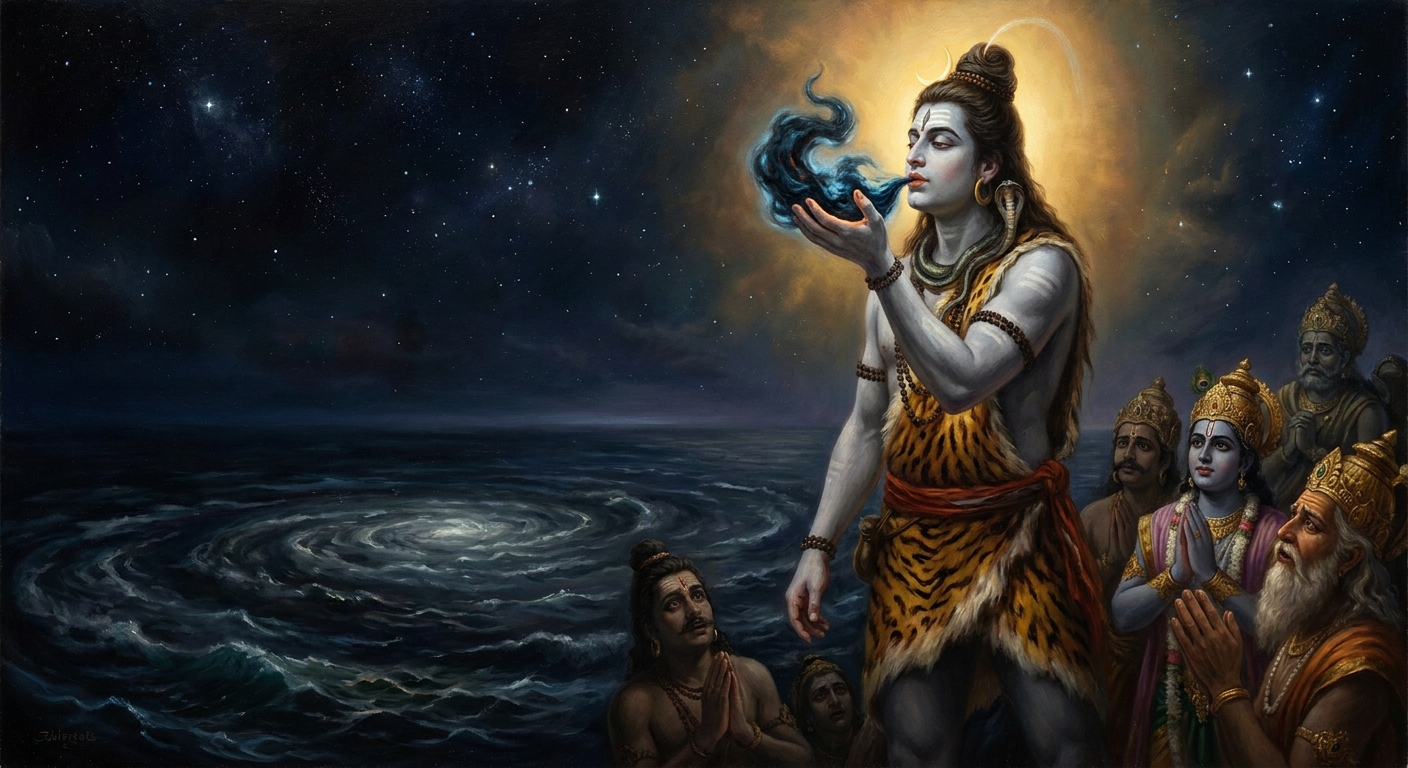
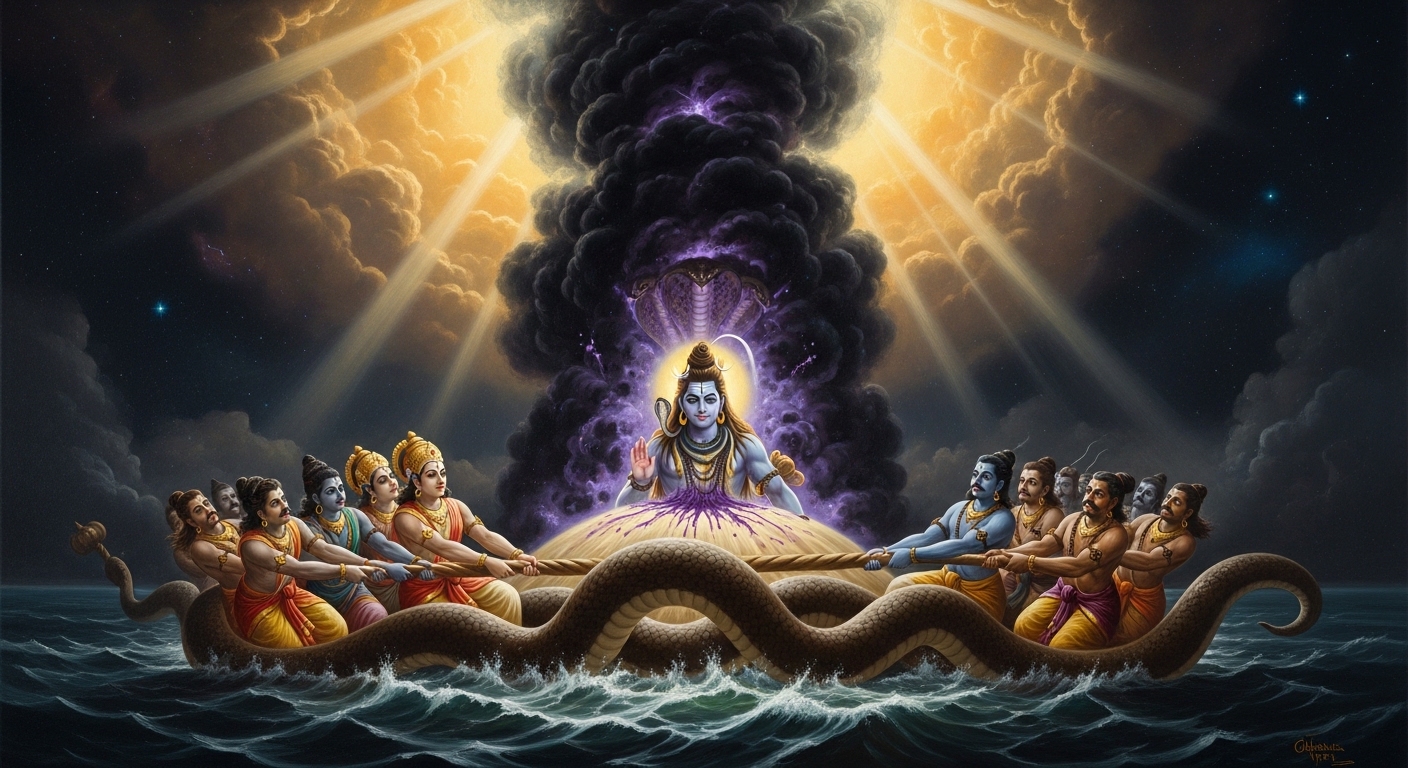
He takes the Halahala into his palm and drinks it.
As it descends his throat, his wife Parvati grabs his throat with both hands. She squeezes. The poison stops in his throat. It cannot descend into his body, where it would be fatal even for Shiva. It cannot come back up, where it would escape and destroy the world. It sits in his throat, held there by his wife’s grip, turning the blue-black color of deep bruising.
Shiva’s throat is blue-black from that day. He is called Nilakantha: the blue-throated one. His iconography shows it on every image, every statue, every painted miniature. The blue throat is the mark of what he held so the world could continue.
After the poison comes the rest.
Surabhi, the divine cow that grants all wishes.
Varuni, goddess of wine.
Parijata, the tree of heaven that blooms eternally and whose flowers never fade.
The Apsaras, the divine dancers.
Chandra, the moon, which rises from the water and is taken by Shiva for his crown.
Dhanvantari, the god of medicine, rises holding a pot of amrita — the nectar of immortality.
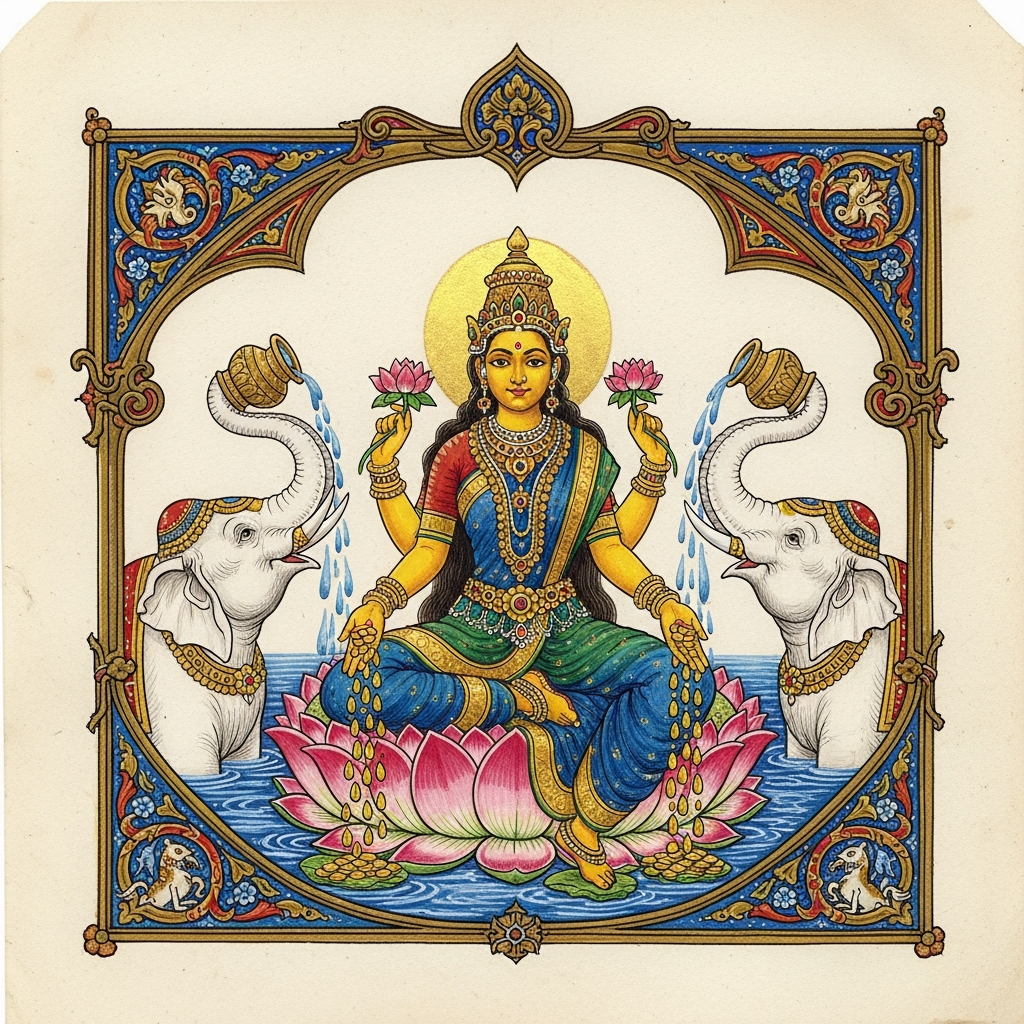
Then Lakshmi herself rises, standing on a lotus, gleaming, choosing Vishnu as her eternal consort. Her return to the cosmos restores the fortune and abundance that Durvasa’s curse removed.
The gods have what they came for.
The Asuras notice.
They have been pulling the rope all this time. They negotiated the truce. They were promised a share of whatever the churning produced. They were present when the poison emerged and did not receive a share of that. Now the nectar is in Dhanvantari’s pot and the gods are moving to claim it, and the Asuras say: we did half this work.
The churning was cooperation. The distribution is war.
Vishnu intervenes in the form of Mohini — a female form, surpassingly beautiful, distracting. Mohini approaches the Asuras and offers to distribute the nectar fairly. The Asuras agree. Mohini distributes it to the gods. She walks toward the Asuras with the empty pot.
One Asura, Svarbhanu, has noticed the trick. He has sat down among the gods in disguise and received his share. The sun-god Surya and the moon-god Chandra recognize him and cry out. Vishnu cuts off his head with the Sudarshana Chakra.
But the nectar has already touched Svarbhanu’s lips and passed his throat. His head lives, and his body lives, separately. They become Rahu (the head, that swallows the sun and causes eclipses) and Ketu (the tail, the descending node of the moon). The severing that was meant to be a death produces two new cosmic problems instead.
The Samudra Manthan produces fourteen primary treasures, depending on the text consulted. But its theological core is those two moments: the poison and the deception.
The poison requires a volunteer to absorb what nobody planned for and everyone needs contained. Shiva does not require persuasion. He comes and he drinks and Parvati holds his throat and the world continues. The blue mark is not hidden — it is his most recognizable feature. He wears the absorbed toxin as a visible part of himself, because it is. The mark of the person who holds the terrible thing so others can continue is permanently inscribed in their body.
The deception — Mohini distributing the nectar unequally — produces its own lesson: the cooperation required to create something does not guarantee equal access to what is created. The Asuras and gods need each other to churn the ocean. The moment the churning is done, the truce is done, and the old competition resumes. The myth does not moralize about this. It presents it as the structure of things.
The nectar of immortality exists in the world now. The gods have it. The demons almost had it. One demon has half of it, in two pieces, orbiting the earth, eating the moon every month, swallowing the sun in eclipses.
The churning never fully resolves. The cooperation was real, and the competition resumed, and the cosmos is shaped by both.
The blue throat of Shiva stands between the two.
It always will.
Scenes
Echoes Across Traditions
Entities
Sources
- *Bhagavata Purana*, Skanda 8, chapters 5-12 (c. 900-1000 CE)
- *Vishnu Purana*, Book I, chapters 9 (c. 400-900 CE)
- *Mahabharata*, Adi Parva, chapters 15-17 (c. 400 BCE-400 CE)
- Wendy Doniger O'Flaherty, *Hindu Myths* (1975)
- Cornelia Dimmitt and J.A.B. van Buitenen, *Classical Hindu Mythology* (1978)
- Devdutt Pattanaik, *Vishnu: An Introduction* (2000)