Beowulf and Grendel: The Hand on the Lintel
c. 600 CE (poem set in this period; manuscript c. 1000 CE) · Heorot — the great mead-hall of the Danish king Hrothgar, on the windswept coast of Scandinavia; the haunted moors and meres beyond
Contents
For twelve winters Heorot has been a hall of corpses. Every night the monster Grendel comes from the moors and takes thirty men in his arms and carries them off to be eaten. Then a Geat warrior arrives by ship — broad-shouldered, light-eyed, certain — and announces he will sleep in the hall tonight without armor or sword, and meet the thing in the dark hand to hand.
- When
- c. 600 CE (poem set in this period; manuscript c. 1000 CE)
- Where
- Heorot — the great mead-hall of the Danish king Hrothgar, on the windswept coast of Scandinavia; the haunted moors and meres beyond
The hall is called Heorot, which means “hart” in the language of the Danes, because the gables are crowned with antlers. It is the greatest building anyone there has ever seen — a long timber hall raised by King Hrothgar at the height of his power, gilded inside, mead-benches running the length of it, harp-music spilling out the doors at night.
It is also a tomb.
Twelve winters now, the same thing has happened. Hrothgar holds a feast. The men drink, sing, boast, lay their swords beside their benches, and finally fall asleep on the rushes. And then, in the dark — sometime in the marrow of the night — something comes from the moors.
The poem calls him Grendel. He is descended from Cain, the first murderer; the poet places him in a Christian frame the original audience must have only half-believed and half-translated from older fears. He is a man-shape, but enormous; he is a thing of fens and dark water; he hates light and music and human laughter, hates them with a bitterness the poem does not bother to explain, because everyone knows what it feels like to be outside a lit window watching others be warm.
Grendel pushes the doors of Heorot open. He stoops to fit through. He walks down the rows of sleeping men. He takes thirty of them at a time — gathers them in his arms like firewood — and carries them off to the moors, where he eats them.
In the morning, the survivors find the blood, and they leave.
Heorot stands empty at night now. No one will sleep there. The greatest hall in the north has been ceded, evening by evening, to the thing in the fens.
—
Word of this travels. It reaches a young man across the sea — Beowulf, nephew of Hygelac, king of the Geats. Beowulf is a fighter who has been waiting for a fight worth his measure. He hears about Hrothgar’s twelve-winter shame, and he gathers fourteen companions, and he sails.
He arrives at the Danish coast in a ship with a curved prow. He walks up the beach in his ring-mail with his retinue behind him. The coast-guard challenges him. Beowulf answers with a courteous boast — son of Ecgtheow, kinsman of Hygelac, here on a matter of business — and the coast-guard lets him pass, half-impressed, half-amused.
He marches up to Heorot. He requests audience with Hrothgar. He stands in the king’s hall and announces, in front of everyone, that he intends to sleep in Heorot tonight. He intends to do it without his sword. He intends to do it without armor. He has heard that Grendel cannot be wounded by iron, and so iron will be no use. He will meet the monster in the dark, hand to hand, and one of them will not walk back out.
There is silence in the hall.
Then a man called Unferth, who sits at the king’s feet and is jealous of any newcomer, sneers at Beowulf. He brings up an old swimming contest Beowulf is said to have lost. Beowulf answers him quietly, then politely, then with a small precise cruelty: he reminds Unferth that a man who has killed his own brothers — as Unferth has — does not make a credible critic of a man who has killed nine sea-monsters by hand. Unferth shuts up.
Hrothgar accepts the offer. The night is prepared.
—
The Danes withdraw from the hall. The Geats lay themselves down on the benches in their armor, swords beside them — they have not promised what their leader promised. Beowulf takes off his mail. He lays his sword aside. He lies down on a bench in his linen, hands folded on his chest, and he waits.
The fire burns low.
Grendel comes.
The poet does not let us miss the approach. He walks across the moors. He pushes open the doors. The doors burst from their hinges at his touch — iron bands, oak planks, gone like a fishnet — and he stoops into the hall.
He sees the bench full of men. He laughs. The poem says he laughs. He grabs the first sleeper, tears him apart, drinks the blood, eats him in pieces. Beowulf lies in the dark and watches and does not move yet, because he wants Grendel to come close enough to commit himself.
Grendel reaches for the next bench.
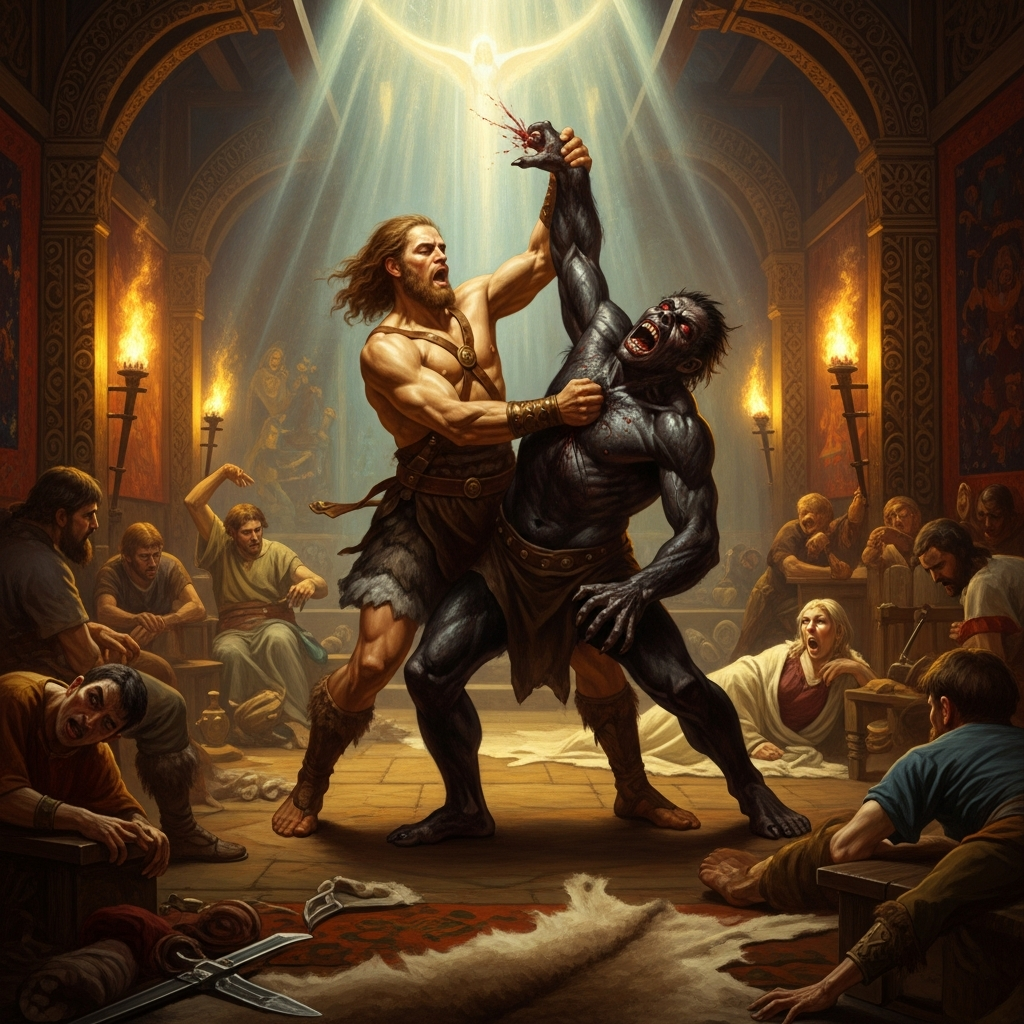
A hand closes on his wrist.
It is the strongest grip Grendel has ever felt. Stronger than anything human has any business having. He is suddenly, for the first time in his long life of taking, taken. He pulls against it and it does not break. He pulls harder and it does not break. He pulls with the full weight of his monstrous body, and Beowulf comes off the bench with him, holding on.
The two of them crash through Heorot in the dark. Mead-benches splinter. Tables overturn. The Geats are awake now, swinging swords at the monster, and the swords slide off — Grendel’s hide is cursed, no iron will bite — but Beowulf does not need iron. He only needs his hands.
Grendel knows, suddenly, that he is going to die.
He tries to flee. He tries to wrench his arm free and run for the doors. Beowulf will not let go. The grip tightens. Sinew pulls against bone. Grendel pulls one way and Beowulf pulls the other, and there is a long terrible moment, and then —
The arm comes off at the shoulder.
Grendel runs into the night, screaming, blood pouring from the socket where his arm used to be. He runs back to the moors. He runs back to his mother’s lair under the dark mere. He dies there before dawn.
Beowulf is left in the wrecked hall holding the arm.
—
In the morning, the Danes come back to Heorot.
They follow Grendel’s blood-trail to the edge of the mere and find it boiling with old corruption — the monster has gone home to die. They turn back to Heorot in wonder.
Beowulf has hung the arm from the gable.
It dangles there, vast and clawed, leaking under the rising sun. The Danes stand beneath it and look up. Hrothgar weeps. Wealhtheow, the queen, comes out with the gold-cup and gives Beowulf a torque so heavy it bows his neck. The bards begin composing the song before the morning is over.
The hall will be re-floored. The benches will be set up again. There will be feasting tonight — the first peaceful feast in twelve winters.
The poem does not let us forget that it is not finished. Grendel had a mother. She is in the mere, and she has heard her son’s dying scream, and she will come for the hall too — tomorrow night. Beowulf will fight her underwater. He will, decades later, fight a dragon, and the dragon will kill him.
But tonight, just tonight, the hall is lit again. The harp plays. Men sleep without their swords for the first time in a generation, because the great hand of Grendel hangs above the door, dripping, proof that the dark is not the only thing strong in the world.
Scenes
Heorot at twilight: the long mead-hall lit gold inside, the moors beyond drowning in fog
Inside the dark hall, Beowulf grips Grendel's wrist as the monster rears against the rafters
Dawn over Heorot: the severed arm of Grendel hung from the gable, dripping
Echoes Across Traditions
Entities
- Beowulf
- Grendel
- Hrothgar
- Wealhtheow
- Unferth
- Heorot
Sources
- *Beowulf* (Old English epic, c. 700–1000 CE)
- Seamus Heaney (trans.), *Beowulf: A New Verse Translation* (1999)
- J. R. R. Tolkien, *Beowulf: The Monsters and the Critics* (1936)
- R. D. Fulk et al. (eds.), *Klaeber's Beowulf* (4th ed., 2008)