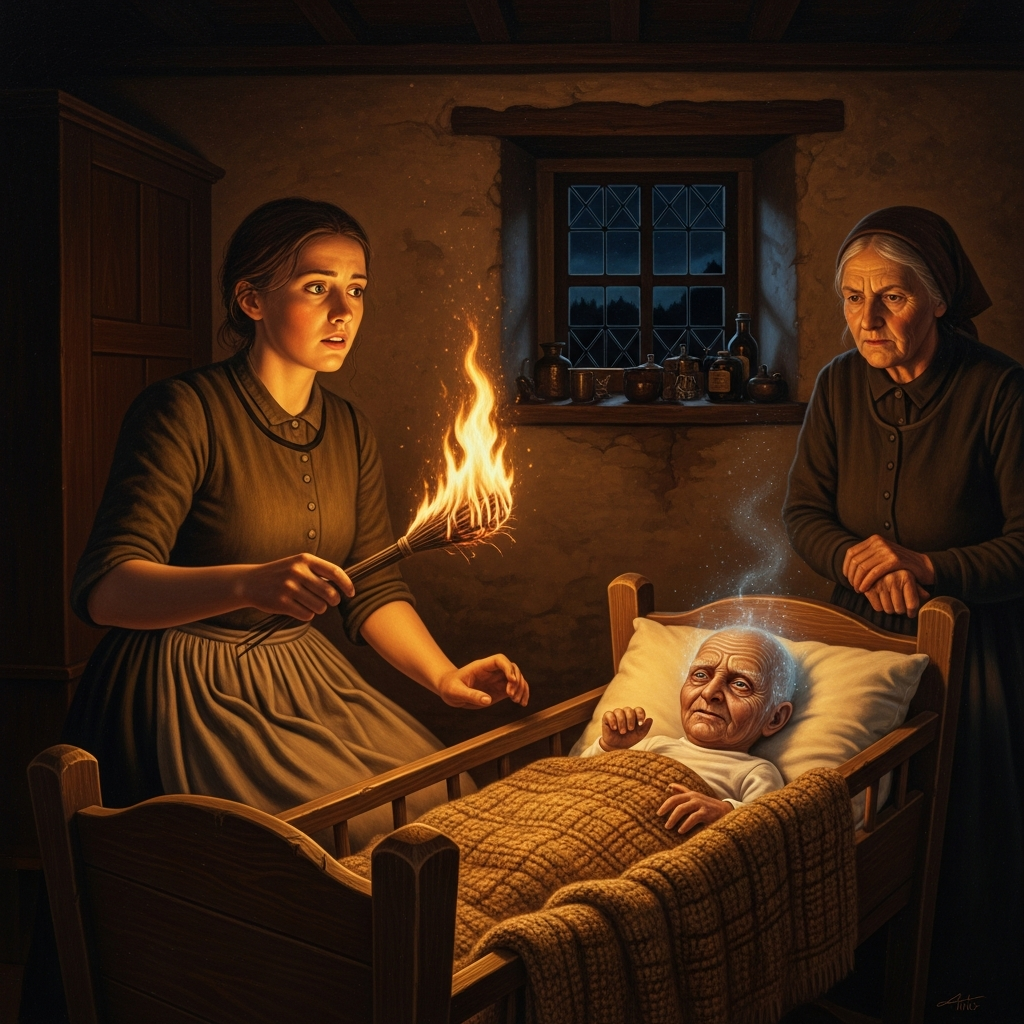
The Stolen Child
undated folk tradition — timeless, set in rural Connacht · A farmhouse on the plains of Connacht, near a fairy mound, Ireland
Contents
A healthy infant vanishes from a Connacht farmhouse and is replaced by a thin, wailing simulacrum — and the mother, guided by a wandering woman who knows the fairy ways, must perform the rite that forces the fairy folk to return what they took.
- When
- undated folk tradition — timeless, set in rural Connacht
- Where
- A farmhouse on the plains of Connacht, near a fairy mound, Ireland
Something is wrong with the baby.
Máire knows it the way she knows weather coming — in the body before the mind catches up. The child she put to sleep last night was fat and laughing, the easy weight of a healthy seven-month infant. The child crying in the cradle this morning is thin, somehow, thinner than a night can make a baby, and the cry is wrong: too continuous, too knowing, the cry of something that has been crying longer than seven months.
She nurses it. It nurses. It doesn’t fill.
Her neighbor Brigid comes by in the afternoon and looks at the baby for a long time without speaking. She is an older woman, Brigid, a woman who has lived through things that have made her careful about jumping to conclusions and also very fast when a conclusion is necessary.
“When did this happen?” she asks.
“Last night. I put him down at dusk.”
Brigid looks at the door, which Máire had left open the previous evening because the weather was warm. She looks at the small iron horseshoe over the lintel — in place, good — and at the gap in the wall where the plaster has come loose, exposing bare stone. No iron there.
“The sídhe,” Brigid says. Not dramatically. As a diagnosis.
The fairy mound is half a mile from the farmhouse, a green hill that no one plows, that animals walk around rather than over, that the whole townland treats with a specific quality of disregard that is actually very careful attention. The Tuatha Dé Danann, defeated by the Milesians and driven underground at the partition of Ireland, live in those mounds and in the spaces below the hills, and they are fond of certain things that the human world has: bright healthy children, fine milk, the particular quality of life that thrives close to the surface of the world.
What they leave in exchange — the thing in the cradle — is called a fóidín mearaí, a changeling. It is not a child. It is a shell, a temporary form, a placeholder. It will cry and drink and fail to thrive and eventually, if the real child is not recovered, it will simply diminish.
The wise woman’s remedies are various and the folklore preserves many of them. Iron exposed near the cradle. Rowan above the door. The testing of the changeling itself: if you can get the creature to reveal its true age — by creating an unusual spectacle that forces it to comment, the shell dropping its infant guise for a moment — the fairy claim on the substitution is broken. One common technique involves brewing eggshells in a thimble over the fire, a task so absurd that the changeling cannot resist remarking on it, and any creature old enough to be startled by eggshell-brewing is old enough to be sent back.
Máire brews the eggshells.
The thing in the cradle watches. Its face, which has been doing nothing but crying, goes still. Then it says, in a voice not at all like an infant’s: “I have seen the oak before the acorn, the acorn before the forest, but I have never seen eggshells brewed for ale.”
The changeling is exposed.
What follows is the recovery: the rites that force the fairy mound to release the taken child and accept the substitute back. Brigid knows them. Máire performs them through a night that neither woman describes afterward in detail.
In the morning there is a baby in the cradle who nurses and fills. He is her son. He is heavier than yesterday, which babies should not be after a hungry night.
She replaces the iron over every gap in the wall. She does not leave the door open after dusk again.
The green hill half a mile away is quiet, as it always is, as it always will be — present, patient, adjacent to every human life and waiting with the particular patience of things that live beneath the ground for the doors that human carelessness leaves open.
Echoes Across Traditions
Entities
- The changeling
- The fairy folk
- The Tuatha Dé Danann underground
- The wise woman
Sources
- Patricia Lysaght, *The Banshee: The Irish Supernatural Death Messenger* (Glendale Press, 1986)
- Éilís Ní Dhuibhne, 'The Old Woman as Hare,' *Béaloideas* 61-62 (1993-4)
- W.B. Yeats, ed., *Fairy and Folk Tales of the Irish Peasantry* (Walter Scott, 1888)