Chunhyang: The Love That Would Not Bend
Pansori oral tradition, formalized 17th–18th century CE; Joseon Dynasty · Namwon, North Jeolla Province, Korea; the pavilion Gwanghallu
Contents
Chunhyang, daughter of a courtesan and a nobleman, falls in love with the magistrate's son Yi Mongryong — then refuses, under torture, to become the new corrupt governor's concubine. She is beaten and imprisoned. Yi Mongryong returns disguised as a beggar, then reveals himself as a royal inspector who arrests the governor. Chunhyang is Korea's Penelope, its Antigone, its Rosa Parks — the woman who endures everything rather than submit.
- When
- Pansori oral tradition, formalized 17th–18th century CE; Joseon Dynasty
- Where
- Namwon, North Jeolla Province, Korea; the pavilion Gwanghallu
There is a pavilion in Namwon called Gwanghallu.
It sits at the edge of a garden where willows trail in a stream, and every spring the young men of the town come to lean against its railings and watch the girls swing on the swings below — a holiday custom, a licensed looking, the one day in the Joseon calendar when young men and young women could be in the same space and let their eyes meet. Yi Mongryong, son of the local magistrate, is at Gwanghallu with his servant Bangja on the fifth day of the fifth month. He sees a girl on the swing.
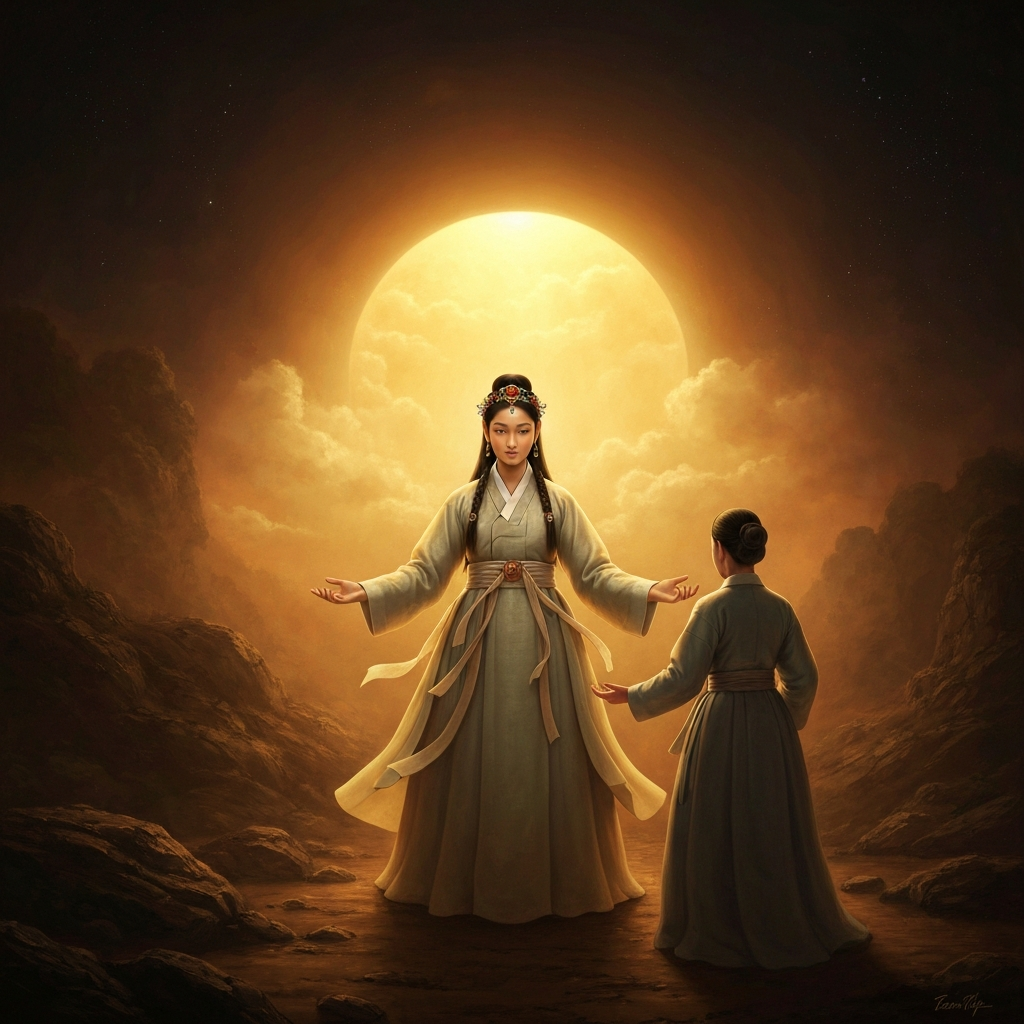
Her name is Chunhyang. Her mother Wolmae is a gisaeng — a courtesan — and her father is a nobleman who has long since gone elsewhere. By the social arithmetic of Joseon Korea, Chunhyang inherits her mother’s class: she is the daughter of a gisaeng, which makes her the property of the state, available for the entertainment of officials who require it. She is sixteen. She is on the swing because it is the one day she is allowed to be seen.
Yi Mongryong watches her and sends Bangja to invite her to meet him.
They fall in love the way people in pansori fall in love — suddenly, completely, and in the full knowledge that the social structure is not built to hold them.
Yi Mongryong visits Chunhyang and Wolmae at their home. He stays. The nights stretch. Wolmae, who has seen enough of what powerful men do to daughters of gisaeng, tries to make the visits formal, tries to make them mean something: she asks for a marriage pledge, an exchange of vows, something that will bind the boy from the magistrate’s house to her daughter’s future. Yi Mongryong makes the pledge. He makes it sincerely. He is seventeen and he means every word.
Then his father is transferred to Seoul, and Yi Mongryong must go.
He stands at Chunhyang’s gate the night before he leaves. He is going to the capital to take the civil examinations. He will return, he says. She believes him. She has the marriage pledge — a strip of paper, a string of promises, the words of a nobleman’s son who has never had to keep words before. She has her mother, who keeps her mouth shut about what she thinks the pledge is worth. She has the memory of the swing, and the willows, and the garden, and the pavilion, which is still standing in Namwon as you read this.
He goes. The months pass. The seasons turn. Chunhyang waits.
The new governor of Namwon is a man named Byeon Hakdo.
He arrives with the full authority of the state in his seal and the full confidence of a man who has learned that authority and desire are the same thing. He hears about Chunhyang — the beautiful girl in the house by the stream, the gisaeng’s daughter, technically available to him, technically obligated to serve. He summons her.
She refuses.
He summons her again, through intermediaries who explain the legal situation with increasing specificity. She refuses again.
He sends officials to her house. She refuses at the door. He sends more officials. She sends them back. Byeon Hakdo, who has governed from the assumption that gisaeng daughters do not refuse, meets for the first time the experience of simply being told no. It has the effect it always has on that kind of man: it makes him want the thing more.
He has her arrested.
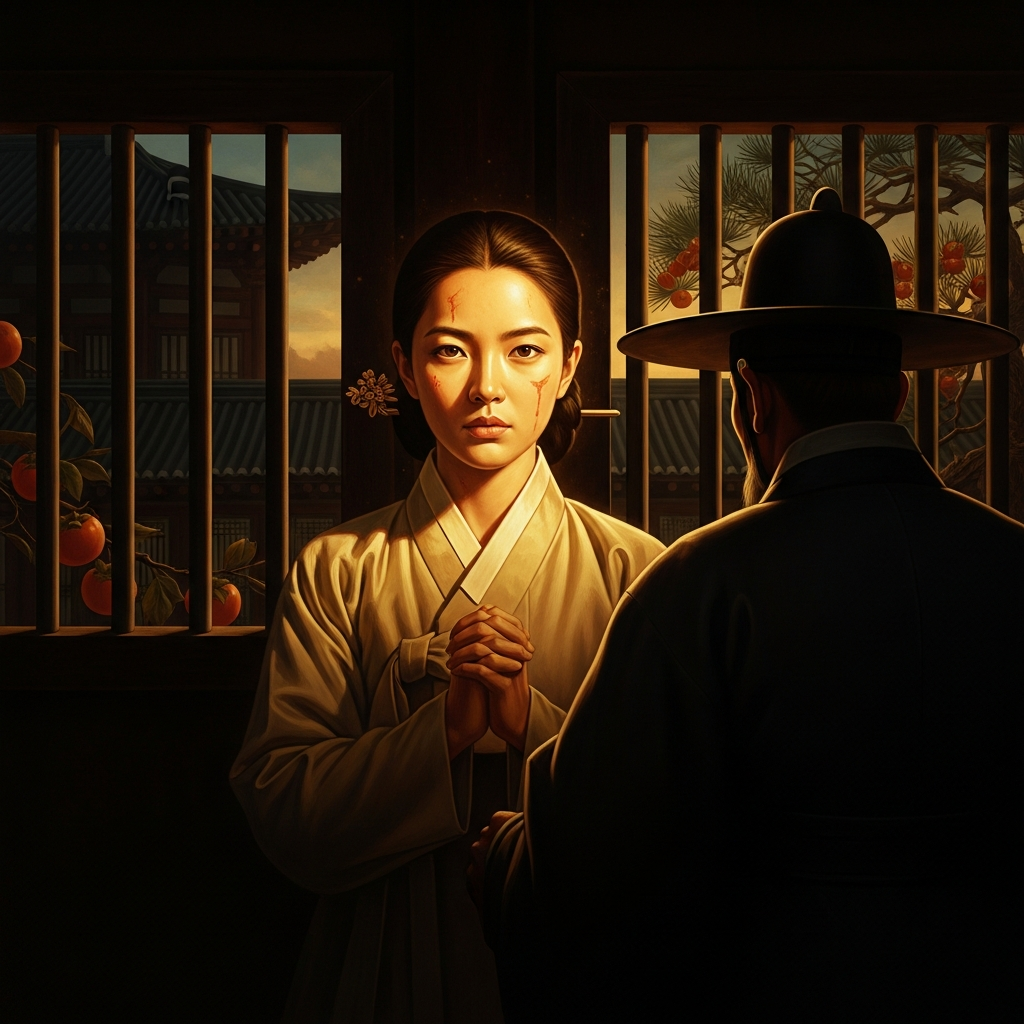
They beat her in the courtyard of the magistrate’s office.
This is in the pansori — the long version, the performed version, the one that takes hours to sing — and the singing of the beating is one of the most famous passages in Korean folk literature. The blows are counted. Each count is a word: one, two, three. The audience knows the count; the performers linger on it; the number of blows is the measure of what Chunhyang is asked to withstand, and the measure of what she will not surrender in exchange for it stopping.
Between blows she speaks.
She says: I have a husband. I made a vow. I will not violate it.
Byeon Hakdo says: Your husband is a student from a better family who has abandoned you in Seoul. He is not coming back. This vow of yours is a letter written in water. Your husband’s promise is nothing.
She says: Then I would rather die than submit to nothing.
They imprison her.
The prison at Namwon in the deep of winter is not a metaphor.
It is cold stone and straw, and Chunhyang is in it, and she does not know when Yi Mongryong is coming or whether he is coming or whether Byeon Hakdo was right about the water and the letter and the nothing. Her mother brings food to the gate. The guards take some of it. She keeps warm by pressing against the wall that the sun hits in the afternoon. She composes poems in her head, the way prisoners do, turning the mind into a room that the cold cannot enter.
Outside, Byeon Hakdo is planning his birthday banquet.
He has invited every official in the region, every entertainer, every person whose presence will confirm that he has power and that power is good. He has announced that Chunhyang will be brought from the prison and made to serve at the feast. He has announced this as a certainty, the way powerful men announce certainties that are actually the last test of whether the world will cooperate.
Among the guests who arrive for the banquet is a beggar.
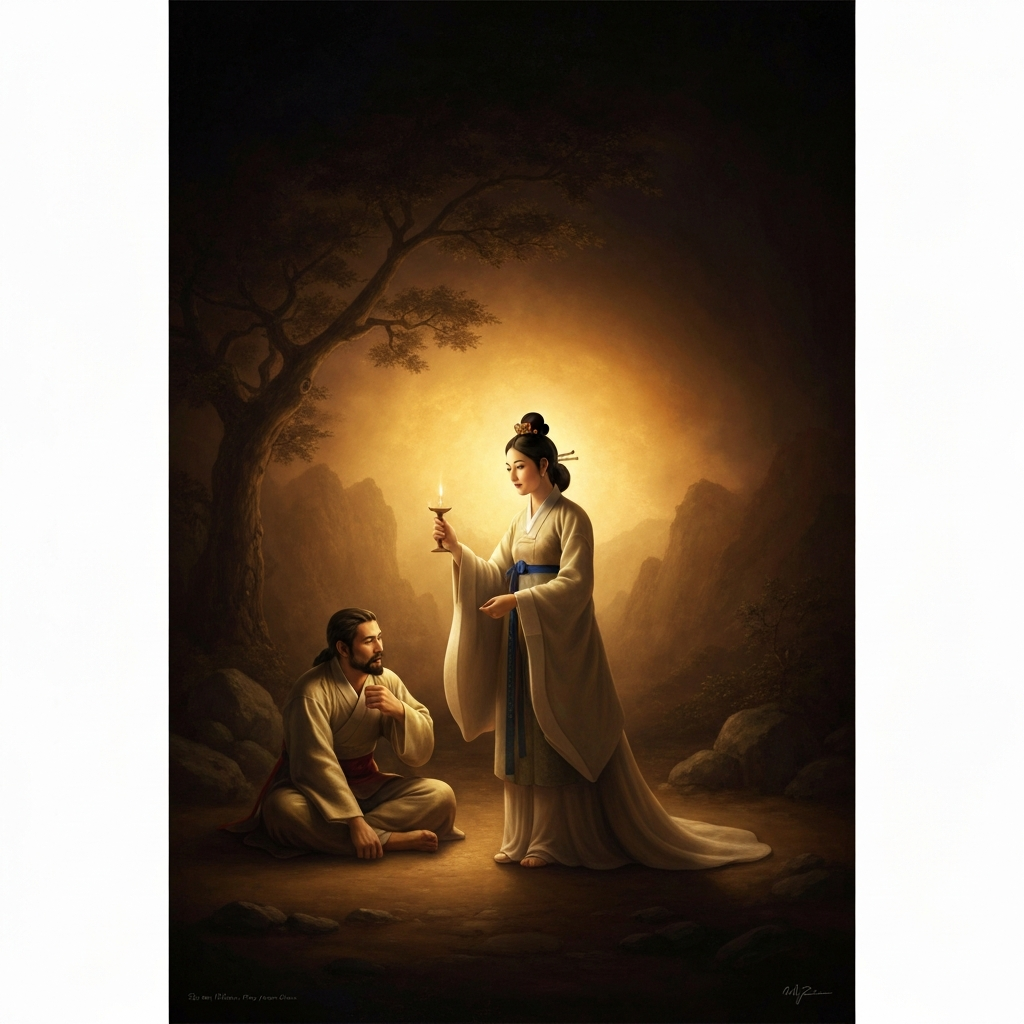
He is ragged. He is thin. His robe is travel-worn and his face is thin and his shoes are not the shoes of a man with a horse. He comes to the gate of the feast with the other petitioners. He is unremarkable. He is Yi Mongryong, who passed the civil examinations in Seoul and was appointed royal inspector — amhaengosa, the king’s secret eye — and has been traveling the province in disguise, and has been in Namwon for three days, and has heard everything.
Chunhyang is brought from the prison.
She is thinner. She walks with the stiffness of someone whose body remembers the blows. She is brought to the feast and she sees the beggar at the gate and she recognizes him, or she does not recognize him — the versions disagree about when she knows. The pansori plays with this. In some performances she knows immediately and her face does not change, because she has learned not to let her face change. In others she does not know until later, and the moment of recognition is its own small flood.
Yi Mongryong waits until the wine is poured and the officials are at ease.
Then he stands and announces himself.
The seal of the royal inspector is not a symbol. It is the embodiment of the king’s authority, which is above the governor’s authority by a distance that cannot be argued. Byeon Hakdo, who has spent months demonstrating the reach of his power, discovers in one moment that his power is borrowed and the lender has come to collect. He is arrested at his own birthday feast, in front of his own guests, by the beggar he let through the gate.
Chunhyang is freed.
The story does not end with the arrest.
The pansori version ends in a reunion scene that the great singers perform slowly, with full attention, because this is what the audience has been waiting for through hours of singing: two people standing across from each other who have kept their word. Chunhyang is thin. Yi Mongryong looks like himself again — the magistrate’s son, the royal official, the boy from the pavilion who meant what he said. The vow held. The water held the letter after all.
What the story says, in the space between the lines, is something the social structure of Joseon was not designed to say: that the daughter of a gisaeng is not the property of the state, and that the word she gives her husband is as binding as any nobleman’s contract, and that the governor who thought her body was available to him was wrong in a way the king himself will confirm.
Chunhyang is not saved by love. She saves herself, every day, by refusing. The love is what comes after, when the world finally catches up to what she already knew.
The pavilion Gwanghallu is still in Namwon. It was rebuilt after being destroyed in war. There is a statue of Chunhyang in the garden, and every spring there is a festival in her name, and tourists come to stand where Yi Mongryong stood at the railing and looked at a girl on a swing who would, two years later, refuse everything.
Echoes Across Traditions
Entities
- Chunhyang
- Yi Mongryong (Lee Mong-ryong)
- Byeon Hakdo (corrupt governor)
- Wolmae (Chunhyang's mother)
Sources
- *Chunhyangjeon* (The Story of Chunhyang), anonymous; oldest surviving manuscript versions from the 18th century CE, Joseon Dynasty
- *Chunhyangga* (The Song of Chunhyang), one of the five surviving *pansori* texts; performed orally from at least the 17th century
- Peter Lee (ed.), *Anthology of Korean Literature from Early Times to the Nineteenth Century* (University of Hawaii Press, 1981)
- Heinz Insu Fenkl, 'Chunhyang: Korea's Most Famous Love Story,' *Manoa* 17.2 (2005)
- Marshall R. Pihl, *The Korean Singer of Tales* (Harvard, 1994) — on pansori as oral literature