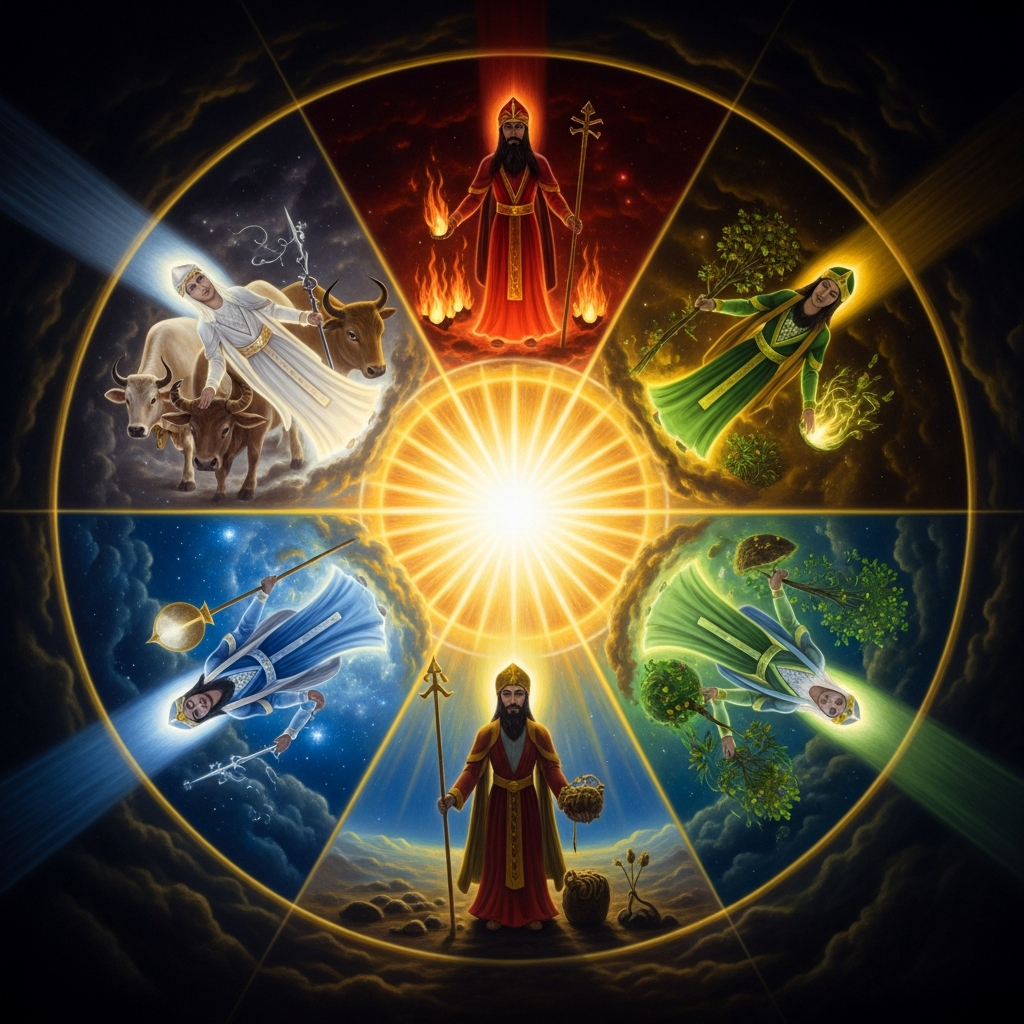
The Codex Borgia's Night: The Sun in the Underworld
c. 1400-1521 CE — Late Postclassic period; the Borgia Group manuscript tradition · Central Mexico — the Borgia Group of codices probably produced in Puebla-Tlaxcala region; Vatican Library (current location)
Contents
The Codex Borgia — the most visually complex pre-Columbian book in existence — contains a sequence of pages showing the sun's journey through the nine sections of the underworld each night, presided over by successive deity pairs in scenes of extraordinary ritual intensity.
- When
- c. 1400-1521 CE — Late Postclassic period; the Borgia Group manuscript tradition
- Where
- Central Mexico — the Borgia Group of codices probably produced in Puebla-Tlaxcala region; Vatican Library (current location)
The sun goes somewhere at night.
This is the theological problem that the Codex Borgia addresses on its most famous pages: not where does the sun go, which can be answered geographically, but what happens there, which is the question that requires a narrative. The sun goes to the underworld. In the underworld, it must survive nine sections, each presided over by a different deity pair, each with its specific dangers and specific rites of passage. The survival is not guaranteed. The sunrise is never automatic.
The Codex Borgia is a screenfold book of thirty-nine deerskin pages, painted with a visual complexity that has occupied scholars for over a century without arriving at complete interpretation. It was in the hands of Cardinal Borgia in Italy by the early nineteenth century — how it got there from central Mexico is unknown — and was published in facsimile by Eduard Seler in 1904, the first systematic attempt to read it.
The night journey section occupies pages 29-46 of the screenfold.
These pages show, in sequence, the nine sections of the underworld through which the sun must pass each night. Each section is presided over by a deity pair: one figure representing the force that rules that section of the underworld, another representing the force that assists the sun through it. Quetzalcoatl appears repeatedly, in different guises, as the companion-guide of the solar journey — the feathered serpent as psychopomp, the wind-deity as the breath that keeps the sun moving through the dark.
The visual language of the Borgia night journey is unlike anything else in Mesoamerican art.
The colors are extraordinary: deep turquoise, bright red, dense black, yellow, orange, the full range of the mineral and organic pigments available to the painters. The figures are not the stiff profile of stone sculpture but dynamic, overlapping, complex — the visual density of these pages is such that each panel rewards hours of looking, revealing new details each time.
The deity figures are labeled with their calendar day-signs — the tlazolteotl at a specific day, Quetzalcoatl at another — in a system that links the night journey to the ritual calendar, so that the reader can identify which nights of the year correspond to which section of the underworld, and therefore which deities must be propitiated on which nights to assist the sun through its particular challenge.
This is practical theology.
The priest who owned and used the Codex Borgia did not read it as myth — as an entertaining story about what the sun does at night. They read it as a manual: on this night, in this section of the underworld, this deity needs this offering, and if the offering is correct, the sun will arrive at the next section safely, and the sunrise will happen.
Xolotl, the dog deity, accompanies the sun in several versions of the underworld journey.
Xolotl — the hairless dog, the xoloitzcuintli, the deformed twin of Quetzalcoatl — is the guide of the dead through the underworld, the animal that helps the soul find its way. His appearance in the night journey section of the Borgia connects the sun’s passage to the passage of the human dead: both make the same journey, both need the same guide, both must pass through the same nine sections.
The sun is the dead in this sequence.
Every night the sun dies and makes the death journey. Every morning it is reborn. The human dead who make the same journey are, in the Maya and central Mexican understanding, participating in the same cycle — the same sequence of sections, the same trials, the same rites of passage. The sun shows that the journey can be made. Its daily return is the proof that the underworld is survivable.
The Borgia pages are the map.
Xolotl knows the way.
The sunrise is not an accident.
Echoes Across Traditions
Entities
- Quetzalcoatl
- Xolotl
- the nine underworld deities
- the Feathered Serpent

Sources
- Eduard Seler, *Codex Borgia: A Full-Color Restoration of the Ancient Mexican Manuscript* (Dover, 1963)
- Cecelia Klein, *The Ideology of Autosacrifice at the Templo Mayor* (Dumbarton Oaks, 1987)
- Gisele Díaz and Alan Rodgers, *The Codex Borgia: A Full-Color Restoration of the Ancient Mexican Manuscript* (Dover, 1993)